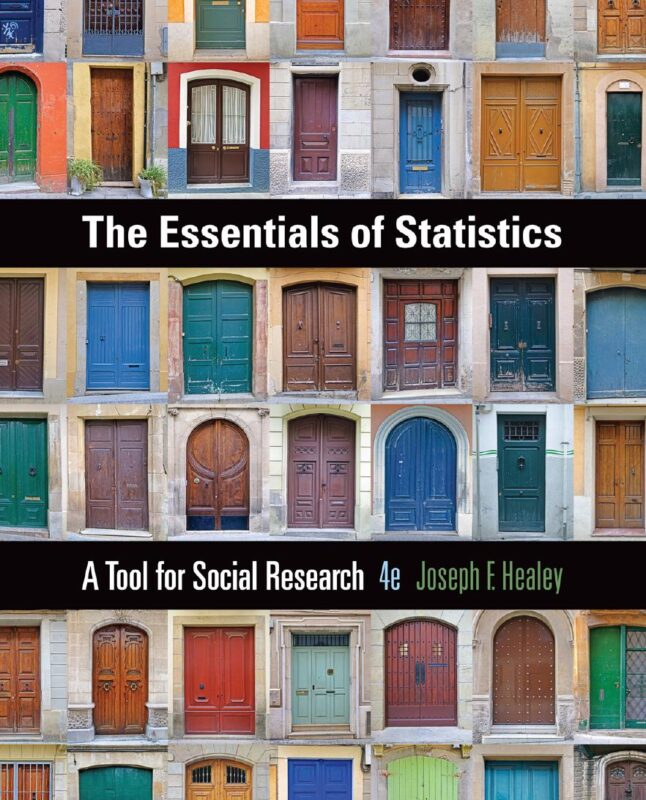
The Essentials of Statistics A Tool for Social Research 4th Edition By Joseph F. Healey
$30.00
Secure checkout
Instant digital download
PDF document
Document details
- Pages
- 482
- File size
- 24.21 MB
- Format
- Digital PDF
- Course
- Education
- Category
- eBook[PDF]
Sign in or create a free account to continue. Your purchase will be saved in My Downloads.
About this ebook
The Essentials of Statistics: A Tool for Social Research (4th Edition) by Joseph F. Healey is structured into three core domains tailored to develop statistical literacy in the social sciences: Descriptive Statistics, Inferential Statistics, and Bivariate Measures of Association. [1, 2, 3]
The detailed table of contents and topics covered across its 11 foundational chapters include: [1]
Chapter Overview & Foundational Concepts
- Chapter 1: Introduction: Outlines the core role of statistics in scientific inquiry, the distinctions between discrete and continuous variables, and the fundamental differences between descriptive and inferential statistics. [1, 2]
Part I: Descriptive Statistics
- Chapter 2: Basic Descriptive Statistics: Focuses on organizing data using tables, calculating percentages, ratios, and rates, and presenting findings visually through charts and graphs. [1, 2]
- Chapter 3: Measures of Central Tendency: Explains how to find and interpret the center of a data distribution using the mode, median, and mean. [1]
- Chapter 4: Measures of Dispersion: Demonstrates how to quantify variability or spread within data using techniques like range, interquartile range, variance, and standard deviation. [1]
- Chapter 5: The Normal Curve: Covers the theoretical properties of the standard normal distribution (Z-scores) and how to calculate areas under the curve to interpret probabilities. [1]
Part II: Inferential Statistics
- Chapter 6: Introduction to Inferential Statistics, the Sampling Distribution, and Estimation: Introduces logic regarding how samples represent populations, the Central Limit Theorem, and calculating confidence intervals.
- Chapter 7: Hypothesis Testing I: The One-Sample Case: Steps through the basic logic of hypothesis testing by comparing a single sample mean or proportion to a known population parameter.
- Chapter 8: Hypothesis Testing II: The Two-Sample Case: Focuses on testing significance between two independent sample means or proportions (such as comparing two demographic groups).
- Chapter 9: Hypothesis Testing III: The Analysis of Variance (ANOVA): Explores testing for statistically significant differences across three or more separate sample groups.
- Chapter 10: Hypothesis Testing IV: Chi-Square: Covers non-parametric hypothesis testing for nominal and ordinal variables to determine if a relationship exists between two categorical metrics. [1]
Part III: Bivariate Measures of Association
- Chapter 11: Bivariate Association for Nominal- and Ordinal-Level Variables: Analyzes the strength and direction of relationships between variables using measures like Gamma, Lambda, and Phi. [1]
File included
tmpphpLYaMGw
24.21 MB
Related ebooks