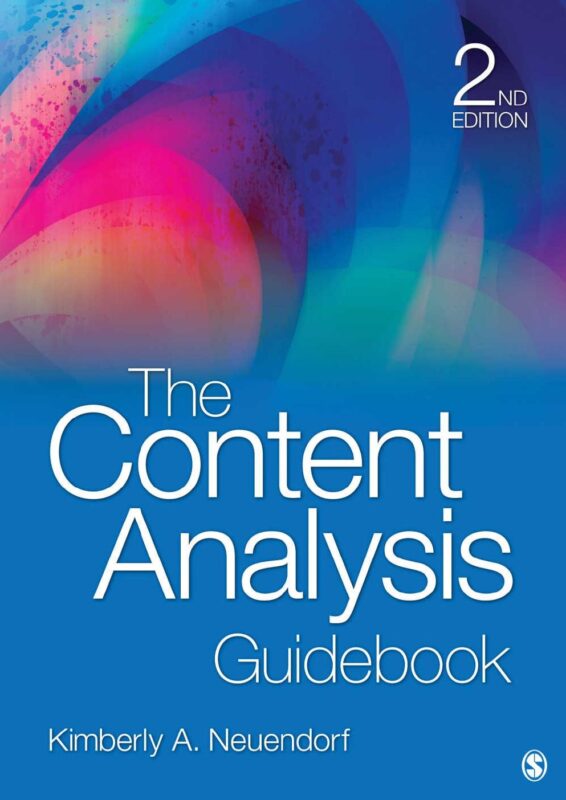
The Content Analysis Guidebook 2nd Edition By Kimberly A Neuendorf
$30.00
Secure checkout
Instant digital download
PDF document
Document details
- Pages
- 659
- File size
- 13.73 MB
- Format
- Digital PDF
- Course
- Education
- Category
- eBook[PDF]
Sign in or create a free account to continue. Your purchase will be saved in My Downloads.
About this ebook
The Content Analysis Guidebook (2nd Edition) by Kimberly A. Neuendorf spans nine core chapters alongside extensive resource tools. [1]
The primary topics and chapters covered in this volume include: [1]
Core Chapters & Topics Covered
- Chapter 1: Defining Content Analysis – Foundations, historical roots, and explicit definitions distinguishing quantitative content analysis from other qualitative or text-based approaches.
- Chapter 2: An Integrative Approach to Content Analysis – Introducing a conceptual framework and step-by-step flowchart mapping out the process from theory to data analysis.
- Chapter 3: Message Units and Sampling – Definitions of sampling units, context units, recording/coding units, and protocols for extracting representative samples from larger populations.
- Chapter 4: Variables and Predictions – Formulating hypotheses, determining operational definitions, and selecting variables appropriate to the underlying research questions.
- Chapter 5: Measurement and Validity – Constructing structured codebooks and coding forms, measurement theory, establishing internal/external validity, and setting up coding protocols.
- Chapter 6: Reliability – Intercoder and intracoder reliability, mathematical indices (e.g., Cohen's kappa, Krippendorff's alpha), training coders, and resolving discrepancies.
- Chapter 7: Content Analysis in the Interactive Media Age – Navigating newer media boundaries, web pages, social platforms, and digital metrics specific to virtual landscapes.
- Chapter 8: Results and Reporting – Guidelines for data processing, hypothesis testing, choosing appropriate statistical analyses, and academic/commercial research presentation styles.
- Chapter 9: Contexts – Broad applications of the methodology across disciplines such as psychology, media studies, political science, and commercial research. [1, 2, 3, 4, 5, 6, 7, 8]
Supplemental Methodological Resources
- Resource 1: CATA—Computer-Aided Text Analysis Options – Comprehensive comparisons of automated software options and dictionary-building methodologies (e.g., LIWC, DICTION, Yoshikoder). [1, 2]
- Resource 2: The Content Analysis Guidebook Online (CAGO) – Overviews of the digital suite of tools, codebanks, datasets, and supplemental digital content compiled for researchers. [1, 2]
File included
tmpphpHMlJD2
13.73 MB
Related ebooks