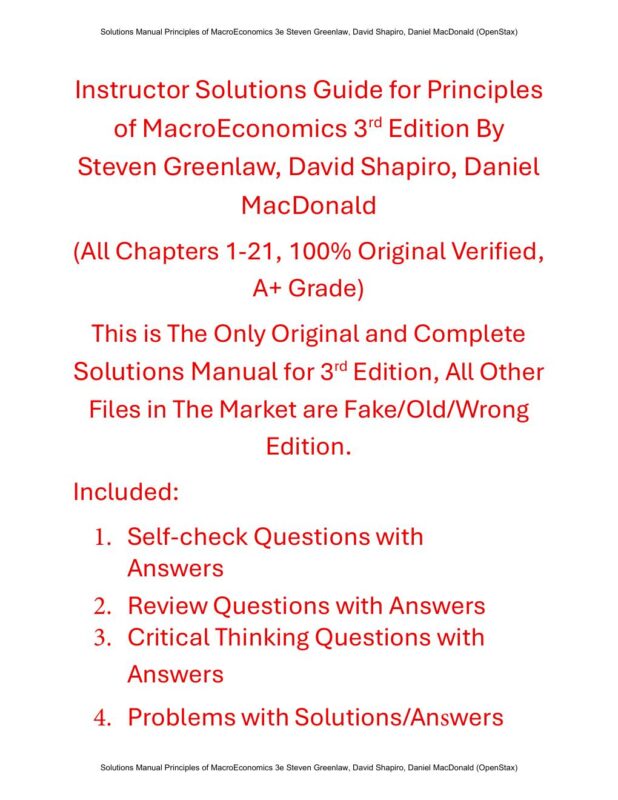
Instructor Solutions Guide for Principles of MacroEconomics 3rd Edition By Steven Greenlaw, David Shapiro, Daniel MacDonald
$30.00
Secure checkout
Instant digital download
PDF document
Document details
- Pages
- 207
- File size
- 3.2 MB
- Format
- Digital PDF
- Course
- Business
- Category
- INSTRUCTOR MANUALS
Sign in or create a free account to continue. Your purchase will be saved in My Downloads.
About this ebook
The Instructor Solutions Guide for Principles of Macroeconomics (3rd Edition) by Steven Greenlaw, David Shapiro, and Daniel MacDonald (published via OpenStax) covers the core foundations of a standard one-semester introductory macroeconomics course. [1, 2, 3, 4, 5]
The textbook is divided into 7 core modules spanning 21 chapters, structured to guide students from fundamental economic decision-making up to global economic systems. [1, 2]
1. Introduction to Economics (Chapters 1–2)
This module lays the foundational concepts of economic thinking. [1]
- Chapter 1: Welcome to Economics! Explores scarcity, the division of labor, micro vs. macro perspectives, and various economic systems.
- Chapter 2: Choice in a World of Scarcity: Covers budget constraints, opportunity cost, marginal decision-making, and the Production Possibilities Frontier (PPF). [1, 2, 3]
2. Core Market Mechanisms (Chapters 3–5)
- Chapter 3: Demand and Supply: Details buyers' and sellers' behaviors, market equilibrium, and shifts in demand and supply.
- Chapter 4: Labor and Financial Markets: Applies supply and demand specifically to wages, employment, borrowing, and lending.
- Chapter 5: Elasticity: Measures price sensitivity and responsiveness in demand and supply. [1, 2, 3, 4]
3. The Macroeconomic Perspective and Goals (Chapters 6–10)
Shifts the focus entirely onto large-scale economic health indicators. [1]
- Chapter 6: The Macroeconomic Perspective: Breaks down Gross Domestic Product (GDP) and measuring economic output.
- Chapter 7: Economic Growth: Evaluates labor productivity, capital accumulation, and standard of living advancements.
- Chapter 8: Unemployment: Covers how to calculate unemployment and defines cyclical, frictional, and structural unemployment types.
- Chapter 9: Inflation: Tracks the Consumer Price Index (CPI) and the consequences of shifting purchasing power.
- Chapter 10: The International Trade and Capital Flows: Looks at trade balances, national savings, and the financial capital relationship. [1, 2, 3, 4, 5]
4. Frameworks for Macroeconomic Analysis (Chapters 11–13)
Introduces the core analytical models used by modern economists to evaluate policy. [1]
- Chapter 11: The Aggregate Demand/Aggregate Supply (AD/AS) Model: The foundational model used to examine economic growth, unemployment, and inflation together. [1, 2]
- Chapter 12: The Keynesian Perspective: Focuses on short-run economic fluctuations, sticky wages, and the role of government intervention. [1, 2]
- Chapter 13: The Neoclassical Perspective: Focuses on long-run aggregate supply, price flexibility, and potential GDP. [1]
5. Monetary Policy and the Financial System (Chapters 14–16)
Explains the structure of money, banking, and global currencies. [1]
- Chapter 14: Money and Banking: Explores the definition of money, how banks create money, and the Federal Reserve system.
- Chapter 15: Monetary Policy and Bank Regulation: Covers interest rates, open market operations, and safeguarding the financial system.
- Chapter 16: Exchange Rates and International Capital Flows: Examines currency markets, floating vs. pegged rates, and macroeconomic impacts. [1, 2, 3, 4]
6. Fiscal Policy and Government Debt (Chapters 14–18)
Analyzes how governments manage taxation, spending, and public budgets. [1]
- Chapter 17: Government Budgets and Fiscal Policy: Details taxation structures, discretionary spending, and automatic stabilizers.
- Chapter 18: The Impacts of Government Borrowing: Evaluates crowding-out effects, national debt, and long-term fiscal sustainability. [1, 2, 3]
7. Global Economics and International Trade (Chapters 19–21)
Applies macroeconomic frameworks on a global scale. [1]
- Chapter 19: Macroeconomic Policy Around the World: Compares global standards of living, growth engines, and high-inflation challenges.
- Chapter 20: International Trade: Explores absolute and comparative advantage, specialization, and consumer benefits.
- Chapter 21: Globalization and Protectionism: Weighs the pros and cons of tariffs, import quotas, and international trade agreements. [1, 2, 3]
File included
tmpphpfajmyM
3.2 MB
Related ebooks