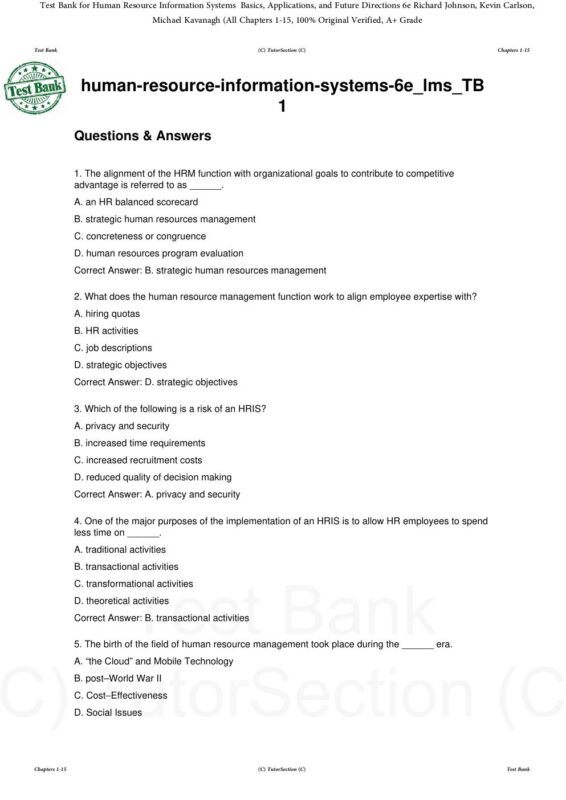
Test Bank for Human Resource Information Systems Basics, Applications, and Future Directions 6th Edition By Richard Johnson, Kevin Carlson, Michael Kavanagh (All Chapters 1-15, 100% Original Verified)
$35.00
Secure checkout
Instant digital download
PDF document
Document details
- Pages
- 93
- File size
- 1.34 MB
- Format
- Digital PDF
- Course
- Business
- Category
- TEST BANKS
Sign in or create a free account to continue. Your purchase will be saved in My Downloads.
About this ebook
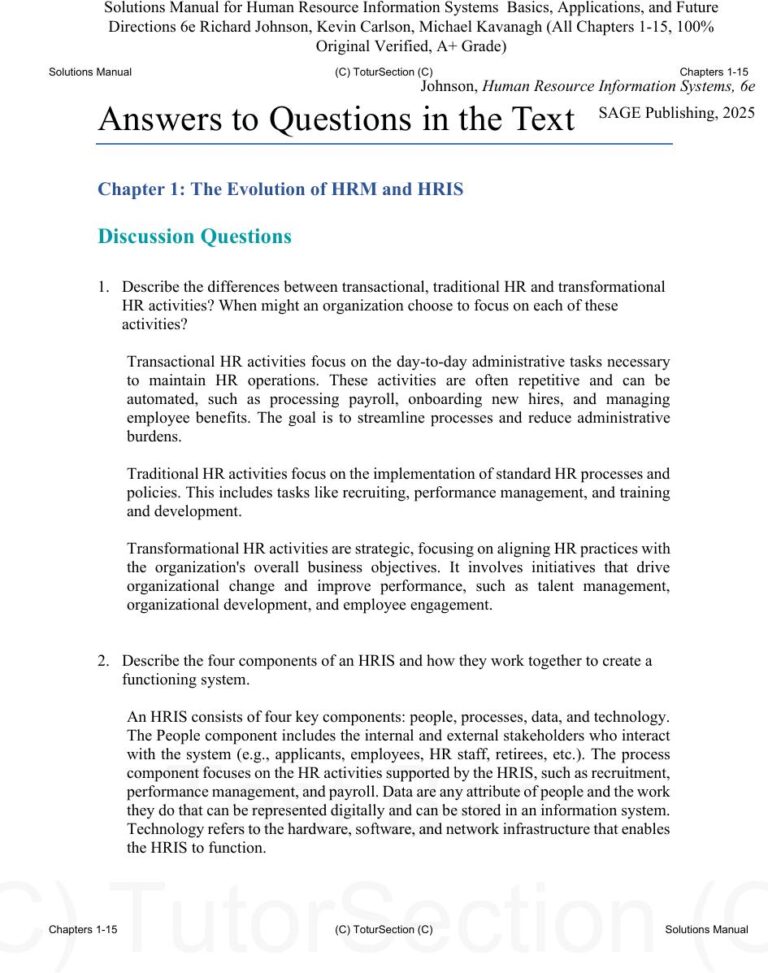
The Test Bank for Human Resource Information Systems: Basics, Applications, and Future Directions" (6th Edition), edited by Richard D. Johnson, Kevin D. Carlson, and Michael J. Kavanagh, bridges the gap between Human Resource Management (HRM) and Information Technology (IT/IS). [1]
The textbook covers 15 to 17 core chapters across several thematic areas, integrating the latest research on advanced technologies: [1, 2, 3]
1. Foundations of HRIS & Data Management
- The Evolution of HRM and HRIS: Tracing the history of HR and how technological infrastructure has transformed administrative functions into strategic components.
- Database Concepts and Applications: How data is stored, organized, and structurally managed within a Human Resource Information System. [1, 2, 3, 4]
2. System Design and the Development Lifecycle
- Systems Considerations in HRIS Design: Technical considerations, system architecture, and standard technical configurations.
- The Systems Development Life Cycle (SDLC): Navigating needs analysis, logical design, and requirements gathering to select an HRIS.
- System Implementation and Maintenance: Best practices for software deployment, change management, data migration, and ongoing maintenance. [1, 2, 3]
3. Core HRIS Applications
- Talent Acquisition Systems: Technology applications used in sourcing, recruitment, applicant tracking, and onboarding. [1, 2]
- Talent Management and Workforce Development: Software solutions addressing performance management, training, career tracking, and skills building. [1, 2]
- Total Rewards Systems: Technology platforms used to administer complex payroll configurations, employee compensation packages, and health benefits. [1, 2]
4. Advanced Technologies & Modern Infrastructure
- Artificial Intelligence (AI) & Machine Learning: Leveraging machine learning algorithms for automation, resume screening, and predictive talent modeling. [1, 2]
- Cloud Computing & Social Media: Shift toward scalable Software-as-a-Service (SaaS) environments and social sourcing platforms. [1]
- Information Security and Privacy: Protecting sensitive employee records, regulatory mandates, and mitigating cybersecurity risks in software networks. [1, 2]
5. Strategy, Analytics, & Future Trends
- HR Metrics and Workforce Analytics: Utilizing organizational data to support data-driven talent decisions, workforce planning, and ROI projections.
- Strategic HR Considerations: Aligning technology implementation with larger enterprise strategies to create a sustainable competitive advantage.
- International HRM & Future Directions: Managing cross-border compliance, global employee footprints, and emerging trends in HR tech. [1, 2, 3, 4, 5]
File included
tmpphpwsGihm
1.34 MB
Related ebooks