Test Bank for The Logic of American Politics 12th Edition By Samuel Kernell, Gary Jacobson, Thad Kousser, Lynn Vavreck, Timothy Johnson (All Chapters 1-15, 100% Original Verified)
$35.00
Secure checkout
Instant digital download
PDF document
Document details
- Pages
- 344
- File size
- 1.6 MB
- Format
- Digital PDF
- Course
- Political Science
- Category
- TEST BANKS
Sign in or create a free account to continue. Your purchase will be saved in My Downloads.
About this ebook
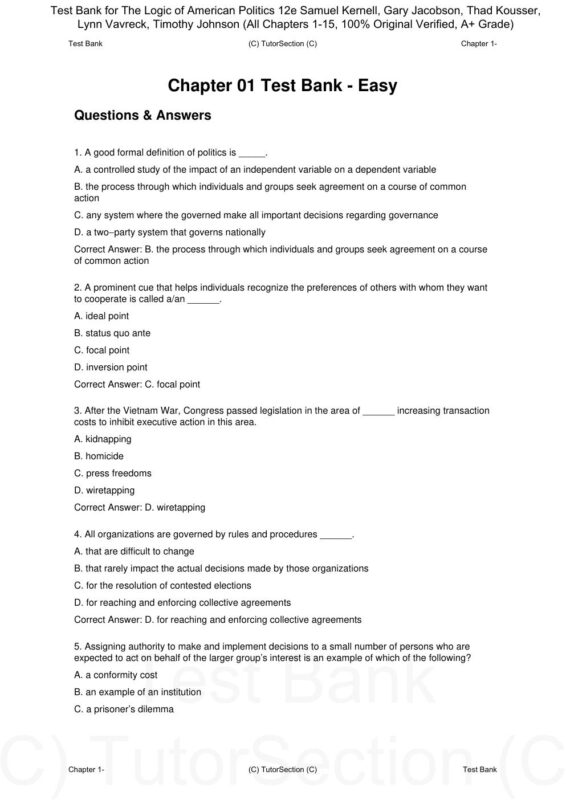
Test Bank for The Logic of American Politics (12th Edition) by Samuel Kernell, Gary Jacobson, Thad Kousser, and Lynn Vavreck framework centers on a specific core concept: politics as a method for solving collective action problems. The authors provide students with an analytical "toolkit" of institutional design concepts (including command, veto, agenda control, voting rules, and delegation) to understand the structure of the U.S. government. [1, 2, 3, 4]
The 12th edition includes updated coverage, incorporating fresh analysis of the 2024 presidential election results and current trends in intense political polarization. [1, 2]
The book's topics are organized into three primary parts: [1]
Core Framework (Introduction)
- Chapter 1: The Logic of American Politics – Introduces institutional design, the costs of collective action (transaction vs. conformity costs), representative governance, and foundational systemic problems like the Free-Rider problem and the Tragedy of the Commons. [1]
Part I: The Foundational Elements & Nationalization of Politics
This section focuses on the political origins, historical development, and basic rules of the American national polity. [1]
- The Constitution – The road to independence, the drafting of the U.S. Constitution, and the fundamental mechanics of federal authority versus state power.
- Federalism – The evolution of power-sharing arrangements between national and state governments.
- Civil Rights – The legal and political struggles for equality, voting access, and protections under the law.
- Civil Liberties – Constitutional protections and freedoms guaranteed to individuals (e.g., freedom of speech, privacy). [1, 2]
Part II: The Major Formal Institutions of Governance
This section reviews how the logic of political development has shaped the organizational features, modern practices, and power balances of the branches of government. [1]
- Congress – The legislative branch, committee structures, lawmaking processes, and the impacts of partisan polarization.
- The Presidency – Presidential authority, executive power, and leadership strategies like "going public".
- The Federal Bureaucracy – The civil service system, the logic of administrative delegation, and political control over agencies.
- The Federal Judiciary – The court system, judicial review, and the highly partisan politics surrounding judicial selection. [1]
Part III: Linkage Institutions
This section details the informal mechanisms and structures that connect everyday citizens to their elected government officials. [1]
- Public Opinion – How political attitudes are formed, measured, and synthesized.
- Voting, Campaigns, and Elections – Voter turnout behavior, campaign strategies, and financial spending regulations.
- Political Parties – The history of the party system, party coalitions, and the incentives behind collective responsibility.
- Interest Groups – The logic of lobbying, pluralism, and how interest groups resolve collective action dilemmas to influence policy.
- The News Media – The evolution of journalism, media economics, and how the communication landscape influences modern political perception. [1]
File included
tmpphpB7MuE1
1.6 MB
Related ebooks