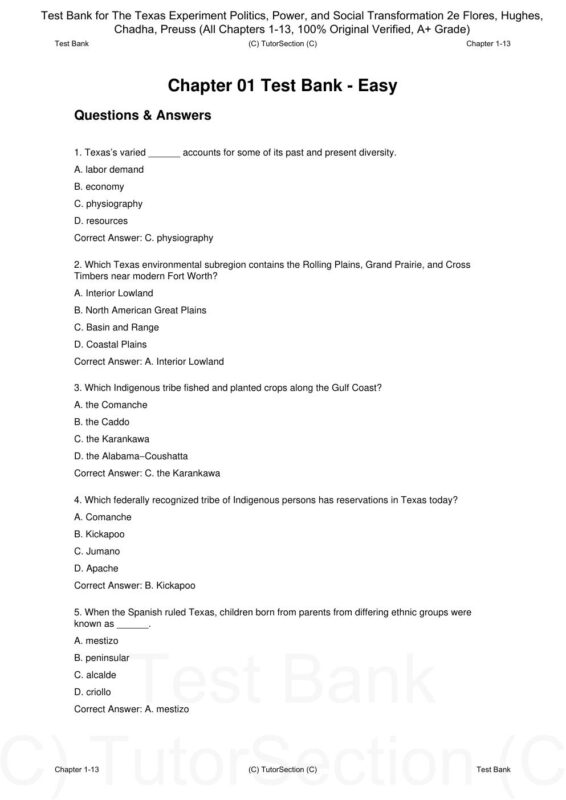
Test Bank for The Texas Experiment Politics, Power, and Social Transformation 2th Edition By Flores, Hughes, Chadha, Preuss (All Chapters 1-13, 100% Original Verified)
$35.00
Secure checkout
Instant digital download
PDF document
Document details
- Pages
- 260
- File size
- 1.3 MB
- Format
- Digital PDF
- Course
- Social Sciences
- Category
- TEST BANKS
Sign in or create a free account to continue. Your purchase will be saved in My Downloads.
About this ebook
Test Test Bank for The Texas Experiment: Politics, Power, and Social Transformation (2nd Edition) by William V. Flores, Christina Hughes, Anita Chadha, and Gene Preuss spans 13 chapters detailing the historical, structural, and multicultural dynamics of Texas government. [1, 2]
The second edition updates these core topics with extensive data from the 2023 Texas legislative cycle: [1]
1. Historical Foundations and Social Evolution
- Texas Society and Politics: Explores the state's diverse geography, resources, and the unvarnished history of how Anglo-American settlements, slavery, and the cotton industry shaped early Texas. [1, 2]
- Historical Conflicts: Covers the causes and consequences of the U.S.–Mexican War, secession from the Union, the impacts of Reconstruction, and the legacy of Jim Crow segregation. [1]
- Shifting Demographics: Analyzes how modern Texas has transformed into a multicultural, highly urbanized, and ethnically diverse state. [1]
2. Constitutional and Federal Frameworks
- The Texas Constitution: Examages what a constitution represents, details the historical sequence of Texas's governing documents, and focuses deeply on the restrictive nature of the Constitution of 1876 (founded on "Retrenchment and Reform"). [1]
- Federalism and Intergovernmental Relations: Looks at the shifting relationship between the Texas state government and the federal government, highlighting federal policy tools and constitutional friction points. [1]
- Local Government: Breaks down the functions, limitations, and power structures of city governments, county administration, and special purpose districts across the state. [1]
3. Political Participation and the Electorate
- Voting and Elections: Explores the historical barriers to voting (such as the white primary and poll taxes) alongside modern Texas voting laws, registration procedures, and voter turnout patterns.
- Political Parties: Traces the transformation of Texas from a one-party Democratic state to a dominant Republican state, alongside the rise of partisan polarization.
- Interest Groups and Lobbying: Documents how powerful lobbying forces, political action committees (PACs), and business elites influence policy decisions in Austin. [1]
4. Institutions of Government
- The Legislative Branch: Details the structure, processes, and biennial scheduling of the Texas Legislature, with updated context on political maneuvering and debates from the 2023 legislative session.
- The Executive Branch and Plural Executive: Examines the intentionally fragmented power of the Texas Governor and the independent authority of other executive offices (such as the Lieutenant Governor and Attorney General).
- The Bureaucracy: Looks at how state agencies administer laws, regulate industries, and handle public services.
- The Texas Judiciary: Maps out the dual supreme court system, the hierarchies of statutory and constitutional courts, original vs. appellate jurisdictions, and systemic inequities within the legal system. [1, 2]
5. Public Policy and Social Transformation
- State Budgeting and Finance: Analyzes how Texas handles its revenue, including its heavy reliance on local property sales taxes rather than a state income tax.
- Public Policy Issues: Investigates modern state-wide challenges including public education financing, healthcare accessibility, border security, infrastructure demands, and energy grid management. [1]
File included
tmpphpmAx2Vg
1.3 MB
Related ebooks