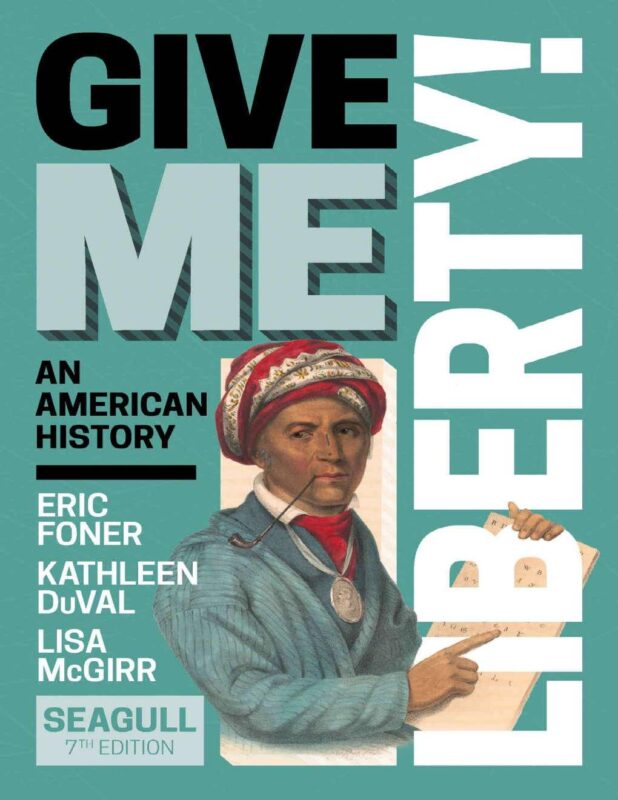
Give Me Liberty! An American History 7th Seagull Edition BY Eric Foner Kathleen DuVal Lisa McGirr
$25.00
Secure checkout
Instant digital download
PDF document
Document details
- Pages
- 2,262
- File size
- 40.43 MB
- Format
- Digital PDF
- Course
- Education
- Category
- eBook[PDF]
Sign in or create a free account to continue. Your purchase will be saved in My Downloads.
About this ebook
Give Me Liberty! An American History (7th Seagull Edition), written by Eric Foner, Kathleen DuVal, and Lisa McGirr, organizes the trajectory of American history around the central, evolving theme of freedom and liberty.
The 7th Edition specifically introduces significantly expanded coverage of Native American history—detailing indigenous definitions of sovereignty, the Dakota War, and the Indian New Deal—to further re-evaluate how the limits of American freedom have shifted over time.
A breakdown of the chronological chapters and core topics covered across the text includes:
Volume 1: To 1877
-
- Chapter 1: A New World – Pre-Columbian indigenous societies, early European exploration (Spanish, French, Dutch), and initial cultural collisions.
- Chapter 2: American Beginnings (1607–1660) – The founding of the Chesapeake (Jamestown) and New England colonies, Puritanism, and early colonial struggles.
- Chapter 3: Creating Anglo-America (1650–1750) – The expansion of the British empire, the growth of the plantation economy, consumer revolutions, and social stratification.
- Chapter 4: Slavery, Freedom, and the Struggle for Empire to 1763 – The transatlantic slave trade, regional slave systems, the rise of British patriotism, the Great Awakening, and the Seven Years' War.
- Chapter 5: The American Revolution (1763–1783) – The imperial crisis, taxation without representation (e.g., the Stamp Act), the Declaration of Independence, and the Revolutionary War.
- Chapter 6: The Revolution Within – How the ideals of liberty democratization affected internal American society, religious freedom, economic definitions of liberty, and the status of women and enslaved people.
- Chapter 7: Founding a Nation (1783–1789) – Life under the Articles of Confederation, Shays's Rebellion, the Constitutional Convention, and the debate over ratification.
- Chapter 8: Securing the Republic (1790–1815) – The political divisions of the 1790s (Hamilton vs. Jefferson), the War of 1812, and the expansion of the public sphere.
- Chapter 9: The Market Revolution – Technological innovations (steamboats, telegraph, cotton gin), westward expansion, commercial agriculture, the factory system, and the rise of individualism.
- Chapter 10: Democracy in America (1815–1840) – The triumph of political democracy, the presidency of Andrew Jackson, the Bank War, and the forced removal of Native Americans (Trail of Tears).
- Chapter 11: The Peculiar Institution – The Old South's cotton economy, the daily realities of chattel slavery, slave culture, and forms of resistance.
- Chapter 12: An Age of Reform (1820–1840) – Utopian communities, the temperance and asylum movements, the rise of radical abolitionism, and the early women's rights movement.
- Chapter 13: A House Divided (1840–1861) – Manifest Destiny, the Mexican-American War, sectional crises (the Compromise of 1850, Kansas-Nebraska Act, Dred Scott decision), and the rise of the Republican Party.
- Chapter 14: A New Birth of Freedom: The Civil War (1861–1865) – The military conflict, Abraham Lincoln’s presidency, the Emancipation Proclamation, and the transformation of the American state.
- Chapter 15: "What Is Freedom?": Reconstruction (1865–1877) – The battle over radical Reconstruction, the 13th, 14th, and 15th Amendments, the brief era of Black political empowerment, and the eventual overthrow of Reconstruction.
Volume 2: From 1865
- Chapter 16: America's Gilded Age (1870–1890) – Industrialization, corporate consolidation (captains of industry), the subjugation of the West, and labor unrest.
- Chapter 17: Freedom's Boundaries, at Home and Abroad (1890–1900) – Populism, the rise of Jim Crow segregation, restrictions on immigration, and American imperialism (Spanish-American War).
- Chapter 18: The Progressive Era (1900–1916) – Urbanization, consumer freedom, the labor movement, and the political reforms of the Progressive presidents (Teddy Roosevelt, Taft, Wilson).
- Chapter 19: Safe for Democracy: The United States and WWI (1916–1920) – American entry into the Great War, wartime suppression of civil liberties, and the failed struggle for a new global order.
- Chapter 20: From Business Culture to Great Depression (1920–1932) – The consumer culture of the 1920s, the "culture wars" (Scopes Trial, KKK), and the stock market crash.
- Chapter 21: The New Deal (1932–1940) – Franklin D. Roosevelt's responses to the Great Depression, the expansion of the welfare state (Social Security), and changes in the labor movement.
- Chapter 22: Fighting for the Four Freedoms: World War II (1941–1945) – The home front, mobilization, the internment of Japanese-Americans, the Holocaust, and the atomic bomb.
- Chapter 23: The United States and the Cold War (1945–1953) – Containment, the Truman Doctrine, the Korean War, and the domestic anti-communist crusade (McCarthyism).
- Chapter 24: An Affluent Society (1953–1960) – The suburban boom, consumerism, the golden age of capitalism, and the emergence of the modern Civil Rights Movement.
- Chapter 25: The Sixties (1960–1968) – The Civil Rights triumphs, JFK and LBJ’s Great Society, the escalation of the Vietnam War, and the rise of the New Left and counterculture.
- Chapter 26: The Triumph of Conservatism (1969–1988) – The Nixon era, stagflation, the Watergate scandal, the rise of the Religious Right, and the Reagan Revolution.
- Chapter 27: From Triumph to Tragedy (1989–2001) – The end of the Cold War, the globalization of the 1990s, the Clinton presidency, and the disputed 2000 election.
- Chapter 28: A New Century and the Crisis of Freedom – The September 11 attacks, the War on Terror, the invasion of Iraq, the Great Recession of 2008, the Obama presidency, the rise of political polarization, and contemporary debates surrounding democracy and civil rights up to the 2020s.
File included
tmpphpbSiK23
40.43 MB
Related ebooks