
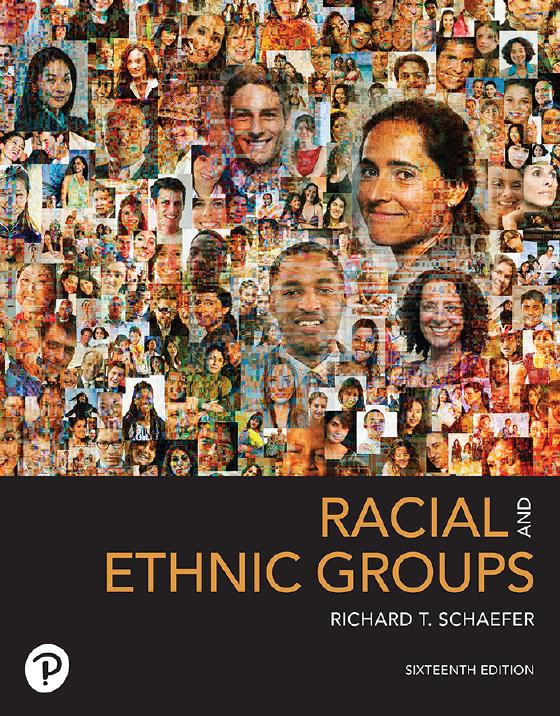
Racial and Ethnic Groups 16th Edition By Richard T. Schaefer
$30.00
Secure checkout
Instant digital download
PDF document
Document details
- Pages
- 465
- File size
- 27.58 MB
- Format
- Digital PDF
- Course
- Social Sciences
- Category
- eBook[PDF]
Sign in or create a free account to continue. Your purchase will be saved in My Downloads.
About this ebook
The textbook Racial and Ethnic Groups (16th Edition) by Richard T. Schaefer provides a comprehensive framework for examining race, ethnic relations, and cultural identities through both sociohistorical contexts and contemporary developments. [1, 2]
The book is structured into major parts covering overarching sociological concepts, specific systemic stressors, and detailed analysis of major minority populations. [1, 2]
Part 1: Perspectives on Racial and Ethnic Groups
- Exploring Race and Ethnicity: Defining subordinate/minority groups, the biological and social construction of race, and theoretical perspectives on intergroup relations (such as assimilation, pluralism, and segregation). [1, 2]
- Prejudice and Racism: The sociological and psychological roots of prejudice, stereotypes, and changing attitudes. [1, 2]
- Discrimination: Exploring individual discrimination, institutional racism, and policies like affirmative action designed to combat systemic inequalities. [1, 2]
Part 2: Ethnic and Religious Sources of Conflict
- Immigration: The history of immigration policy in the United States, ongoing legislative debates, civil discourse, and the social dynamics surrounding modern refugees. [1, 2]
- Ethnicity, Whiteness, and Religion: Examining the concept of "white privilege," white ethnic groups, and religious diversity/freedom as variables in social conflict. [1]
Part 3: Major Racial and Ethnic Minority Groups in the United States
This section utilizes group-specific historical narratives and first-person accounts to explore the unique social challenges faced by distinct communities: [1, 2]
- Native Americans: History of treaties, displacement, and contemporary issues including the latest focus on language preservation among Indigenous communities.
- African Americans: The historical framework of slavery and Jim Crow laws, leading into an examination of African Americans Today regarding modern social movements, economic standing, and institutional hurdles.
- Latinos / Hispanic Americans: The growth and demographic diversity of the Hispanic population, with a dedicated deep-dive into the specific experiences of Mexican Americans and Puerto Ricans.
- Muslim and Arab Americans: Exploring the internal cultural diversity within these communities and navigating post-9/11 discrimination.
- Asian Pacific Americans: Analyzing the broad array of nationalities under the pan-ethnic umbrella, alongside dedicated evaluations of Chinese Americans and Japanese Americans.
- Jewish Americans: Anti-Semitism and the ongoing sociological quest to maintain cultural and religious identity. [1, 2, 3, 4]
Part 4: Additional Dimensions & Comparative Perspectives
- Women as the Oppressed Majority: Treating gender through a minority-group framework, addressing sexism, economic inequality, and political representation.
- Beyond the United States: A comparative global perspective examining intergroup relations and racial/ethnic dynamics in international settings. [1, 2, 3]
Key Updates and Focus Areas in the 16th Edition
The 16th Edition integrates several pressing topics to reflect the modern landscape: [1]
- Expanded Intersectionality Analysis: Enhanced focus on how multiple identities (e.g., race, gender, socioeconomic class) overlap to create distinct layers of privilege or discrimination.
- Pandemic Consequences: Structural discussions around the disproportionate impacts of the coronavirus epidemic on minority communities.
- Contemporary Social Movements: Analysis of shifting U.S. refugee policies, recent social justice movements, and changing demographic shifts highlighted by recent census trends. [1, 2, 3]
File included
tmpphpYTyTQ8
27.58 MB
Related ebooks