
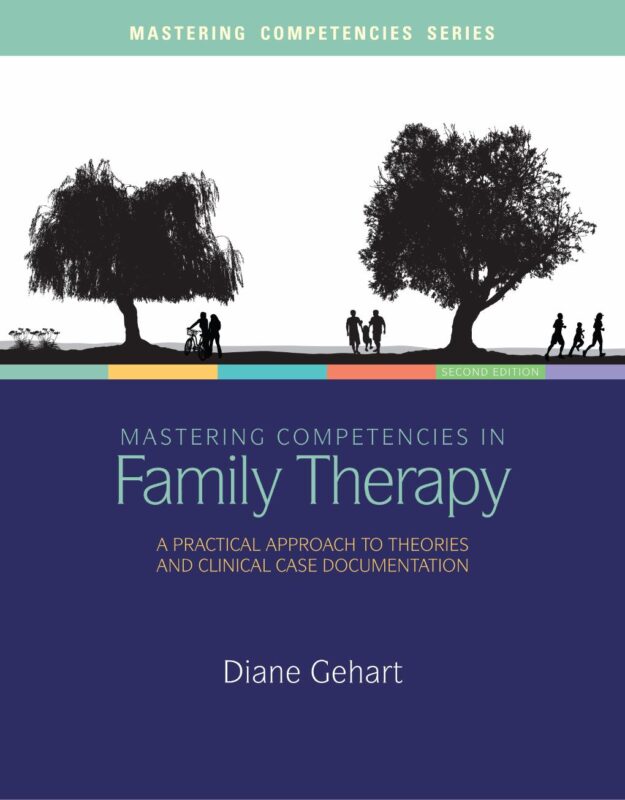
Mastering Competencies in Family Therapy: A Practical Approach to Theories and Clinical Case Documentation By Diane R_ Gehart
$28.00
Secure checkout
Instant digital download
PDF document
Document details
- Pages
- 686
- File size
- 12.57 MB
- Format
- Digital PDF
- Course
- Education
- Category
- eBook[PDF]
Sign in or create a free account to continue. Your purchase will be saved in My Downloads.
About this ebook
Mastering Competencies in Family Therapy: A Practical Approach to Theories and Clinical Case Documentation by Diane R. Gehart covers the foundational competencies, core theories, and essential documentation workflows required for professional couple and family therapy practice. [1, 2]
The book is uniquely structured around a five-step clinical model designed to satisfy the Core Competencies of the American Association for Marriage and Family Therapy (AAMFT): [1, 2, 3, 4]
-
- Mapping the territory (Theoretical orientation)
- Identifying oases and obstacles (Clinical assessment and diagnosis)
- Selecting a path (Treatment planning)
- Tracking progress (Evaluation)
- Leaving a trail (Clinical documentation) [1]
Below is a detailed breakdown of the major topics covered throughout the text.
1. Core Clinical Competencies & Documentation
-
- AAMFT Core Competencies: Overlapping heavily with universal counseling standards (such as CACREP), the text details admission to treatment, ethical frameworks, and legal standards. [1, 2]
- Case Conceptualization: Formulating a holistic perspective of a client system using demographic profiles, presenting problems, and systemic assessment. [1]
- Clinical Assessment & Diagnosis: Integrating standard DSM-5 systemic diagnoses and multi-generational assessment tools like genograms. [1, 2]
- Integrated Treatment Planning: Creating dual-purpose treatment plans that blend medical/symptom-based language with theory-based relational goals across initial, working, and termination phases. [1]
- Progress Notes: Writing compliant, efficient clinical case notes that satisfy agency and insurance demands. [1]
2. Classical Family Therapy Theories
-
- Bowen Intergenerational Therapy: Focusing on differentiation of self, multigenerational transmission, emotional triangles, and family genograms. [1, 2, 3, 4, 5]
- Structural Family Therapy: Managing family hierarchies, subsystems, boundaries, coalitions, and implementing Intensive Structural Therapy. [1, 2]
- Strategic & Systemic Therapies: Analyzing communication patterns, feedback loops, and using paradoxical interventions (Milan approach, MRI model). [1, 2]
- Experiential Family Therapy: Utilizing emotional expression, self-actualization, and communication stances (Satir’s model) to resolve conflict. [1, 2, 3]
- Psychodynamic & Object Relations: Applying attachment theories to adult partnerships and family relationships.
3. Postmodern & Cognitive-Behavioral Approaches
-
- Solution-Focused Brief Therapy (SFBT): Emphasizing client strengths, exception questions, and the miracle question.
- Narrative Therapy: Externalizing problems, deconstructing dominant cultural scripts, and re-authoring lives.
- Cognitive-Behavioral & Couple Therapies: Mapping cognitive distortions within systems, alongside contemporary expansions like Integrative Behavioral Couple Therapy (IBCT). [1, 2, 3]
4. Cross-Theoretical Integration & Diversity
- The Karl Tomm Model: Utilizing reflexive and circular questioning to build cross-theoretical comparisons in session.
- Diversity & Social Justice: Intersecting gender, race, socio-economic status, sexual orientation, and culture into clinical case conceptualizations.
- Evidence-Based Practice: Merging outcome research and empirical efficacy studies directly into everyday therapeutic interventions. [1, 2, 3, 4, 5]
File included
tmpphpOeTrHn
12.57 MB
Related ebooks