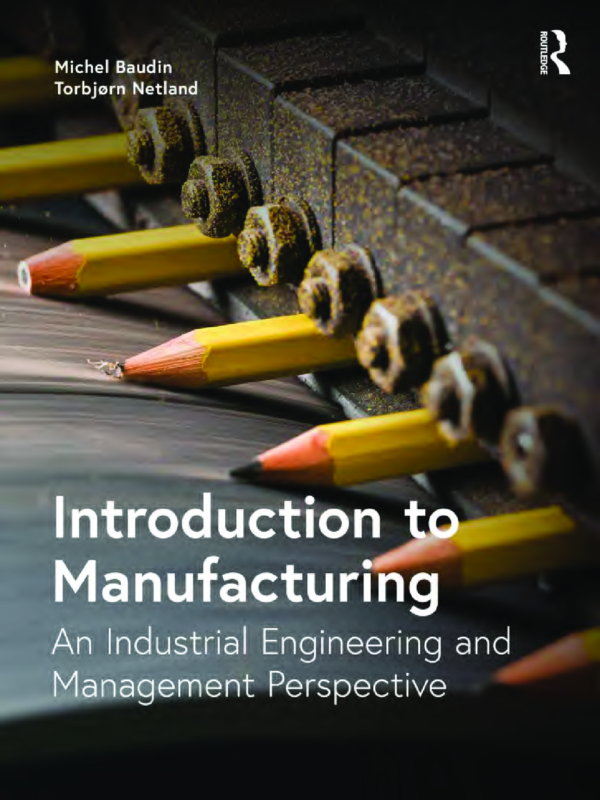
Introduction to Manufacturing An Industrial Engineering and Management Perspective By Michel Baudin, Torbjørn H. Netland
$30.00
Secure checkout
Instant digital download
PDF document
Document details
- Pages
- 800
- File size
- 11.38 MB
- Format
- Digital PDF
- Course
- Engineering
- Category
- eBook[PDF]
Sign in or create a free account to continue. Your purchase will be saved in My Downloads.
About this ebook
The textbook Introduction to Manufacturing: An Industrial Engineering and Management Perspective by Michel Baudin and Torbjørn Netland is structured into five core parts that view factory operations as an interconnected system. [1, 2]
Here are the specific topics and areas covered under each section:
1. Getting to Know Manufacturing
- Economic Foundation: Analyzes manufacturing strictly as a value-generating economic activity.
- Manufacturing Strategy: How production targets align with overall corporate and business goals.
- Market Demand Forecasting: Methods used to predict market needs and size production runs accordingly. [1, 2, 3, 4, 5]
2. Engineering the Factory
- Physical Design: Focuses on facility layout, architectural planning, and assembly line balancing.
- Process Design: Mapping out production steps from raw components to finished goods.
- Infrastructure & Technology: Selecting machinery, process technology, automation tools, and physical hardware. [1, 2, 3, 4]
3. Making Information Flow
- Central Nervous System: Explores how physical events on the shop floor trigger data responses.
- Production Scheduling: How tasks are prioritized, sequenced, and communicated to workers or machines.
- Event Tracking: Real-time response data architectures used to monitor disruptions, scrap rates, and output. [1]
4. Making Materials Flow
- Internal Logistics: Methods for materials handling, transport, and routing inside the factory walls.
- Warehousing: Managing raw inventory, work-in-progress (WIP), and finished products safely and efficiently.
- Supply Chain Integration: Connecting factory floor logistics with external suppliers and distribution networks. [1, 2, 3]
5. Enhancing Performance
- Performance Management: Establishing key performance indicators (KPIs) to measure efficiency, quality, and cycle times.
- Continuous Improvement: Frameworks for maintaining and optimizing standard operations day-to-day.
- Emergency Management: Protocols for mitigating production risks, machinery breakdowns, and critical supply shortages. [1, 2]
File included
tmpphprawIBb
11.38 MB
Related ebooks