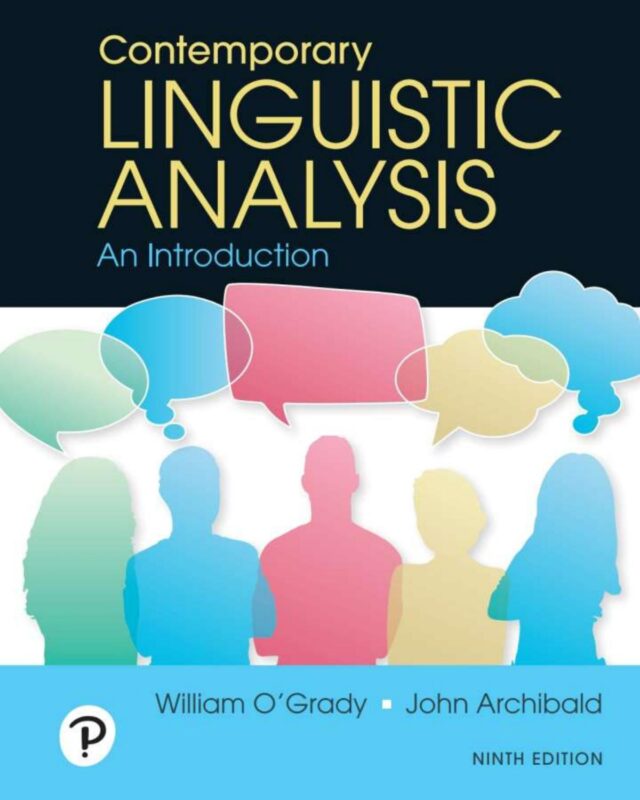
Contemporary Linguistic Analysis An Introduction 9th Edition By William O’Grady, John Archibald
$30.00
Secure checkout
Instant digital download
PDF document
Document details
- Pages
- 618
- File size
- 12.22 MB
- Format
- Digital PDF
- Course
- Social Sciences
- Category
- eBook[PDF]
Sign in or create a free account to continue. Your purchase will be saved in My Downloads.
About this ebook
The 9th Edition of Contemporary Linguistic Analysis: An Introduction, edited by William O'Grady and John Archibald, spans 16 comprehensive chapters. Grounded heavily in the generative grammar paradigm, the textbook introduces the scientific methodology used to analyze core structural elements of language while integrating the specific socio-political context of the Canadian linguistic landscape. [1, 2, 3, 4, 5]
The main topics and core chapters included in this edition are categorized below:
Core Structural Linguistics
- Chapter 1: Language: A Preview – Introduces foundational concepts of what language is, human grammatical knowledge, and biological specializations for speech. [1, 2]
- Chapter 2: Phonetics: The Sounds of Language – Covers the production, anatomy, and articulation of speech sounds using the International Phonetic Alphabet (IPA). [1, 2, 3]
- Chapter 3: Phonology: Contrasts and Patterns – Analyzes sound systems, features, phonological rules, and syllable structures. [1, 2]
- Chapter 4: Morphology: The Analysis of Word Structure – Focuses on morphemes, word formation processes (derivation, compounding), and structural components of words. [1, 2]
- Chapter 5: Syntax: The Analysis of Sentence Structure – Explores structural relationships, category types, and phrase structures using generative frameworks. (Note: This edition also offers an alternate version of this chapter online for basic syntactic description independent of generative grammar). [1, 2, 3]
- Chapter 6: Semantics: The Study of Meaning – Investigates the literal meaning of words, phrases, and truth-conditional meanings. (This chapter was completely rewritten and updated for the 9th edition). [1, 2, 3]
Language Change & Typology
- Chapter 7: The Classification of Languages – Covers language types, genetic relationships, and morphological typology.
- Chapter 8: Historical Linguistics: The Study of Language Change – Explores how languages evolve phonologically, lexically, and syntactically over time.
- Chapter 9: Indigenous Languages in Canada – Offers a specialized look at the history, structures, and modern realities of native Canadian languages. [1, 2]
Language Acquisition & Cognitive Processing
- Chapter 10: First Language Acquisition – Focuses on how children naturally develop speech, phonology, and grammar.
- Chapter 11: Second Language Acquisition – Evaluates the cognitive and linguistic processes of learning an additional language later in life.
- Chapter 12: Bilingualism and Bilingual Acquisition – A brand-new chapter addition to this edition, examining simultaneous language acquisition with a particular focus on the bilingual landscape of Canada.
- Chapter 13: Psycholinguistics: The Study of Language Processing – Focuses on how the human mind stores, retrieves, and interprets language in real-time.
- Chapter 14: Brain and Language – Explores neurolinguistics, localized brain functions, and language disorders like aphasia. [1, 2, 3, 4]
Social Contexts & Communication Modalities
File included
tmpphpeVqT9Q
12.22 MB
Related ebooks