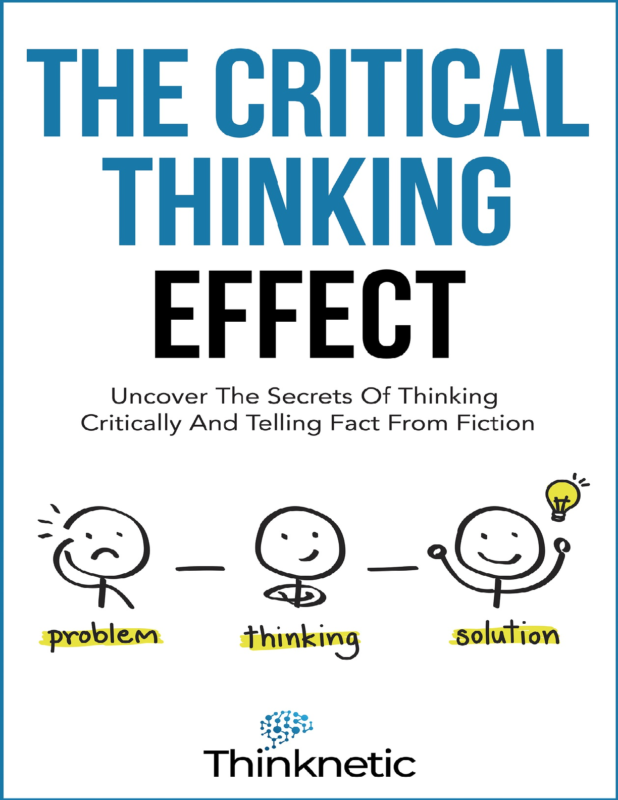
The Critical Thinking Effect: Uncover The Secrets Of Thinking Critically And Telling Fact From Fiction 1st Edition By Thinknetic
$30.00
Secure checkout
Instant digital download
PDF document
Document details
- Pages
- 128
- File size
- 2.05 MB
- Format
- Digital PDF
- Course
- Education
- Category
- eBook[PDF]
Sign in or create a free account to continue. Your purchase will be saved in My Downloads.
About this ebook
The Critical Thinking Effect: Uncover the Secrets of Thinking Critically and Telling Fact from Fiction (1st Edition, 2021) is a practical self-help psychology and logic book by Thinknetic. Spanning roughly 206 pages, it is part of the Critical Thinking & Logic Mastery series and is designed to help readers navigate information overload, avoid cognitive traps, and make smarter decisions. [1, 2, 3]
Core Themes and Topics
- Sifting Fact From Fiction: Learn how to analyze news, social media, and data without falling for misleading statistics or false narratives. [1]
- Cognitive Biases and Traps: Identifies common mental shortcuts and logical fallacies that distort everyday reasoning. [1, 2, 3]
- Real-World Case Studies: Uses engaging, unconventional examples—such as the misinterpretation of the "Mozart Effect" study or lessons learned from dueling ice cream shops—to show logic in action. [1, 2]
- Actionable Exercises: Provides practical activities and steps to build sound arguments and strengthen daily problem-solving skills. [1]
The 10 foundational flaws and logical traps emphasized throughout their framework include:
1. Confirmation Bias
- The Flaw: Subconsciously searching for, favoring, and recalling information that validates your pre-existing beliefs while ignoring counter-evidence.
- Real-World Impact: Reading only news outlets that align with your political views, which creates a polarizing echo chamber. [1, 2, 3, 4, 5]
2. Ad Hominem (Attacking the Person)
- The Flaw: Directing an argument away from the actual substance of the debate to attack the opponent's character, motive, or personal traits.
- Real-World Impact: Dismissing a scientist's valid climate data simply because you dislike their personality or their funding source. [1, 2, 3, 4, 5]
3. Straw Man Argument
- The Flaw: Oversimplifying, exaggerating, or completely misrepresenting an opponent's argument to make it significantly easier to knock down. [1, 2]
- Real-World Impact: Someone states, "We should allocate more budget to public schools," and an opponent responds, "Why do you hate our military and want to leave us defenseless?" [1, 2]
4. False Dilemma (Black-and-White Thinking)
- The Flaw: Presenting an issue as an absolute "either/or" choice when multiple alternative solutions actually exist.
- Real-World Impact: Falling for the rigid ultimatum: "Either you support this specific war completely, or you completely hate your country." [1, 2, 3, 4]
5. Slippery Slope
- The Flaw: Arguing without evidence that a minor, relatively harmless first step will inevitably trigger a disastrous chain reaction.
- Real-World Impact: Claiming that allowing employees to work from home one day a week will cause them to stop working entirely, bankrupting the company. [1, 2, 3, 4]
6. False Causality (Post Hoc Ergo Propter Hoc)
- The Flaw: Assuming that because Event B occurred after Event A, Event A must have directly caused Event B.
- Real-World Impact: Wearing a specific pair of "lucky" socks on a day you win a game, and concluding the socks caused the victory. [1, 2, 3, 4, 5]
7. Hasty Generalization (Jumping to Conclusions)
- The Flaw: Drawing a sweeping, universal conclusion based on an incredibly small or unrepresentative sample size.
- Real-World Impact: Meeting two rude individuals while visiting a new city and declaring that every citizen in that city is unpleasant. [1, 2, 3, 4, 5]
8. Appeal to Emotion
- The Flaw: Manipulating feelings—such as fear, pity, or pride—to win an argument in place of presenting objective, factual evidence.
- Real-World Impact: A commercial urging you to buy a security system by showing terrifying footage of home break-ins, rather than sharing actual safety statistics. [1, 2, 3, 4, 5]
9. Bandwagon Appeal (Ad Populum)
- The Flaw: Arguing that a claim must be true or an action must be right simply because a massive number of people believe it or do it.
- Real-World Impact: Investing heavily in a highly volatile cryptocurrency purely because "everyone on social media is buying it." [1, 2, 3, 4]
10. Circular Reasoning (Begging the Question)
- The Flaw: An argument where the premise and the conclusion are identical, essentially proving nothing because it loops back on itself.
- Real-World Impact: Asserting that "The law must be obeyed because it is illegal to break the law." [1, 2]
File included
eBook-The-Critical-Thinking-Effect-Uncover-The-Secrets-Of-Thinking-Critically-And-Telling-Fact-From-Fiction-1e-Thinknetic.pdf
2.05 MB
Related ebooks