
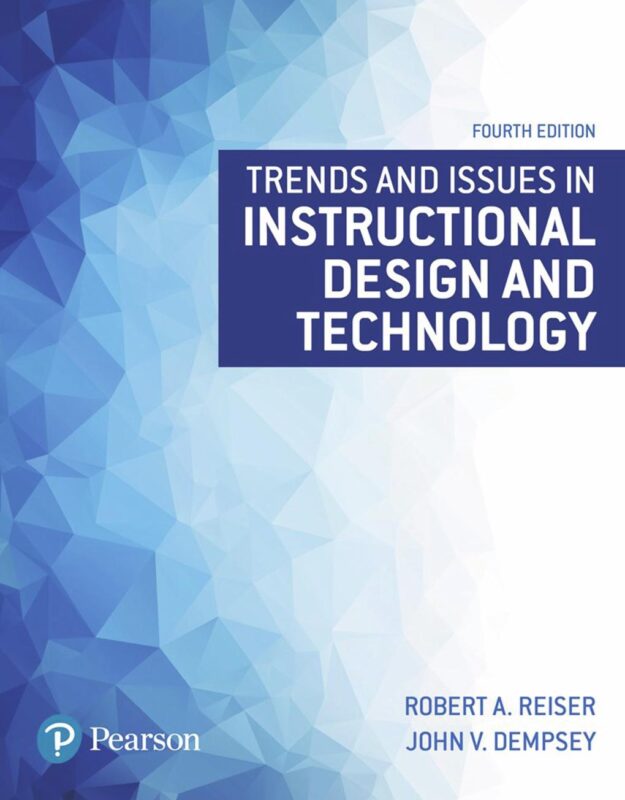
Trends and Issues in Instructional Design and Technology 4th Edition By Robert A. Resier John V. Dempsey
$27.00
Secure checkout
Instant digital download
PDF document
Document details
- Pages
- 369
- File size
- 8.4 MB
- Format
- Digital PDF
- Course
- Education
- Category
- eBook[PDF]
Sign in or create a free account to continue. Your purchase will be saved in My Downloads.
About this ebook
The Trends and Issues in Instructional Design and Technology (4th Edition) by Robert A. Reiser and John V. Dempsey is organized into ten comprehensive sections designed to give a clear picture of foundational knowledge, modern practices, and emerging shifts in the IDT field. [1, 2]
The primary sections and core topics covered in this edition include: [1]
I. Definition and History of the Field
- Naming and Defining the Field: Historical and conceptual terminology defining Instructional Design and Technology (IDT).
- Evolution of IDT: A foundational timeline of historical shifts, from early audiovisual movements to modern digital learning practices. [1]
II. Instructional Design Models
- Foundational Frameworks: Core features of traditional paradigms (such as the ADDIE model).
- Agile and Alternative Models: In-depth alternatives focusing on iterative design, including the Successive Approximation Model (SAM) and the Pebble-in-the-Pond model. [1, 2, 3]
III. Theories and Models of Learning and Instruction
- Psychological Foundations: Behavioral, cognitive, and constructivist learning theories applied to instruction.
- The Learning Sciences: Explaining where the learning sciences stem from and how they translate to instructional design.
- Motivation and Volition: Core factors that influence learner motivation and ongoing performance (e.g., the ARCS model). [1]
IV. Evaluating and Managing Instructional Programs and Projects
- Evaluation Models: A comparative breakdown of major evaluation systems.
- Advanced Metrics: Measuring the Return on Investment (ROI) in technology-based learning.
- Learning Analytics: Using data mining and predictive analytics to optimize instructional environments.
- Project Management: Strategies for managing on-site and virtual design teams, as well as scarce organizational resources. [1, 2, 3]
V. Performance Improvement
- Human Performance Improvement (HPI): Exploring non-instructional interventions and human performance technology.
- Performance Support: Electronic performance support systems (EPSS) and tools integrated into work environments.
- Informal Learning: Understanding and designing for self-directed, unstructured learning experiences outside traditional classrooms. [1, 3]
VI. IDT in Various Settings
- Business, Industry, & Military: Designing corporate training pipelines and specialized defense education.
- Healthcare Education: Navigating simulation and digital tech constraints in medical fields.
- K-12 & Higher Education: Overcoming the real-world barriers of integrating technology into public schools and university settings.
- Global Contexts: Comparative trends examining how instructional design operates in Europe and Asia (focusing heavily on Japan and Korea). [1]
VII. Getting an IDT Position and Succeeding at It
- Career Readiness: Pragmatic advice and professional histories on securing instructional design jobs.
- Performance Consulting: Moving from a pure "content creator" role to a business consultant solving performance issues.
- Professional Development: Insights on key organizations, networking, and keeping skills current. [, 2]
VIII. Technology and Learning
- Digital Ecosystems: The intersection of general e-learning with systematic instructional systems.
- Social Media & Mobile Learning: Designing instruction specifically leveraging social networks and handheld mobile devices.
- Massive Open Online Courses (MOOCs): Structural mechanics behind scaling high-enrollment online learning courses.
- Rich Media Application: Best practices in multimedia learning and cognitive theories behind visual/auditory delivery. [, 2]
IX. Instructional Strategies
- Social Interdependence Theory: Crafting high-quality cooperative and collaborative learning environments.
- Educational Gaming: Balancing entertainment value with robust formative assessment and authentic mechanics.
- Problem-Based Learning (PBL): Structuring complex, ill-defined problems to prompt deep learner critical thinking.
- Authentic Tasks: The measurable benefits of designing real-world contexts within virtual spaces. [1, 2]
X. Current Issues in Instructional Design and Technology
- Professional Ethics: Evaluating structural ethics rules applied straight to active instructional design practice.
- Diversity and Accessibility: Creating universally designed learning (UDL) frameworks that guarantee content accessibility.
- Economics of Educational Materials: Open Educational Resources (OER) and the shifting landscape of textbook/material pricing.
- Changing Conceptions of Design: Evolving philosophies around what constitutes successful aesthetic and functional design. []
File included
tmpphp6IpsWY
8.4 MB
Related ebooks