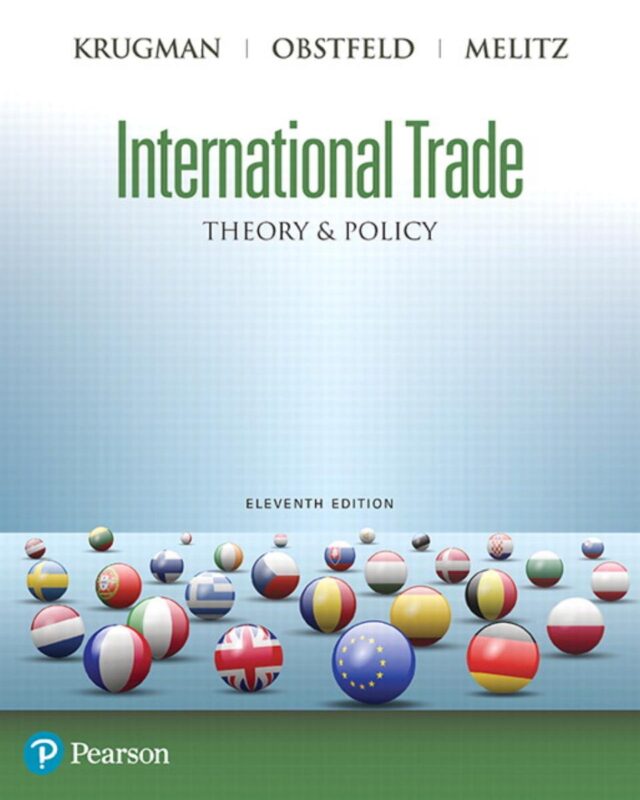
International Trade Theory and Policy 11th Edition By Paul R Krugman, Maurice Obstfeld, Marc J Melitz
$30.00
Secure checkout
Instant digital download
PDF document
Document details
- Pages
- 365
- File size
- 16.11 MB
- Format
- Digital PDF
- Course
- Education
- Category
- eBook[PDF]
Sign in or create a free account to continue. Your purchase will be saved in My Downloads.
About this ebook
The 11th Edition of International Trade: Theory and Policy by Paul R. Krugman, Maurice Obstfeld, and Marc J. Melitz provides a comprehensive and balanced approach to international trade concepts. The book is traditionally structured into two main components: International Trade Theory and International Trade Policy. [1, 2]
Part 1: International Trade Theory
- Introduction to International Economics: An overview of what the discipline covers, the gains from trade, and patterns of commerce. [1]
- World Trade: An Overview: Examining global trade dynamics, trade patterns, and how country size and distance impact economic interaction (the Gravity Model). [1, 2]
- Labor Productivity and Comparative Advantage (The Ricardian Model): Understanding how differences in technology and labor productivity determine trade advantages and gains. [1, 2]
- Specific Factors and Income Distribution: Analyzing how trade creates winners and losers in the short run by shifting resource demands across specific industries. [1, 2]
- Resources and Trade (The Heckscher-Ohlin Model): Exploring trade driven by comparative differences in national resource endowments (like capital and labor). [1, 2]
- The Standard Trade Model: A generalized framework integrating production possibilities, relative supply, relative demand, and terms of trade. [1]
- External Economies of Scale and the International Location of Production: Investigating how specialized geographic industry clusters drive trade even without traditional comparative advantages. [1, 2]
- Firms in the Global Economy: Focusing on the "New New Trade Theory" (spearheaded by Marc Melitz), which examines heterogeneous firms, export decisions, foreign direct investment (FDI), and outsourcing. [1]
Part 2: International Trade Policy
- The Instruments of Trade Policy: Evaluating the mechanisms used to control trade, including tariffs, import quotas, export subsidies, and non-tariff barriers.
- The Political Economy of Trade Policy: Discussing arguments for and against free trade, national welfare maximization, and why governments implement protectionist policies.
- Trade Policy in Developing Countries: Looking at economic growth strategy paths such as import-substituting industrialization versus export-oriented regimes.
- Controversies in Trade Policy: Addressing modern challenges such as environmental standards, globalization anxieties, labor rights, and strategic trade policies driven by advanced technology industries. [1, 2, 3, 4, 5, 6]
File included
tmpphpnN9gHN
16.11 MB
Related ebooks