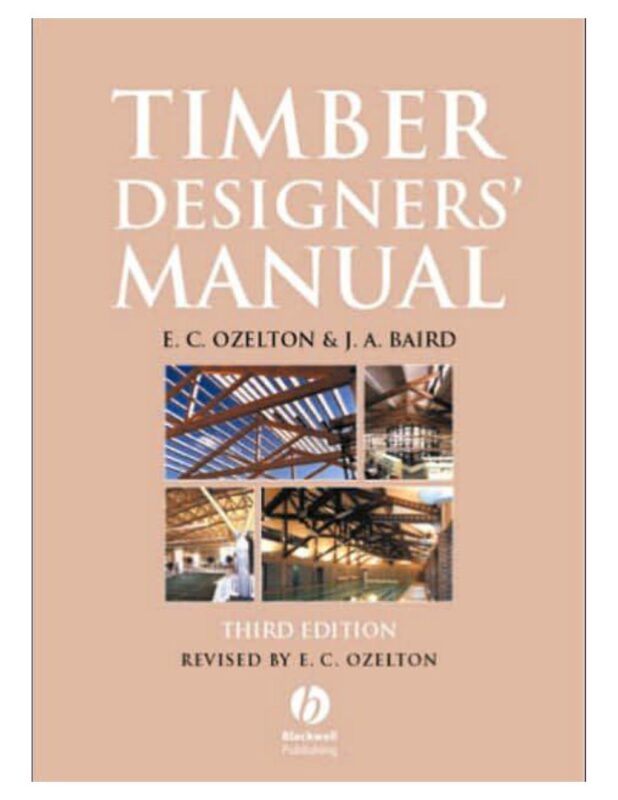
Timber Designers Manual 3rd Edition BY E. C. Ozelton, J. A. Baird
$28.00
Secure checkout
Instant digital download
PDF document
Document details
- Pages
- 556
- File size
- 3.52 MB
- Format
- Digital PDF
- Course
- Education
- Category
- eBook[PDF]
Sign in or create a free account to continue. Your purchase will be saved in My Downloads.
About this ebook
The Timber Designers' Manual (3rd Edition) by E. C. Ozelton and J. A. Baird is a comprehensive engineering guide focusing on the structural design and detailing of timber components. It aligns heavily with the British Standard BS 5268-2:2002 and includes introductory frameworks for Eurocode 5. [1, 2, 3]
1. Materials and Fundamental Design Actions
- The Materials Used in Timber Engineering: Solid timber, plywood, particleboard, OSB, wood fibreboards, engineered wood products (EWP), adhesives, and mechanical fasteners. [1]
- Stress Levels for Solid Timber: Grade stress derivation, characteristic strength, load sharing, modulus of elasticity, and moisture content adjustments. [1]
- Loading & Deflection: Practical design load criteria, shear deflection, creep, and dynamic properties. [1, 2]
2. Flexural and Tension Members
- Design of Beams (General Notes): Fundamental concepts of flexural member behavior.
- Specific Beam Configurations: Chapters explicitly dedicated to solid timber beams, multiple section beams, glulam beams, and thin web beams.
- Lateral Stability of Beams: Overturning, lateral buckling, and torsional considerations.
- Decking & Composite Lumber: Structural composite lumber (SCL) and solid timber decking.
- Tension Members: Direct axial tension design rules. [1, 2]
3. Compression Members (Columns)
- General Design of Compression Members: Axial stress, directional restraint, slenderness ratio, and effective length concepts.
- Column Types: Dedicated chapters covering solid timber columns, multi-member columns, and glulam columns. [1, 2]
4. Joints and Structural Systems
- Joint Engineering: Mechanical joints (including updated design values for 8.8 grade bolts) and glue/finger joints.
- Complex Assemblies: Stress-skinned panels and truss frameworks.
- System Stability: Overall building stability, including horizontal roof/floor diaphragms and vertical shear walls. [1, 2, 3]
5. Durability, Testing, and Codes
- Structural Design for Fire Resistance: Fire performance and calculations.
- Preservation & Hardwoods: Durability, chemical treatment, and specific nuances of structural hardwood.
- Testing & Modern Standards: Prototype testing procedures and comprehensive guidelines for Design to Eurocode 5.
- Miscellaneous Tables: Extensive coefficients and reference charts to bypass manual math. [1, 2, 3, 4]
File included
tmpphp2qEtyn
3.52 MB
Related ebooks