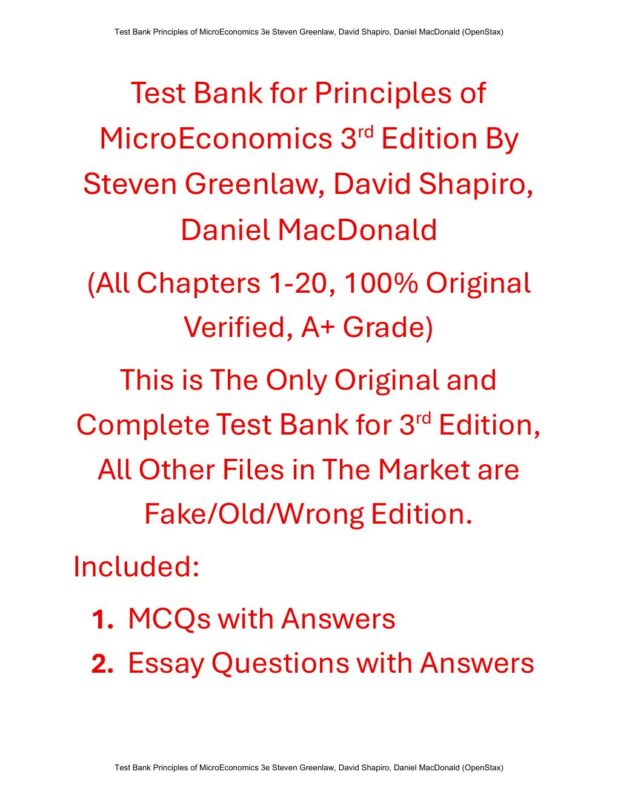
Test Bank for Principles of MicroEconomics 3rd Edition By Steven Greenlaw, David Shapiro, Daniel MacDonald
$30.00
Secure checkout
Instant digital download
PDF document
Document details
- Pages
- 495
- File size
- 7.18 MB
- Format
- Digital PDF
- Course
- Business
- Category
- TEST BANKS
Sign in or create a free account to continue. Your purchase will be saved in My Downloads.
About this ebook
The Test Bank for Principles of Microeconomics (3rd Edition) by David Shapiro, Daniel MacDonald, and Steven A. Greenlaw—published by OpenStax—is organized into 5 core parts spanning 20 chapters. [1, 2, 3, 4]
The comprehensive breakdown of the topics and chapters covered in this edition includes:
Part 1: What is Economics? (Chapters 1–2)
This introductory section focuses on how individuals and societies make decisions when facing limited resources. [1, 2]
- Chapter 1: Welcome to Economics! – Introduction to scarcity, the division of labor, the differences between microeconomics and macroeconomics, and an overview of traditional, command, and market economies. [1, 2]
- Chapter 2: Choice in a World of Scarcity – Analyzing choices using the Production Possibilities Frontier (PPF), opportunity cost, budget constraints, marginal analysis, and sunk costs. [1]
Part 2: Supply and Demand (Chapters 3–4)
- Chapter 3: Demand, Supply, and Equilibrium – Exploring demand and supply schedules, market equilibrium, price controls (ceilings and floors), and consumer/producer surplus. [1, 2]
- Chapter 4: Labor and Financial Markets – Applying the supply and demand model directly to human resource markets (wages) and financial/capital systems. [1, 2]
Part 3: The Fundamentals of Microeconomic Theory (Chapters 5–10)
This segment covers consumer behavior, firm production mechanics, and core market structures. [1, 2]
- Chapter 5: Elasticity – Price elasticity of demand and supply, cross-price elasticity, income elasticity, and how elasticity impacts total revenue.
- Chapter 6: Consumer Choices – Utility maximization, marginal utility, behavioral economics, and how price changes alter consumer equilibrium.
- Chapter 7: Production and Costs – Explicit and implicit costs, short-run vs. long-run production, marginal product, and economies of scale.
- Chapter 8: Perfect Competition – Characteristics of perfectly competitive markets, output decisions, entry and exit in the long run, and efficiency.
- Chapter 9: Monopoly – Barriers to entry, how a monopolist maximizes profit, and the social costs of monopoly power.
- Chapter 10: Monopolistic Competition and Oligopoly – Differentiated products, collusion, game theory, and the prisoner's dilemma. [1, 2, 3, 4, 5]
Part 4: Microeconomic Policy Issues (Chapters 11–18)
This section looks at market failures, government intervention, social safety nets, and labor issues. [1, 2, 3]
- Chapter 11: Monopoly and Antitrust Policy – Corporate mergers, regulation of natural monopolies, and deregulation history.
- Chapter 12: Environmental Protection and Negative Externalities – Command-and-control regulation, pollution charges, marketable permits, and the economics of climate change.
- Chapter 13: Positive Externalities and Public Goods – Investments in innovation, intellectual property rights, and public goods (like national defense).
- Chapter 14: Poverty and Economic Inequality – The poverty line, safety net programs (Medicaid, TANF), and measuring income inequality (Lorenz curves).
- Chapter 15: Issues in Labor Markets: Unions, Discrimination, Immigration – Collective bargaining, gender/racial wage gaps, and the economic impacts of immigration.
- Chapter 16: Information, Risk, and Insurance – Asymmetric information, moral hazard, adverse selection, and the mechanics of insurance markets.
- Chapter 17: Financial Markets – Corporate stock, bonds, venture capital, and personal financial investment strategies.
- Chapter 18: Public Economy – Voter participation, special interest politics, and flaws within democratic political systems. [1]
Part 5: International Economics (Chapters 19–20)
- Chapter 19: International Trade – Absolute and comparative advantage, intra-industry trade, and the benefits of reduced trade barriers.
- Chapter 20: Globalization and Protectionism – Tariffs, import quotas, the World Trade Organization (WTO), and the socioeconomic arguments for and against trade barriers.
File included
tmpphp9HdSAX
7.18 MB
Related ebooks