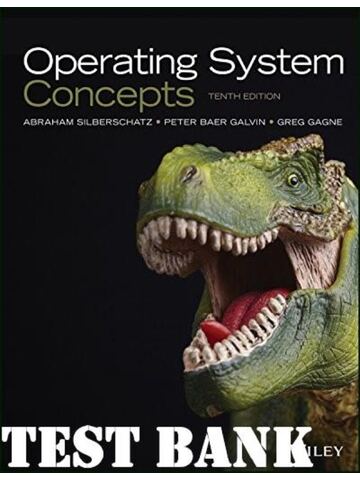
TEST BANK for Operating System Concepts, 10th Edition by Abraham Silberschatz, Greg Gagne and Peter Galvin. All Chapters 1-17
$22.00
Secure checkout
Instant digital download
PDF document
Document details
- Pages
- 194
- File size
- 1.68 MB
- Format
- Digital PDF
- Course
- Computer Science
- Category
- TEST BANKS
Sign in or create a free account to continue. Your purchase will be saved in My Downloads.
About this ebook
TEST BANK for Operating System Concepts, 10th Edition ISBN: 978-1-119-32091-3 by Abraham Silberschatz, Greg Gagne and Peter B. Galvin. All Chapters 1-17 (Complete Download).
TABLE OF CONTENTS
CHAPTER 1: Introduction 1.1 What Operating Systems Do 1.2 Computer-System Organization 1.3 Computer-System Architecture 1.4 Operating-System Operations 1.5 Resource Management 1.6 Security and Protection 1.7 Virtualization 1.8 Distributed Systems 1.9 Kernel Data Structures 1.10 Computing Environments 1.11 Free and Open-Source Operating Systems 1.12
CHAPTER 2: Operating-System Structures 2.1 Operating-System Services 2.2 User and Operating-System Interface 2.3 System Calls 2.4 System Services 2.5 Linkers and Loaders 2.6 Why Applications Are Operating-System Specific 2.7 Operating-System Design and Implementation 2.8 Operating-System Structure 2.9 Building and Booting an Operating System 2.10 Operating-System Debugging 2.11 Programming Problems Programming Projects PART TWO: PROCESS MANAGEMENT
CHAPTER 3: Processes 3.1 Process Concept 3.2 Process Scheduling 3.3 Operations on Processes 3.4 Interprocess Communication 3.5 IPC in Shared-Memory Systems 3.6 IPC in Message-Passing Systems 3.7 Examples of IPC Systems 3.8 Communication in Client–Server Systems 3.9 Programming Problems Programming Projects
CHAPTER 4: Threads & Concurrency 4.1 Overview 4.2 Multicore Programming 4.3 Multithreading Models 4.4 Thread Libraries 4.5 Implicit Threading 4.6 Threading Issues 4.7 Operating-System Examples 4.8 Programming Problems Programming Projects
CHAPTER 5: CPU Scheduling 5.1 Basic Concepts 5.2 Scheduling Criteria 5.3 Scheduling Algorithms 5.4 Thread Scheduling 5.5 Multi-Processor Scheduling 5.6 Real-Time CPU Scheduling 5.7 Operating-System Examples 5.8 Algorithm Evaluation 5.9 Programming Projects PART THREE: PROCESS SYNCHRONIZATION
CHAPTER 6: Synchronization Tools 6.1 Background 6.2 The Critical-Section Problem 6.3 Peterson's Solution 6.4 Hardware Support for Synchronization 6.5 Mutex Locks 6.6 Semaphores 6.7 Monitors 6.8 Liveness 6.9 Evaluation 6.10 Programming Problems
CHAPTER 7: Synchronization Examples 7.1 Classic Problems of Synchronization 7.2 Synchronization within the Kernel 7.3 POSIX Synchronization 7.4 Synchronization in Java 7.5 Alternative Approaches 7.6 Programming Problems Programming Projects
CHAPTER 8: Deadlocks 8.1 System Model 8.2 Deadlock in Multithreaded Applications 8.3 Deadlock Characterization 8.4 Methods for Handling Deadlocks 8.5 Deadlock Prevention 8.6 Deadlock Avoidance 8.7 Deadlock Detection 8.8 Recovery from Deadlock 8.9 Programming Problems Programming Projects PART FOUR: MEMORY MANAGEMENT
CHAPTER 9: Main Memory 9.1 Background 9.2 Contiguous Memory Allocation 9.3 Paging 9.4 Structure of the Page Table 9.5 Swapping 9.6 Example: Intel 32- and 64-bit Architectures 9.7 Example: ARMv8 Architecture 9.8 Programming Problems Programming Projects
CHAPTER 10: Virtual Memory 10.1 Background 10.2 Demand Paging 10.3 Copy-on-Write 10.4 Page Replacement 10.5 Allocation of Frames 10.6 Thrashing 10.7 Memory Compression 10.8 Allocating Kernel Memory 10.9 Other Considerations 10.10 Operating-System Examples 10.11 Programming Problems Programming Projects PART FIVE: STORAGE MANAGEMENT
CHAPTER 11: Mass-Storage Structure 11.1 Overview of Mass-Storage Structure 11.2 HDD Scheduling 11.3 NVM Scheduling 11.4 Error Detection and Correction 11.5 Storage Device Management 11.6 Swap-Space Management 11.7 Storage Attachment 11.8 RAID Structure Programming Problems
CHAPTER 12: I/O Systems 12.1 Overview 12.2 I/O Hardware 12.3 Application I/O Interface 12.4 Kernel I/O Subsystem 12.5 Transforming I/O Requests to Hardware Operations 12.6 STREAMS 12.7 Performance PART SIX: FILE SYSTEM
CHAPTER 13: File-System Interface 13.1 File Concept 13.2 Access Methods 13.3 Directory Structure 13.4 Protection 13.5 Memory-Mapped Files
CHAPTER 14: File-System Implementation 14.1 File-System Structure 14.2 File-System Operations 14.3 Directory Implementation 14.4 Allocation Methods 14.5 Free-Space Management 14.6 Efficiency and Performance 14.7 Recovery 14.8 Example: The WAFL File System Programming Problems
CHAPTER 15: File-System Internals 15.1 File Systems 15.2 File-System Mounting 15.3 Partitions and Mounting 15.4 File Sharing 15.5 Virtual File Systems 15.6 Remote File Systems 15.7 Consistency Semantics 15.8 NFS PART SEVEN: SECURITY AND PROTECTION
CHAPTER 16: Security 16.1 The Security Problem 16.2 Program Threats 16.3 System and Network Threats 16.4 Cryptography as a Security Tool 16.5 User Authentication 16.6 Implementing Security Defenses 16.7 An Example: Windows 10 Summary Exercises
CHAPTER 17: Protection 17.1 Goals of Protection 17.2 Principles of Protection 17.3 Protection Rings 17.4 Domain of Protection 17.5 Access Matrix 17.6 Implementation of the Access Matrix 17.7 Revocation of Access Rights 17.8 Role-Based Access Control 17.9 Mandatory Access Control (MAC) 17.10 Capability-Based Systems 17.11 Other Protection Improvement Methods 17.12 Language-Based Protection PART EIGHT: ADVANCED TOPICS
File included
TEST-BANK-for-Operating-System-Concepts-10th-Edition.pdf
1.68 MB
Related ebooks