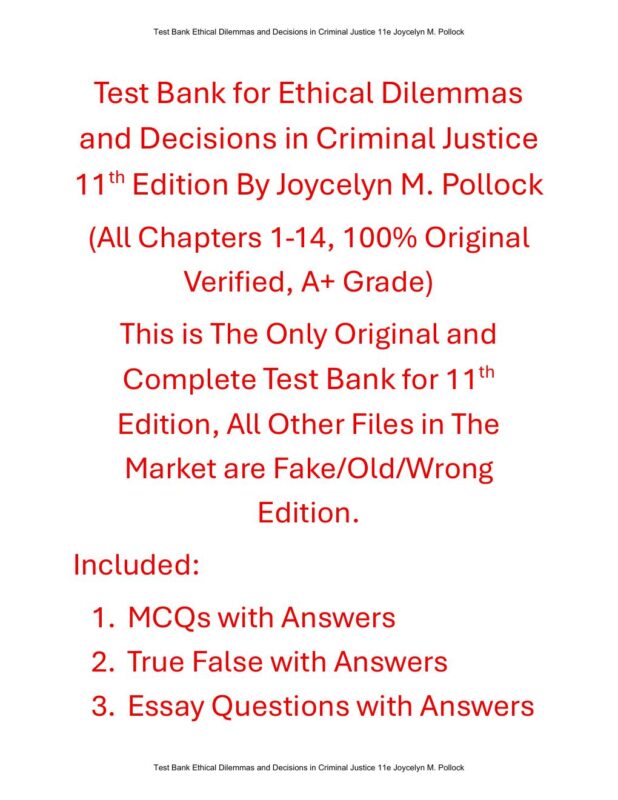
Test Bank For Ethical Dilemmas and Decisions in Criminal Justice 11th Edition By Joycelyn M. Pollock
$30.00
Secure checkout
Instant digital download
PDF document
Document details
- Pages
- 212
- File size
- 4.86 MB
- Format
- Digital PDF
- Course
- Criminal Justice
- Category
- TEST BANKS
Sign in or create a free account to continue. Your purchase will be saved in My Downloads.
About this ebook
The Test Bank For 11th edition of Ethical Dilemmas and Decisions in Criminal Justice by Joycelyn M. Pollock provides a comprehensive, structured examination of ethical decision-making across the main pillars of the justice system: policing, courts, and corrections. [1, 2]
The textbook is traditionally organized into five core parts, blending foundational philosophical theories with modern real-world events. [1, 2]
Part I: Ethics and the Criminal Justice System
- Defining Morality and Ethics: Explores the critical definitions of terms like morals, ethics, values, and duties within institutional structures. [1, 2, 3]
- Ethical Systems: Introduces major foundational philosophies such as Utilitarianism, Deontology (Kantian ethics), Virtue Ethics, Religion, and the Ethics of Care. [1, 2]
- Justice and Law: Analyzes principles of distributive and corrective justice, social justice, and the concept of "the rule of law."
- Moral Development: Examines psychological and biological theories regarding why individuals behave unethically and how moral reasoning develops.
Part II: Ethics and Policing
- The Police Role: Explores the ethical conflict between the crime control model vs. the due process model, along with police subculture.
- Police Discretion and Dilemmas: Investigates the limits of profiling, surveillance, deceptive tactics during interrogation, and situational discretion.
- Police Corruption and Misconduct: Details excessive use of force, systemic corruption, and accountability measures.
- Modern Update: This section heavily incorporates discussions on the Black Lives Matter movement, the defund police movement, and reforms tracking the George Floyd protests. [1, 3, 4, 5]
Part III: Ethics and the Courts
- Defense Attorneys: Examines the ethics of zealous advocacy, confidentiality, and defending clients known to be guilty.
- Prosecutors: Delves into prosecutorial discretion, plea bargaining, and misconduct (such as hiding exculpatory evidence or Brady violations).
- Judges: Addresses judicial discretion, sentencing disparities, and the politics of selecting judges. [1, 2, 3, 4, 5]
Part IV: Ethics and Corrections
- The Ethics of Punishment: Evaluates the moral justifications for sentencing (retribution, deterrence, incapacitation, and rehabilitation).
- Institutional Misconduct: Focuses on the misuse of power by correctional officers, prison subcultures, and inmate rights.
- Community Corrections: Explores ethical issues faced by probation and parole officers balancing surveillance against rehabilitation.
Part V: Ethical Choices in the 21st Century
- The War on Terror: Examines privacy rights, surveillance policies, and national security ethics.
- Contemporary Institutional Challenges: Discusses systemic corruption and the privatization of corrections.
- Modern Update: Analyzes governmental restrictions used to control the 2020 pandemic and the ethical/legal fallout of the January 2021 Capitol assault. [1, 2]
File included
tmpphpTEKAwI
4.86 MB
Related ebooks