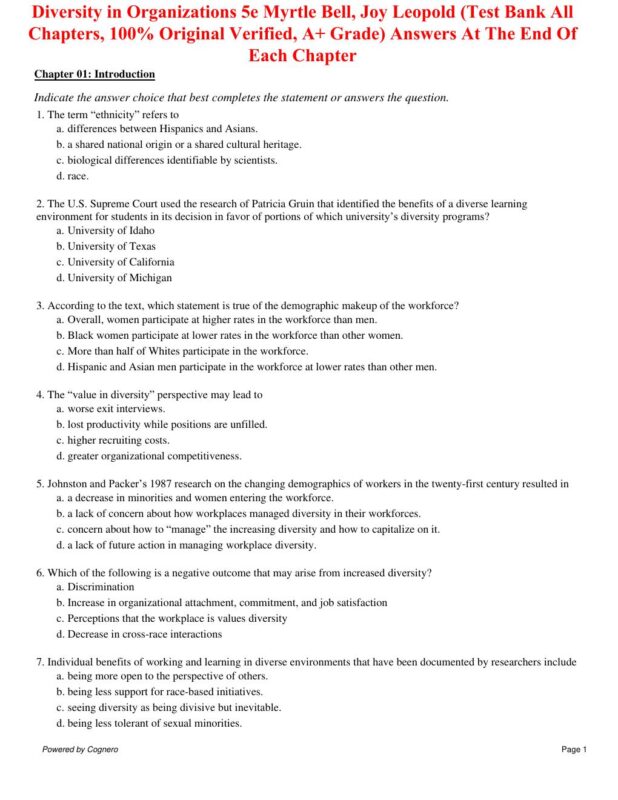
Test Bank for Diversity in Organizations 5th Edition By Myrtle Bell, Joy Leopold (All Chapters, 100% Original Verified, A+ Grade)
$25.00
Secure checkout
Instant digital download
PDF document
Document details
- Pages
- 115
- File size
- 1.72 MB
- Format
- Digital PDF
- Course
- Business
- Category
- TEST BANKS
Sign in or create a free account to continue. Your purchase will be saved in My Downloads.
About this ebook
The Test Bank for Diversity in Organizations, 5th Edition by Myrtle P. Bell and Joy Leopold is structured into two core parts across 15 chapters. It covers foundational theories, workplace legislation, and a comprehensive analysis of specific demographic groups. [1, 2]
Part I: Introduction, Theoretical Background, and Legislation
This section builds the conceptual framework required to understand diversity dynamics in professional settings. [1]
- Introduction to Diversity: Broad overview of what diversity means for applicants, employees, and customers.
- Theoretical Foundations: Theories explaining social identity, dominant vs. non-dominant group dynamics, and discrimination.
- Legislation: Up-to-date legal protections, equal employment opportunity laws, and recent legislative developments. [1, 2, 3]
Part II: Examining Specific Groups and Categories
This section provides data-driven insights into how various identity groups navigate workplace discrimination, inclusion, and representation. [1, 2]
- Blacks / African Americans: Research on systemic barriers, hiring biases, and career progression.
- Latinos / Hispanics / Latinx: Workplace dynamics, language policies, and labor market experiences.
- Asians / Asian Americans: The "model minority" myth, the glass ceiling, and stereotypes.
- Whites / Anglo Americans: Privilege, allyship, and the role of the dominant group in DEI initiatives.
- Native Americans and Multi-Racial Members: Unique historical challenges and shifting demographic identity trends.
- Sex and Gender: Pay gaps, structural bias, corporate leadership access, and occupational segregation.
- Work and Family: Balancing parental leave, caregiving responsibilities, and organizational flexibility.
- Sexual Orientation and Gender Identity: LGBTQ+ protections, microaggressions, and inclusive policy design.
- Religion: Accommodating religious dress, holidays, and faith-based practices.
- Age: Generational differences, ageism against older workers, and expectations of younger employees.
- Physical and Mental Ability: Accessibility, standard accommodations, and combating disability stigma.
- Weight and Appearance: Legal gaps and social stigmas surrounding size, weight, and beauty standards. [1, 2, 3]
File included
ScholarFriends.com-tb-ready-115.pdf
1.72 MB
Related ebooks