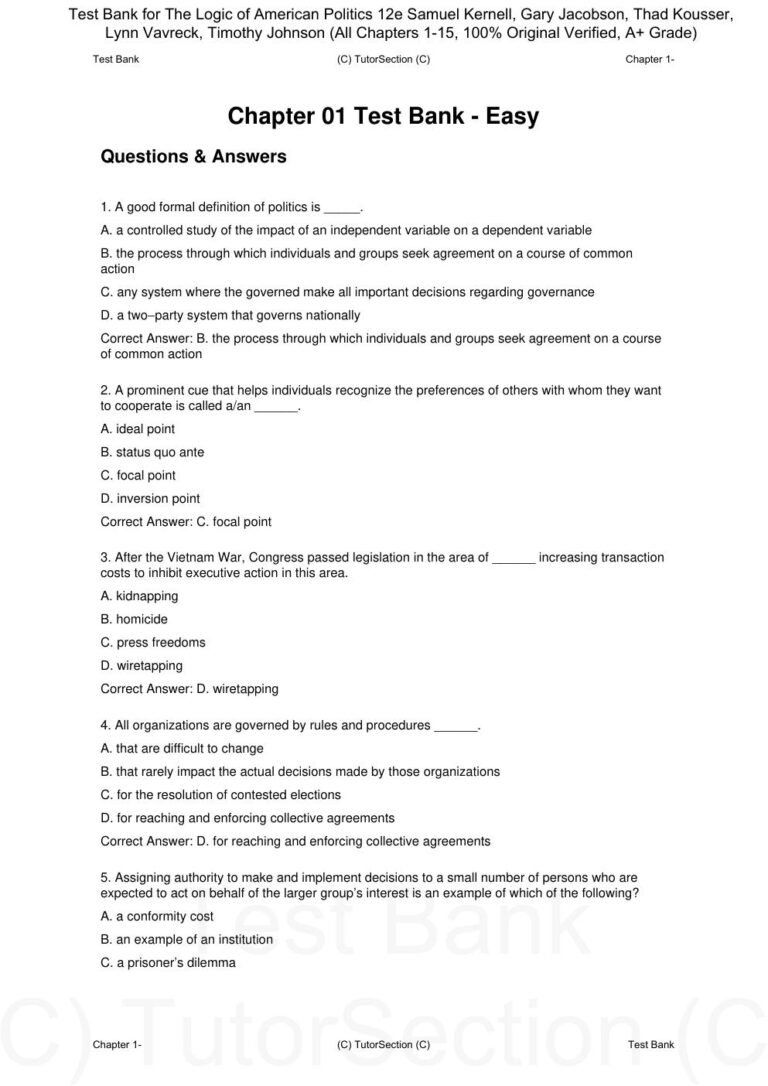
Test Bank for Development and Social Change A Global Perspective 8th Edition By Philip McMichael, Heloise Weber (All Chapters 1-10, 100% Original Verified)
$35.00
Secure checkout
Instant digital download
PDF document
Document details
- Pages
- 76
- File size
- 1.15 MB
- Format
- Digital PDF
- Course
- Social Sciences
- Category
- TEST BANKS
Sign in or create a free account to continue. Your purchase will be saved in My Downloads.
About this ebook
The Test Bank for Development and Social Change: A Global Perspective (8th Edition) by Philip McMichael and Heloise Weber explores how global development thinking and practice are shaped by socio-political, historical, and ecological forces. Rather than framing history as linear "progress," the text details how development is a highly contested political construct built on unequal power dynamics among states, elite groups, and corporations. [1, 2, 3, 4]
The core framework organizes global social change into four interconnected historical "projects," which structure all topics covered across the curriculum: [1]
1. The Colonial Project
- The Colonial Division of Labor: Tracing the foundations of global inequality back to European colonial expansion (15th to 20th centuries). [1]
- Resource Extraction: How non-European societies were systematically restructured to supply raw materials to Europe, creating long-term dependencies. [1, 2]
- Subjugation & Resistance: The destruction of indigenous political economies and early anti-colonial resistance movements. [1, 2]
2. The Development Project (The Development Era)
- Post-WWII Decolonization: The rise of the sovereign nation-state model across Asia, Africa, and Latin America.
- National Economic Growth: The introduction of national industrialization frameworks like Import-Substitution Industrialization (ISI).
- The Bretton Woods System: The institutional roles established by the World Bank and International Monetary Fund (IMF).
- The Food Aid Regime: How agricultural aid from the Global North influenced geopolitics and reordered the international division of labor. [1]
3. The Neoliberal Globalization Project
- The Debt Crisis & Structural Adjustment: The transition away from the "Development Era" in the 1980s via enforced economic reforms.
- Market-Led Displacements: Transnational restructuring, deregulation, and the privatization of public goods managed by economic coalitions.
- Global North-South Inequalities: The widening wealth gaps within regions, including the rising economic clout of the BRICS nations. [1, 2, 3]
4. The Sustainable Development Project & Social Counter-Movements
- Ecological Limits of Growth: Planet-threatening environmental outcomes, resource depletion, climate crises, and food/energy instability. [1, 2]
- Global Counter-Movements: Transnational organizing and social movements fighting for indigenous rights, equity, and environmental justice. [1, 2]
- Alternative Philosophies: Exploration of non-evolutionary paradigms such as "de-growth", food sovereignty, and localized ecological cycles. [1, 2]
File included
tmpphp2adngu
1.15 MB
Related ebooks