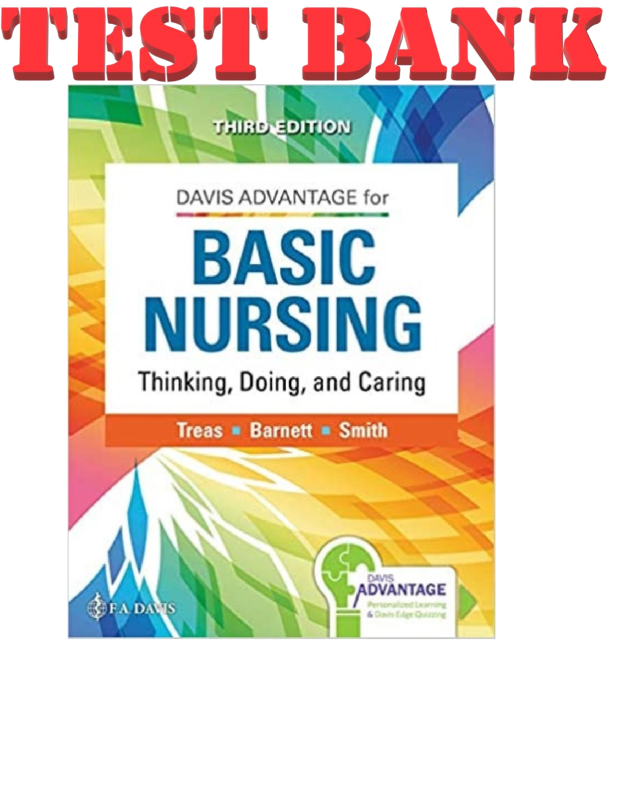
TEST BANK for Davis Advantage for Basic Nursing Thinking, Doing, and Caring, 3rd Edition By Leslie Treas, Karen Barnett, Mable Smith
$27.00
Secure checkout
Instant digital download
PDF document
Document details
- Pages
- 386
- File size
- 1.24 MB
- Format
- Digital PDF
- Course
- NURSING
- Category
- TEST BANKS
Sign in or create a free account to continue. Your purchase will be saved in My Downloads.
About this ebook
The TEST BANK for Davis Advantage for Basic Nursing: Thinking, Doing, and Caring (3rd Edition) by Leslie Treas, Karen Barnett, and Mable Smith covers foundational nursing concepts, clinical judgment, and core practical skills. [1]
The curriculum spans 41 chapters mapped to five major structural units. It is systematically updated to align with the NCSBN Clinical Judgment Measurement Model (CJMM). [1, 2, 3, 4]
Unit 1: How Nurses Think
- Evolution of Nursing Thought & Action: Historical context and definition of modern nursing.
- Clinical Judgment: Critical thinking models and clinical reasoning pathways.
- The Steps of the Nursing Process: Combined chapter covering assessment, diagnosis, planning, implementation, and evaluation.
- Evidence-Based Practice: Theory & Research: Utilizing research to support best patient outcomes. [1, 2, 3, 4, 5]
Unit 2: Factors Affecting Health
Examines human growth, psychosocial variables, and environmental factors impacting patient wellness. [1, 2]
- Life Span Development: Infancy through middle adulthood and older adults.
- Experiencing Health & Illness: Dynamics of personal health perceptions and illness behaviors.
- Stress & Adaptation: Physiological and psychological responses to coping mechanisms.
- Psychosocial Health & Illness: Mental wellbeing, self-concept, and psychiatric considerations.
- Family Health: Understanding structural family dynamics in care.
- Caring in Multicultural Healthcare Environments: Cultural competence and diverse populations.
- Spirituality: Addressing spiritual needs and religious considerations in healing.
- Experiencing Loss: Grief, dying, and end-of-life care management. [1, 2, 3, 4, 5]
Unit 3: Essential Nursing Interventions
Details fundamental interactive and protective actions required across clinical environments. [1]
- Promoting Health: Preventative healthcare strategies and lifestyle guidance.
- Communication & Therapeutic Relationships: Professional patient interaction and teamwork.
- Patient Education: Teaching methodologies and learning assessment techniques.
- Documenting & Reporting: Electronic health records, legal charting, and interprofessional clinical summaries.
- Measuring & Interpreting Vital Signs: Standards for monitoring temperature, pulse, respirations, and blood pressure.
- Physical Assessment: System-by-system physical examination skills.
- Promoting Asepsis & Preventing Infection: Sterile techniques, hand hygiene, and isolation protocols.
- Safety: Fall prevention, environmental controls, and error reduction.
- Facilitating Hygiene: Skin care, bathing protocols, and basic grooming assistance.
- Medication Safety & Administration: Core math formulas, safe distribution routes, and pharmacological guidelines. [1, 2, 3, 4, 5]
Unit 4: Supporting Physiological Health
- Nutrition: Dietary analysis, tube feeding, and metabolic support.
- Urinary & Bowel Elimination: Catheterization, ostomy care, and incontinence management.
- Sensation, Perception, & Response: Managing neurological and sensory deficits.
- Pain: Assessment tools, pharmacological, and non-pharmacological comfort metrics.
- Physical Activity & Immobility: Mechanics of body movement, positioning, and bedrest complications.
- Sexual Health: Taking histories and addressing intimacy challenges during illness.
- Sleep & Rest: Circadian rhythm management and clinical sleep interventions.
- Skin Integrity & Wound Healing: Pressure injury tracking, staging, and dressing management.
- Oxygenation: Airway clearance and therapeutic oxygen systems.
- Circulation & Perfusion: Cardiovascular support and peripheral vascular evaluation.
- Hydration & Homeostasis: Fluid balance tracking, lab diagnostics, and IV therapy.
- Caring for the Perioperative Patient: Pre-op checks, intra-op safety, and post-op recovery steps. [1, 2]
Unit 5: The Context for Nurses' Work
- Community & Home Health Nursing: Care models outside traditional hospitals.
- Nursing Informatics: Healthcare technologies and data tracking parameters.
- Legal Accountability: Licensure standards, malpractice issues, and statutory duties.
- Leading & Managing: Prioritization, delegation, and workflow oversight.
- Ethics & Values: Bioethics principles, professional codes, and resolving ethical dilemmas. [1, 2]
File included
TEST-BANK-for-Davis-Advantage-for-Basic-Nursing-Thinking-Doing-and-Caring-3rd-Edition-By-Leslie-Treas-Karen-Barnett-Mable-Smith.pdf
1.24 MB
Related ebooks