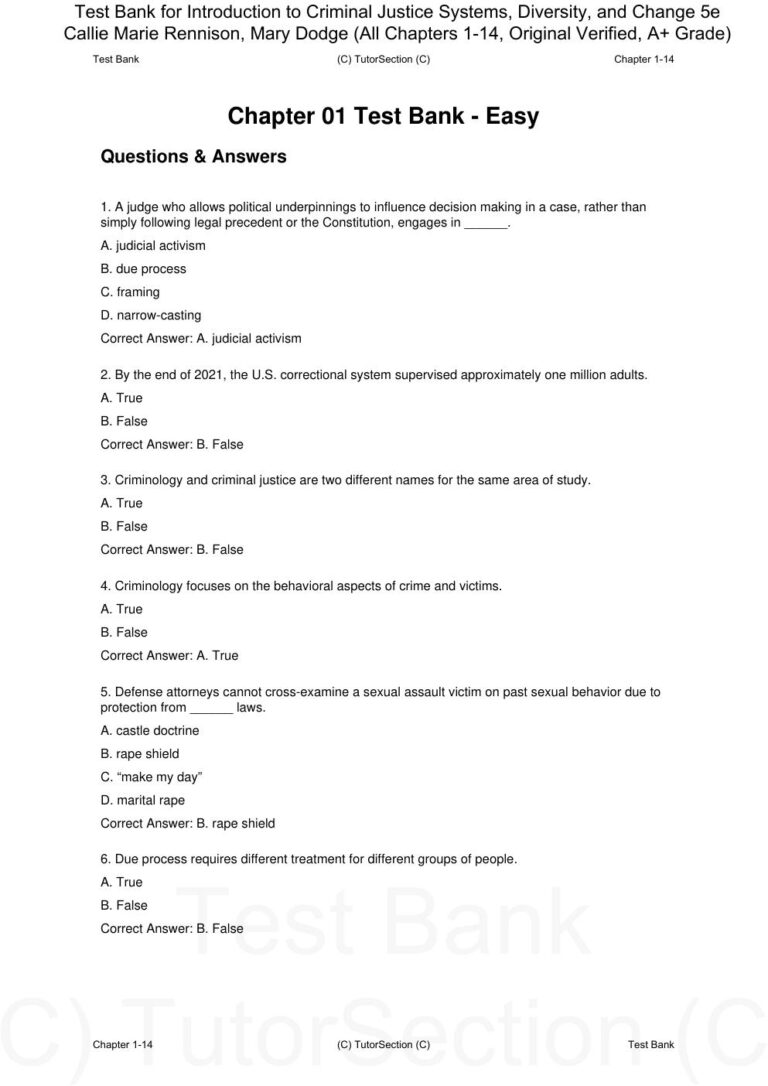

Test Bank for Criminology Today An Integrative Introduction 11th Edition By Frank Schmalleger
$30.00
Secure checkout
Instant digital download
PDF document
Document details
- Pages
- 288
- File size
- 2.69 MB
- Format
- Digital PDF
- Course
- Criminology
- Category
- TEST BANKS
Sign in or create a free account to continue. Your purchase will be saved in My Downloads.
About this ebook
Test Bank for Criminology Today: An Integrative Introduction (11th Edition) by Frank Schmalleger organizes the study of crime into a clear, four-part structure framework. The textbook frames its material around the core debate of social problems versus individual responsibility, utilizing up-to-date real-world developments like fentanyl, carjacking, and the Cybersecurity and Infrastructure Security Agency (CISA) Act. [1]
Below is the complete breakdown of the chapters and topics covered in the 11th Edition published by Pearson:
Part 1: Crime and Criminology
- What Is Criminology? Understanding crimes and the people who commit them, introducing basic concepts and data collection.
- Where Do Theories Come From? Transitioning from ideas to empirical evidence, detailing research methods, and evaluating criminal justice policy formulation. [1, 2, 3]
Part 2: Crime Causation
- Early Theories of Crime: Historical perspectives on criminality, showcasing classical and neoclassical schools of thought, rational choice, and deterrence. [1, 2]
- Biosocial Theories, Body Chemistry, and Neurocriminology: How biological factors, genetics, and brain chemistry interact with environment to trigger behaviors. [1]
- Psychological and Psychiatric Foundations of Criminal Behavior: Evaluating individual thought patterns, personality disorders, behavioral conditioning, and cognitive theories. [1]
Part 3: Crime Causation Revisited
- Social Structure Theories: Analyzing how neighborhood dynamics, poverty, subcultures, and institutional strain influence crime rates. [1, 2]
- Theories of Social Process and Social Development: Focuses on learned behaviors, peer relationships, social control, and life-course criminality. [1]
- Social Conflict and Emergent Theories: Examines power imbalances, social inequalities, and contemporary perspectives like feminist criminology. [1]
Part 4: The Crime Picture
- Criminal Victimization: Investigating the impact of crime on survivors, victimization patterns, and victim rights.
- Crimes Against Persons: Analysis of violent actions like homicide, assault, robbery, and modern trends in carjacking.
- Crimes Against Property: Evaluating burglary, theft, arson, and financial losses associated with property offenses.
- White-Collar and Organized Crime: Studying corporate fraud, environmental crimes, and illicit criminal syndicates.
- Drug and Sex Crimes: Reviewing recreational drug offenses, substance abuse policy (e.g., the fentanyl crisis), and public order sex offenses.
- High Technology Crime: Tackling digital vulnerabilities, malware, online theft, and the role of the CISA Act.
- Globalization and Terrorism: Exploring transnational crimes, human trafficking, and global terror organizations. [1, 2]
File included
tmpphpwRU7HW
2.69 MB
Related ebooks