Test Bank for Comparative Politics: Mapping Institutions, Power, and Legitimacy 1st Edition By Eric Langenbacher (All Chapters 1-11, 100% Original Verified)
$35.00
Secure checkout
Instant digital download
PDF document
Document details
- Pages
- 147
- File size
- 2.19 MB
- Format
- Digital PDF
- Course
- Political Science
- Category
- TEST BANKS
Sign in or create a free account to continue. Your purchase will be saved in My Downloads.
About this ebook
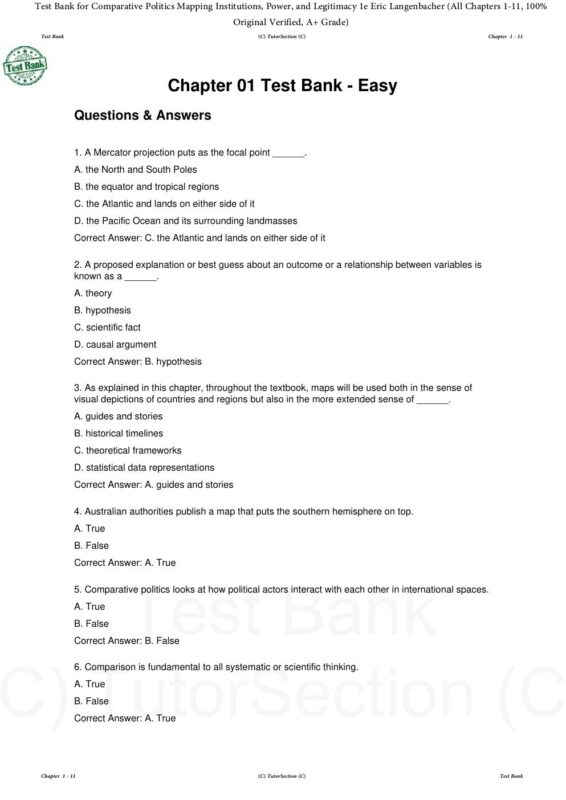
The Test Bank for Comparative Politics: Mapping Institutions, Power, and Legitimacy (1st Edition) by Eric Langenbacher (published by CQ Press / Sage Publishing) introduces the foundations of comparative politics through a unique framework centered on geographic mapping and data analysis. [1]
Rather than relying purely on text, the book utilizes world geography and data-based case studies to evaluate how political structures perform and how global relationships shift. The core thematic framework is built entirely around two foundational concepts: power and legitimacy, and how the structural choices made by institutions affect them. [1, 2]
Core Theoretical and Conceptual Topics
1. Introduction: Maps, Power, and Legitimacy
- The Comparative Method: Introducing foundational scientific and comparative methodologies used by political scientists to isolate variables and compare political behaviors across nations. [1, 2]
- Spatial Political Analysis: Utilizing maps, geographic realities, and data visualizations to reevaluate traditional national borders and international relationships. [1]
- Defining the Dynamics: Setting up the core analytical axis of the book: what constitutes political power, how authority transitions into legitimacy, and why these elements matter. [1, 2]
2. The State and Its Functions
- The Evolution of the State: Exploring the institutional definitions of the state, sovereignty, and internal versus external recognition.
- State Capacity and Failure: Evaluating why some states successfully maintain order, extract resources, and provide public goods, while others experience institutional decay or total state failure. [1, 2]
3. Modern Political Development
- Historical Pathways: Tracing the long-term historical processes, structural transformations, and critical junctures (such as industrialization and democratization) that shaped contemporary political landscapes.
- Institutions over Time: Utilizing historical institutionalism to analyze how early political choices constrain or guide modern government paths. [1]
4. The Nation and Identity Politics
- Nationalism and Identity: Deconstructing the concepts of nations, nationalism, and ethnic or cultural identities.
- Social Cleavages: Looking at how modern states navigate cultural, religious, and linguistic divisions, and how these forces influence the overall stability and legitimacy of a regime.
Institutional Frameworks and System Varieties
The latter portion of the text breaks down specific mechanisms of governance, tracking how institutional design determines political outcomes:
- Regime Types (Democracy vs. Authoritarianism): Addressing fundamental questions regarding why some countries cultivate democratic institutions while others transition to or maintain dictatorships, alongside how these choices affect citizen well-being.
- Constitutional Designs: Analyzing the foundational rules of the game—specifically comparing presidential, parliamentary, and semi-presidential executives.
- Electoral Systems and Parties: Mapping out how different voting mechanisms (e.g., proportional representation vs. plurality rules) shape party systems, determine voter turnout, and influence legislative representation.
- Government Formation: Exploring how coalitions form, how cabinets function, and what determines the lifespan and accountability of a sitting government. [1, 2]
File included
tmpphprZWfhV
2.19 MB
Related ebooks