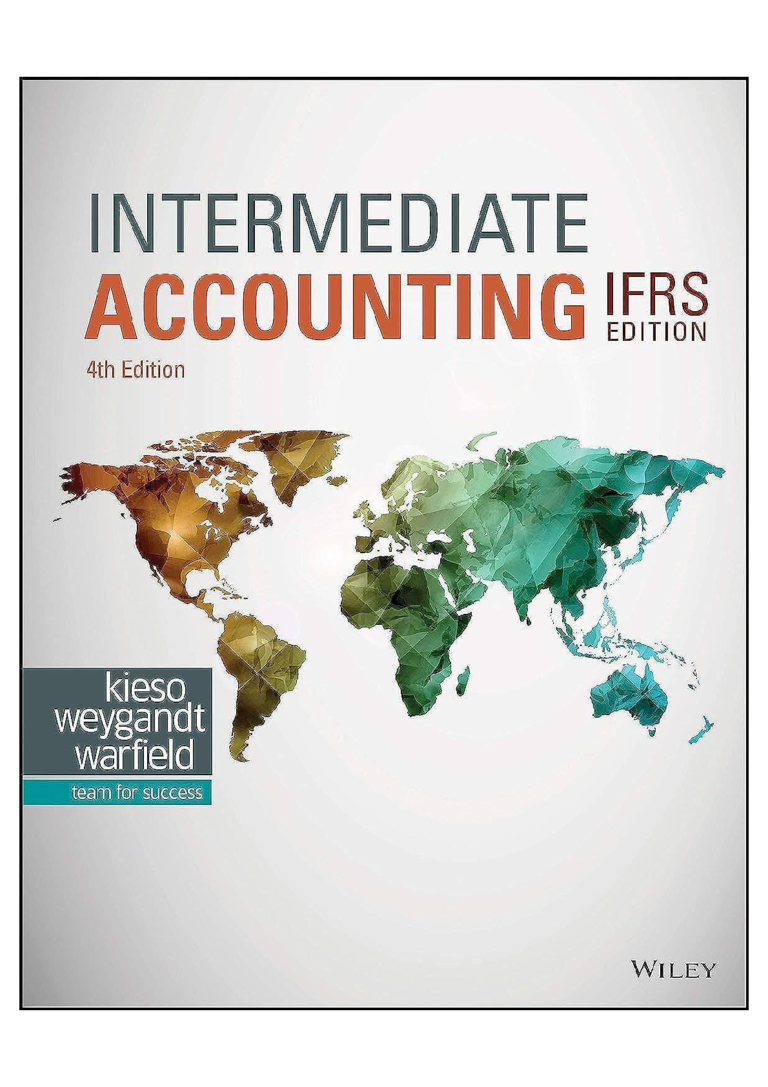

Solution Manual for Financial Accounting with International Financial Reporting Standards (IFRS), 4th Edition by Jerry J. Weygandt, Paul D. Kimmel, and Donald E. Kieso
$23.00
Secure checkout
Instant digital download
PDF document
Document details
- Pages
- 969
- File size
- 6.96 MB
- Format
- Digital PDF
- Course
- Accounting
- Category
- SOLUTIONS MANUAL
Sign in or create a free account to continue. Your purchase will be saved in My Downloads.
About this ebook
The Solution Manual for Financial Accounting with International Financial Reporting Standards (IFRS), 4th Edition by Jerry J. Weygandt, Paul D. Kimmel, and Donald E. Kieso covers 14 standard core chapters. It mirrors the main textbook's framework by providing step-by-step problem solutions, assignment classification tables, and grading rubrics for all end-of-chapter exercises. [1, 2, 3]
The complete list of topics covered in the solution manual includes:
Part 1: Foundations of Financial Accounting
- Chapter 1: Accounting in Action – Introduction to accounting principles under IFRS, the accounting equation, users of financial data, and basic financial statements. [1, 2, 3, 4]
- Chapter 2: The Recording Process – Understanding debits and credits, journalizing transactions, and posting to the ledger. [1]
- Chapter 3: Adjusting the Accounts – Accrual accounting principles, recognizing revenues and expenses, and preparing adjusting entries. [1]
- Chapter 4: Completing the Accounting Cycle – Using worksheets, closing entries, reversing entries, and preparing a classified statement of financial position. [1, 2]
Part 2: Accounting for Business Operations and Assets
- Chapter 5: Accounting for Merchandise Operations – Inventory systems (perpetual vs. periodic), recording purchases, sales, and multi-step income statements for retail businesses.
- Chapter 6: Inventories – Cost flow assumptions (FIFO, Average-Cost), lower-of-cost-or-net realizable value (LCNRV), and inventory errors.
- Chapter 7: Fraud, Internal Control, and Cash – Sarbanes-Oxley principles adjusted for international contexts, control features of a bank account, and reconciling cash.
- Chapter 8: Accounting for Receivables – Valuation of accounts receivable, uncollectible accounts (allowance method), and notes receivable.
- Chapter 9: Plant Assets, Natural Resources, and Intangible Assets – Revaluation of property, plant, and equipment (PPE), depreciation methods under IFRS, depletion, and amortization. [1, 2, 3]
Part 3: Liabilities and Equity
- Chapter 10: Current Liabilities – Accounting for notes payable, sales taxes, unearned revenues, and payroll.
- Chapter 11: Non-Current Liabilities – Bond issuances, pricing, amortizing bond discounts and premiums using the effective-interest method, and long-term notes payable.
- Chapter 12: Corporations: Organization, Share Transactions, and Equity – Corporate formation, issuing ordinary and preference shares, treasury shares, dividends, and retained earnings. [1, 2]
Part 4: Advanced Financial Analysis
File included
Solution-manual-for-Financial-Accounting-with-International-Financial-Reporting-Standards-4th-Edition-by-Jerry-J.-Weygandt.pdf
6.96 MB
Related ebooks