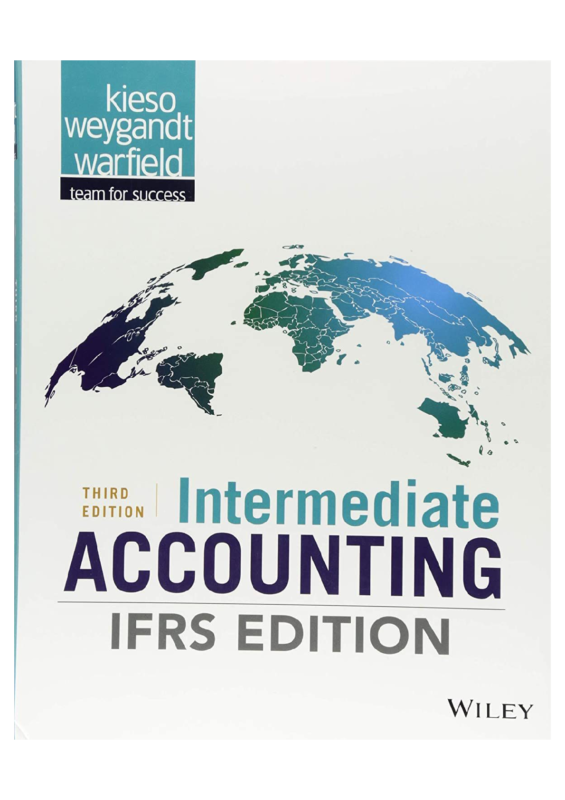
Solution manual for Intermediate Accounting, 3rd Edition, IFRS Edition by Donald E. Kieso, Jerry J. Weygandt, and Terry D. Warfield
$23.00
Secure checkout
Instant digital download
PDF document
Document details
- Pages
- 1,782
- File size
- 9.42 MB
- Format
- Digital PDF
- Course
- Accounting
- Category
- SOLUTIONS MANUAL
Sign in or create a free account to continue. Your purchase will be saved in My Downloads.
About this ebook
The solution manual for Intermediate Accounting, 3rd Edition, IFRS Edition by Donald E. Kieso, Jerry J. Weygandt, and Terry D. Warfield systematically covers all 24 chapters of the textbook. It provides step-by-step problem resolutions, case analyses, and conceptual guidance mapped directly to International Financial Reporting Standards (IFRS). [1, 2, 3, 4, 5]
Foundations of Financial Reporting
- Chapter 1: Financial Reporting and Accounting Standards (Global markets, standard-setting organizations like the IASB, and financial reporting challenges). [1, 2, 3]
- Chapter 2: Conceptual Framework for Financial Reporting (Objective of financial reporting, qualitative characteristics, and basic elements). [1, 2, 3]
- Chapter 3: The Accounting Information System (The accounting cycle, journal entries, ledgers, and adjusting/closing processes). [1, 2]
Financial Statements and Core Concepts
- Chapter 4: Income Statement and Related Information (Format, discontinued operations, non-controlling interests, and retained earnings statement). [1, 2, 3, 4]
- Chapter 5: Statement of Financial Position and Statement of Cash Flows (Classification of assets, liabilities, equity, and basic cash flow structures). [1, 2]
- Chapter 6: Accounting and the Time Value of Money (Simple/compound interest, present value, and future value concepts). [1]
Asset Valuation and Accounting
- Chapter 7: Cash and Receivables (Valuation of receivables, bad debts, and factoring).
- Chapter 8: Valuation of Inventories: A Cost-Basis Approach (Inventory systems, goods included, and FIFO/weighted-average costing).
- Chapter 9: Inventories: Additional Valuation Issues (Lower-of-cost-or-net-realizable-value, gross profit method, and retail inventory method).
- Chapter 10: Acquisition and Disposition of Property, Plant, and Equipment (Capitalization of costs, borrowing costs, and exchanges of assets).
- Chapter 11: Depreciation, Impairments, and Depletion (Methods of depreciation, component depreciation, and asset impairment tests).
- Chapter 12: Intangible Assets (Amortization, goodwill valuation, and Research & Development (R&D) accounting). [1, 2, 3, 4, 5]
Liabilities and Equity
- Chapter 13: Current Liabilities, Provisions, and Contingencies (Recognizing provisions, contingent liabilities, and short-term obligations).
- Chapter 14: Non-Current Liabilities (Bonds payable, notes payable, and extinguishment of debt).
- Chapter 15: Equity (Issuance of shares, treasury shares, preference share participating rights, and dividends). [1, 2]
Advanced Financial Topics
- Chapter 16: Dilutive Securities and Earnings per Share (Convertible debt, share warrants, basic EPS, and diluted EPS calculation).
- Chapter 17: Investments (Debt investments, equity investments, amortized cost, and fair value through OCI/Profit or Loss).
- Chapter 18: Revenue Recognition (The 5-step revenue model, contract modifications, and long-term construction contracts).
- Chapter 19: Accounting for Income Taxes (Deferred tax assets and liabilities, temporary vs. permanent differences).
- Chapter 20: Accounting for Pensions and Postretirement Benefits (Defined contribution vs. defined benefit plans and pension expense components).
- Chapter 21: Accounting for Leases (Lessee and lessor accounting criteria, right-of-use assets, and finance/operating leases). [1, 2, 3, 4, 5]
Presentation, Disclosures, and Analysis
- Chapter 22: Accounting Changes and Error Analysis (Changes in accounting policy, changes in estimates, and retrospective error correction).
- Chapter 23: Statement of Cash Flows (Direct vs. indirect methods and classification of operating, investing, and financing activities).
- Chapter 24: Presentation and Disclosure in Financial Reporting (Full disclosure principle, notes to financial statements, and segment reporting). [1, 2, 3, 4, 5]
File included
Solution-for-each-chapter-and-Solution-manual-for-Intermediate-Accounting-3rd-Edition-IFRS-Edition-Donald-E.-Kieso.pdf
9.42 MB
Related ebooks