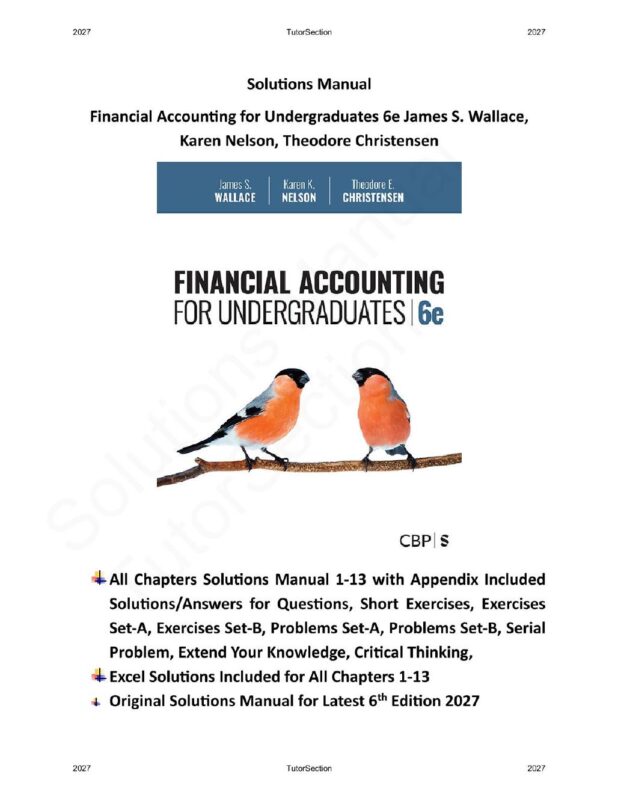
Solutions Manual for Financial Accounting for Undergraduates 6th Edition By James Wallace, Karen Nelson, Theodore Christensen
$65.00
Secure checkout
Instant digital download
PDF document
Document details
- Pages
- 737
- File size
- 11.66 MB
- Format
- Digital PDF
- Course
- Accounting
- Category
- SOLUTIONS MANUAL
Sign in or create a free account to continue. Your purchase will be saved in My Downloads.
About this ebook
The Solutions Manual for Financial Accounting for Undergraduates (6th Edition) by James S. Wallace, Karen Nelson, and Theodore Christensen provides step-by-step solutions for homework exercises, problems, and cases across all 13 chapters of the textbook. [1, 2]
The essential topics and chapters covered in this manual include: [1]
Core Concepts & The Accounting Cycle
- Chapter 1: Financial Accounting and Business Decisions – Introduction to business organizations, business activities (operating, investing, financing), the role of accounting information, and regulatory bodies like the FASB. [1, 2, 3]
- Chapter 2: Processing Accounting Information – The fundamental accounting equation (Assets = Liabilities + Equity), debits/credits, journal entries, T-accounts, and compiling an unadjusted trial balance. [1, 2]
- Chapter 3: Accrual Basis of Accounting – Explaining cash vs. accrual accounting, timing rules (revenue and expense recognition principles), adjusting entries (deferrals and accruals), and the closing process. [1, 2]
- Chapter 4: Understanding Financial Statements – Deep dive into classifications within the primary financial reports (Balance Sheet, Income Statement, Statement of Stockholders' Equity). [1, 2]
Operating Assets & Internal Controls
- Chapter 5: Accounting for Merchandising Operations – Recording sales and purchases of merchandise, tracking shipping costs, discounts, returns, and gross profit structures.
- Chapter 6: Accounting for Inventory – Cost-flow assumptions including FIFO, LIFO, and weighted average methods alongside the lower-of-cost-or-market rule.
- Chapter 7: Internal Control and Cash – Fraud prevention frameworks, Sarbanes-Oxley compliance, cash controls, and completing bank reconciliations.
- Chapter 8: Accounting for Receivables – Valuing accounts receivable, projecting and estimating bad debts using allowance methods, and accounting for notes receivable. [1, 2, 3]
Long-Term Elements, Financing, & Analysis
- Chapter 9: Accounting for Long-Lived and Intangible Assets – Acquisition, depreciation methods (straight-line, double-declining balance), asset disposals, and evaluating intangible assets.
- Chapter 10: Accounting for Liabilities – Current liabilities, payroll taxes, notes payable, and accounting for long-term financing bonds.
- Chapter 11: Stockholders' Equity – Issuing common and preferred stock, accounting for cash and stock dividends, treasury stock transactions, and retained earnings.
- Chapter 12: Statement of Cash Flows – Preparing the cash flow statement using the direct or indirect methods across operating, investing, and financing divisions.
- Chapter 13: Analysis and Interpretation of Financial Statements – Utilizing horizontal analysis, vertical analysis, and foundational financial ratios (liquidity, solvency, and profitability) to judge company health. [1, 2, 3, 4, 5]
File included
ScholarFriends.com-sm-ready-w-link.pdf
11.66 MB
Related ebooks