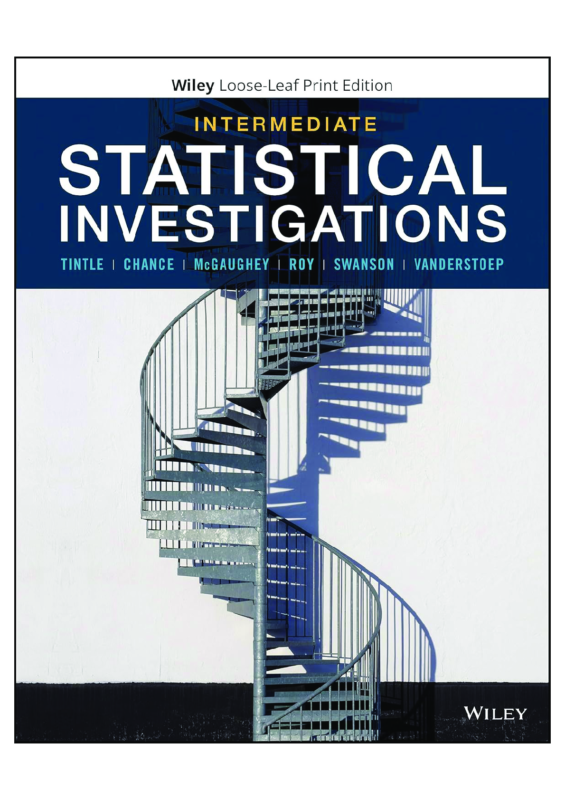
solutions manual for Intermediate Statistical Investigations 1st Edition by Nathan Tintle, Beth L. Chance, Karen
$23.00
Secure checkout
Instant digital download
PDF document
Document details
- Pages
- 86
- File size
- 5.6 MB
- Format
- Digital PDF
- Course
- Basic Statistics
- Category
- SOLUTIONS MANUAL
Sign in or create a free account to continue. Your purchase will be saved in My Downloads.
About this ebook
The core topics covered in the solutions manual and textbook for Intermediate Statistical Investigations (1st Edition) by Nathan Tintle, Beth L. Chance, Karen McGaughey, and colleagues revolve around multivariable thinking and explaining variation. [1, 2, 3]
The curriculum expands on introductory statistics by providing a cohesive framework to simultaneously analyze multiple explanatory variables against a response variable using simulation-based inference. [1, 2, 3]
Core Structural Framework
Every chapter in the solutions manual maps back to a consistent six-step statistical investigation method: [1]
- Ask a research question.
- Design a study.
- Explore the data.
- Draw inferences.
- Formulate conclusions.
- Look back and ahead. [1]
Chapter-by-Chapter Topics Covered (Chapters 1–6)
The official solutions manual and companion test banks systematically break down the following concepts: [1, 2, 3]
- Preliminaries: Review of first-course concepts, data visualization basics, and an introduction to multivariable thinking to explain variation. [1, 2, 3]
- Chapter 1: Sources of Variation
- Identifying and diagramming sources of variation in an experiment.
- Comparing multiple group means using overall F-tests.
- Theory-based and simulation-based analysis of variance (ANOVA) framework.
- Post-hoc analysis (pairwise differences, confidence intervals, and prediction intervals).
- Statistical power and how it changes with group size, sample size, and variability. [1, 2, 3]
- Chapter 2: Controlling Additional Sources of Variation
- Chapter 3: Explaining Variation with Quantitative Explanatory Variables
- Simple linear regression and evaluating line of best fit.
- Multiple linear regression models incorporating several quantitative variables.
- Interpreting regression coefficients in a multivariable context.
- Chapter 4: Explaining Variation with Categorical and Quantitative Variables
- Constructing parallel line models.
- Adjusting for confounding variables using Analysis of Covariance (ANCOVA) concepts.
- Testing for interaction effects (non-parallel lines) between variable types.
- Chapter 5: Explaining Variation in a Categorical Response Variable
- Transitioning from quantitative to categorical outcomes.
- Introduction to logistic regression models.
- Calculating and interpreting odds, odds ratios, and probabilities.
- Chapter 6: Comprehensive Multivariable Case Studies & Research
- Evaluating published research articles and critical reading skills.
- Applying complex, multi-variable analytical strategies to real-world datasets.
- Utilizing the custom Rossman Chance Web Applets for modern, simulation-based verification. [1, 2, 3]
File included
Solution-for-each-chapter-and-Solution-manual-for-Intermediate-Statistical-Investigations-1e-Tintle.pdf
5.6 MB
Related ebooks