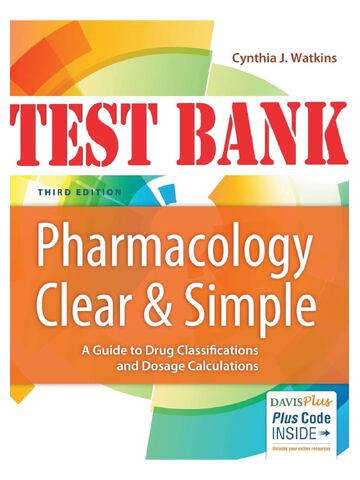
TEST BANK for Pharmacology Clear and Simple: A Guide to Drug Classifications and Dosage Calculations 3rd Edition by Cynthia J. Watkins
$22.00
Secure checkout
Instant digital download
PDF document
Document details
- Pages
- 373
- File size
- 5.62 MB
- Format
- Digital PDF
- Course
- Pharmacology
- Category
- TEST BANKS
Sign in or create a free account to continue. Your purchase will be saved in My Downloads.
About this ebook
TEST BANK for Pharmacology Clear and Simple: A Guide to Drug Classifications and Dosage Calculations" (3rd Edition) by Cynthia J. Watkins breaks down its 21 chapters into three major learning modules: pharmacology foundations, math and clinical calculations, and body systems-based drug classifications. [1, 2, 3, 4]
Part I: Foundations of Pharmacology
This initial section introduces core pharmacology terminology, safety concepts, legal regulations, and clinical workflows: [1, 2]
- Chapter 1: History of Pharmacology – Evolution of medication development and historical context.
- Chapter 2: Basics of Pharmacology – Pharmacokinetics (absorption, distribution, metabolism, excretion) and pharmacodynamics.
- Chapter 3: Patient Safety in Medication Administration – Prevention of medication errors and safety protocols.
- Chapter 4: Regulations – Legal standards, FDA rules, and drug scheduling laws.
- Chapter 5: Prescriptions and Labels – Reading, interpreting, and transcribing medical orders accurately. [1, 2, 3]
Part II: Mathematics and Dosage Calculations
This functional worktext section provides a step-by-step math refresher and formulas to compute drug administration safely: [1, 2]
- Chapter 6: Review of Mathematics – Intensive refresher on fractions, decimals, percentages, and ratios.
- Chapter 7: Measurement Systems – Converting between Metric, Apothecary, and Household systems.
- Chapter 8: Dosage Calculations – Formulas and dimensional analysis for oral, topical, and basic liquid doses.
- Chapter 9: Enteral Medications and Administration – Preparation and techniques for oral, sublingual, and rectal administration.
- Chapter 10: Parenteral Medications and Administration – Equipment, safety, and calculations for injections (IM, SQ, ID) and basic IV infusions. [1, 2, 3, 4]
Part III: Drug Classifications by Body System
The final and largest section uses a body systems approach to group drug classes, mechanisms of action, side effects, and precautions: [1, 2]
- Chapter 11: Integumentary System Medications – Skin treatments, topical agents, and burn care drugs.
- Chapter 12: Musculoskeletal System Medications – Drugs for arthritis, muscle spasms, and osteoporosis.
- Chapter 13: Nervous System Medications – Analgesics, anesthetics, sedatives, and psychotropic drugs.
- Chapter 14: Eye and Ear Medications – Ophthalmic and otic drops for infections, glaucoma, and inflammation.
- Chapter 15: Endocrine System Medications – Hormones, diabetes therapies, and thyroid medications.
- Chapter 16: Cardiovascular System Medications – Antihypertensives, antiarrhythmics, statins, and anticoagulants.
- Chapter 17: Immunological System Medications – Vaccines, immunosuppressants, and anti-infectives (antibiotics, antivirals).
- Chapter 18: Pulmonary System Medications – Bronchodilators, steroids, and respiratory allergy treatments.
- Chapter 19: Gastrointestinal System Medications – Antacids, PPIs, antiemetics, laxatives, and antidiarrheals.
- Chapter 20: Reproductive and Urinary System Medications – Diuretics, contraceptives, and fertility medications.
- Chapter 21: Vitamins, Minerals, Herbs, and Complementary/Alternative Medicine – Dietary supplements and holistic therapies. [1, 2, 3]
File included
TEST-BANK-for-Pharmacology-Clear-and-Simple-A-Guide-to-Drug-Classifications-and-Dosage-Calculations-3rd-Edition-by-Cynthia-J.-Watkins.pdf
5.62 MB
Related ebooks