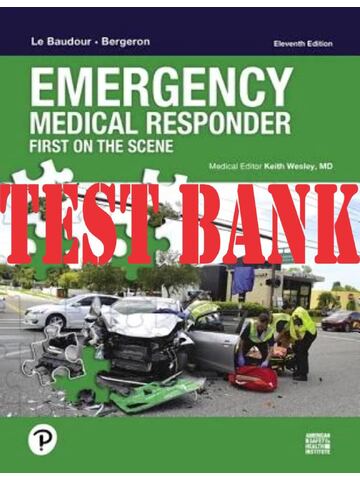
TEST BANK for Emergency Medical Responder: First on Scene 11th Edition by Chris, David and Keith
$19.00
Secure checkout
Instant digital download
PDF document
Document details
- Pages
- 176
- File size
- 991.75 KB
- Format
- Digital PDF
- Course
- Medical Studies
- Category
- TEST BANKS
Sign in or create a free account to continue. Your purchase will be saved in My Downloads.
About this ebook
TEST BANK for Emergency Medical Responder: First on Scene (11th Edition) by Chris Le Baudour, J. David Bergeron, and Dr. Keith Wesley is structured into 27 core chapters. The textbook covers everything from foundational EMS operations to specialized patient care, strictly aligned with the National EMS Education Standards. [1, 2, 3, 4]
Foundational Principles & Operations
- Introduction to EMS Systems: History, roles, and responsibilities of the EMR.
- Legal and Ethical Principles: Patient consent, refusal of care, confidentiality, and scope of practice.
- Wellness and Safety: Personal protection, stress management, bloodborne pathogens, and scene safety.
- Medical Terminology & Anatomy: Understanding human body systems and lifespan development phases.
- Introduction to Pathophysiology: How illness and injury disrupt normal body functions.
- Lifting and Moving Patients: Proper body mechanics and emergency/non-emergency moves.
- Effective Communication: Relaying information to dispatchers, team members, and hospital staff.
- Effective Documentation: Completing precise paper and electronic patient care reports. [1, 2, 3, 4, 5]
Airway, Resuscitation, & Assessment
- Airway Management: Techniques for opening, clearing, and maintaining a patent airway.
- Principles of Oxygen Therapy: Operating oxygen cylinders, regulators, and delivery devices.
- Principles of Resuscitation: Cardiopulmonary resuscitation (CPR) and automated external defibrillator (AED) usage.
- History and Vital Signs: Techniques for gathering patient history and measuring vital statistics.
- Patient Assessment: Performing systematic primary and secondary physical exams. [1, 2, 3, 4, 5]
Medical & Environmental Emergencies
- Caring for Cardiac Emergencies: Recognizing chest pain, heart attacks, and cardiac distress.
- Caring for Respiratory Emergencies: Treating asthma, respiratory failure, and breathing issues.
- Common Medical Emergencies: Managing seizures, altered mental status, diabetes, stroke, and poisoning.
- Environmental Emergencies: Addressing heat illness, hypothermia, bites, stings, and drowning. [1, 2, 3, 4]
Trauma Care & Wound Management
- Soft-Tissue Injuries & Bleeding: Controlling external bleeding, dressing wounds, and treating burns.
- Recognition and Care of Shock: Identifying and treating various forms of circulatory shock.
- Muscle and Bone Injuries: Splinting, stabilizing fractures, and managing dislocations.
- Head and Spinal Injuries: Managing traumatic brain injuries and neck/spine stabilization.
- Chest and Abdominal Emergencies: Treating open and closed torso wounds. [1, 2]
Special Patient Populations & EMS Operations
- Pregnancy and Childbirth: Assisting with emergency delivery and neonatal care.
- Infants and Children: Anatomical differences and pediatric assessment strategies.
- Geriatric Patients: Unique medical and communication needs of older adults.
- Special Needs & Hospice: Managing chronically ill, physically disabled, or end-of-life patients.
- EMS Operations: Incident management, triage, vehicle rescue, and hazardous materials safety. [1, 2, 3, 4]
File included
Emergency-Medical-Responder-First-on-Scene-11th-Edition-by-Chris-David-Keith-TEST-BANK.pdf
991.75 KB
Related ebooks