
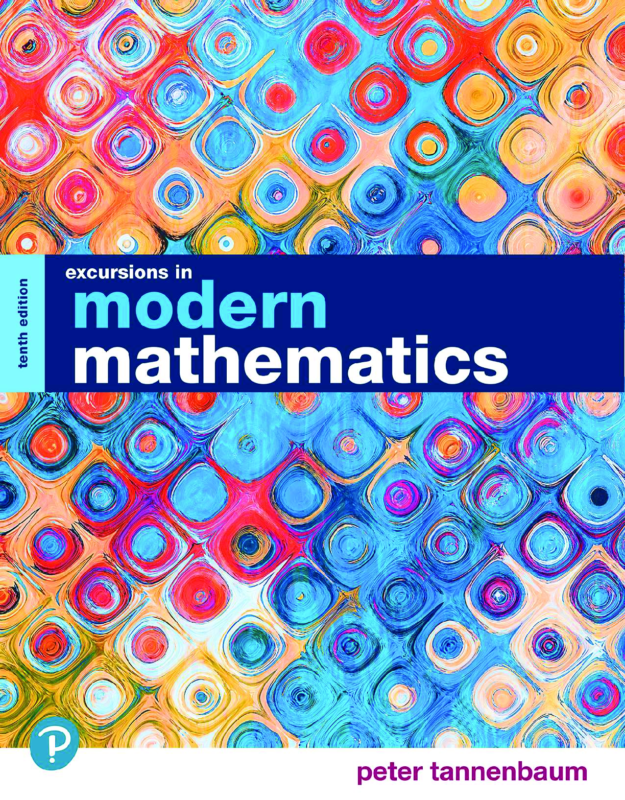
Excursions in Modern Mathematics 10th Edition By Peter Tannenbaum
$30.00
Secure checkout
Instant digital download
PDF document
Document details
- Pages
- 596
- File size
- 35.21 MB
- Format
- Digital PDF
- Course
- Education
- Category
- eBook[PDF]
Sign in or create a free account to continue. Your purchase will be saved in My Downloads.
About this ebook
The Excursions in Modern Mathematics (10th Edition) by Peter Tannenbaum is organized into 17 chapters across 5 distinct thematic parts, which cover accessible, real-world applications of math for liberal arts students. [1, 2]
Part I: The Mathematics of Social Choice
- The Mathematics of Voting: Explores the paradoxes of democracy, preference ballots, preference schedules, the plurality method, the Borda count method, instant runoff voting (plurality-with-elimination), and pairwise comparisons. [1, 2]
- Weighted Voting Systems: Covers power dynamics in voting, coalitions, and calculating voting power using indices like the Banzhaf or Shapley-Shubik power indexes. [1, 2]
- Fair Division: Analyzes the mathematics of sharing assets, inheritance, or estate division using continuous and discrete fair-division methods. [1, 2]
- The Mathematics of Apportionment: Investigates how legislative seats or resources are distributed fairly using methods like Hamilton, Jefferson, Webster, and the Huntington-Hill rules. [1, 2]
Part II: Management Science
- Euler Circuits: Covers graph theory optimization applied to routing problems like garbage collection, postal routes, and urban navigation.
- The Traveling-Salesman Problem: Discusses Hamilton circuits and paths used to optimize complex logistics, touring, and travel itineraries.
- The Mathematics of Networks: Focuses on the minimum cost of connecting nodes using trees, networks, and Kruskal’s algorithm.
- Scheduling: Evaluates how to sequence complex projects using architectural networks, critical paths, and the priority-list algorithm. [1, 2, 3, 4]
Part III: Growth & Financial Mathematics
- Population Growth Models: Compares different models of change including linear, exponential, and logistic growth dynamics.
- Financial Mathematics: Delves into percentages, simple interest, compound interest, managing retirement savings, and understanding consumer debt. [1, 2, 3]
Part IV: Shape and Form
- The Mathematics of Symmetry: Discusses rigid motions, geometric reflections, rotations, translations, glide reflections, and symmetry patterns.
- Fractal Geometry: Explores the structures of nature using self-similarity, the Koch Snowflake, the Sierpinski Gasket, and the Mandelbrot Set.
- Fibonacci Numbers and the Golden Ratio: Studies the recursive relationships of Fibonacci numbers, gnomons, and spiral growth formations in the natural world. [1]
Part V: Statistics
- Data Collection: Investigates censuses, population sampling methods, clinical studies, and the mechanics of modern opinion polling.
- Descriptive Statistics: Teaches data organization through graphs, charts, and numeric measurements like the mean, median, and standard deviation.
- Probability: Covers basic probability concepts, calculation of odds, and expected values.
- Normal Distributions: Explores the properties of normal curves, standard scores (z-scores), and the central limit theorem. [1, 2, 3, 4]
File included
eBook-PDF-Excursions-in-Modern-Mathematics-10th-Edition-By-Peter-Tannenbaum.pdf
35.21 MB
Related ebooks