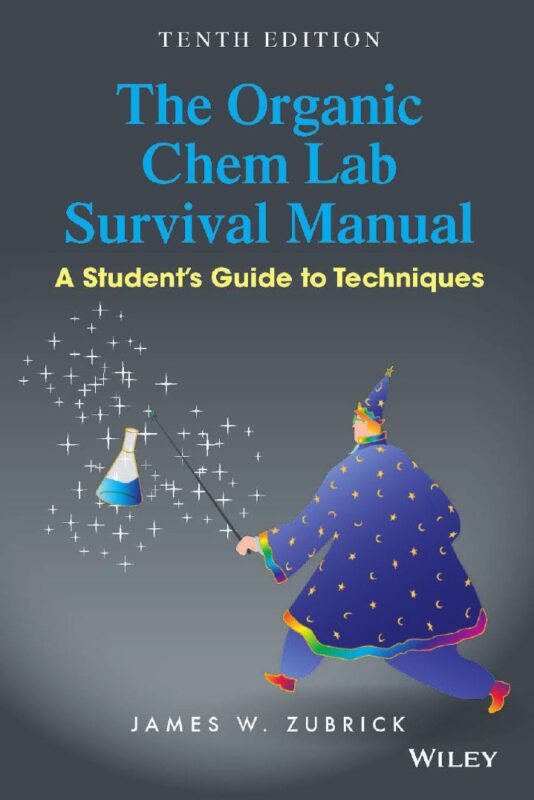
The Organic Chem Lab Survival Manual A Students Guide to Techniques 10th Edition By James W. Zubrick
$30.00
Secure checkout
Instant digital download
PDF document
Document details
- Pages
- 315
- File size
- 3.96 MB
- Format
- Digital PDF
- Course
- Education
- Category
- eBook[PDF]
Sign in or create a free account to continue. Your purchase will be saved in My Downloads.
About this ebook
The Organic Chem Lab Survival Manual: A Student's Guide to Techniques (10th Edition) by James W. Zubrick covers essential laboratory safety, basic equipment operations, purification methods, and key analytical instrumentation required for undergraduate organic chemistry courses.
 Amazon.com +1
The textbook primarily focuses on macroscale techniques, while also integrating corresponding microscale procedures. The core topics covered in this edition include:
 John Wiley +1
1. Lab Foundations & Documentation
-
- Safety Protocols: Fundamental rules for working safely in a chemical laboratory environment.
- Keeping a Notebook: Instruction on recording experiments, featuring "gold and silver standards" for student research notebook pages.
- Interpreting Handbooks & Digital Data: Transitioning from printed reference handbooks to sourcing chemical property data using smartphones and the internet.
-
2. Glassware & Basic Setup
-
- Standard Jointware & Microscale Jointware: Setup, identification, care, and troubleshooting for basic lab apparatus.
- Pipet Tips & Syringes: Proper handling of liquid reagents using syringes, needles, and septa.
- Cleaning, Drying, and Drying Agents: Removing water from glassware and utilizing chemical drying agents on product solutions.
- Clamping: Tips for securing multi-piece glassware configurations safely.
- Sources of Heat: Safe operation of bunsen burners, hot plates, and heating mantles.
Future4200 +4
-
3. Separation & Purification Techniques
-
- Melting Point Determination: Utilizing traditional equipment as well as modern digital units like the SRS DigiMelt.
- Recrystallization: Finding a good crystallization solvent and performing macroscale and microscale purification.
- Extraction and Washing: Liquid-liquid extraction methods alongside integrated extraction theory.
- Distillation: Macroscale and microscale setups covering simple, fractional, vacuum, and steam distillation, supported by distillation theory (e.g., Raoult’s Law, azeotropes).
- Reflux and Addition: Setting up reaction assemblies for heating mixtures under reflux.
- Sublimation & Boiling Points: Identification and microscale determination processes.
Chemistry.Com.Pk +3
-
4. Chromatography
-
- Thin-Layer Chromatography (TLC): Stationary phases, mobile phases, and analyzing retention factors (
).Rfcap R sub f
- Wet-Column Chromatography: Column packing, solvent selection, and sample separation.
- Gas Chromatography (GC): Instrumental settings, injecting samples, and interpreting chromatograms.
Google Books +1
-
5. Instrumentation & Spectroscopy
-
- Refractometry: Determining the refractive index of liquids.
- Infrared (IR) Spectroscopy: Instrumentation mechanics and detailed guidelines for interpreting IR spectra to identify functional groups.
- Nuclear Magnetic Resonance (NMR): Understanding sample preparation and analyzing proton and carbon NMR spectra.
- UV-Vis Spectroscopy: Principles of ultraviolet-visible absorption spectroscopy.
File included
ScholarFriends.com-the-organic-chem-lab-survival-manual-a-students-guide-to-techniques-10th-edition-by-james-.pdf
3.96 MB
Related ebooks