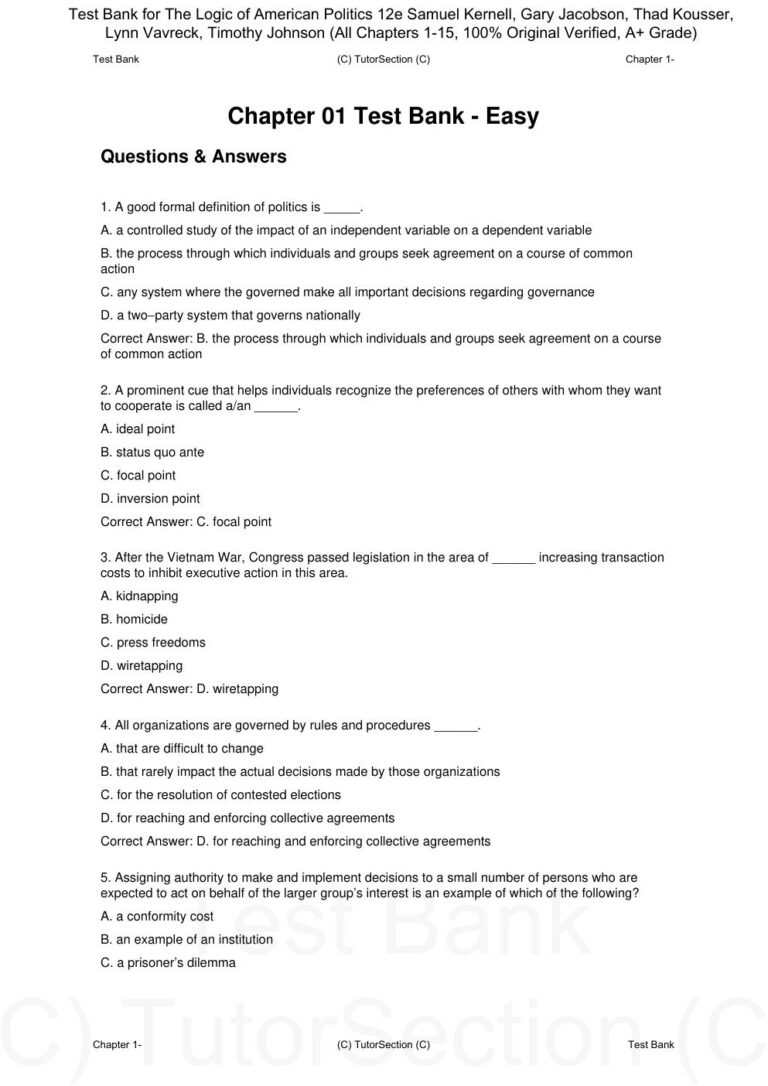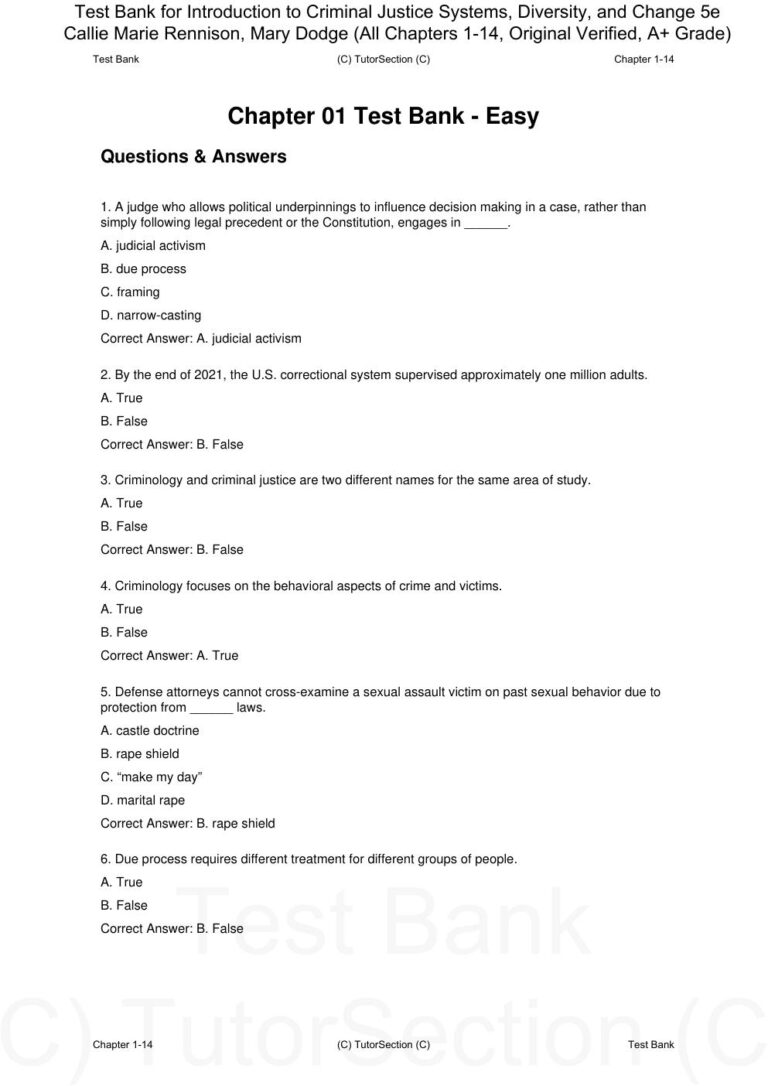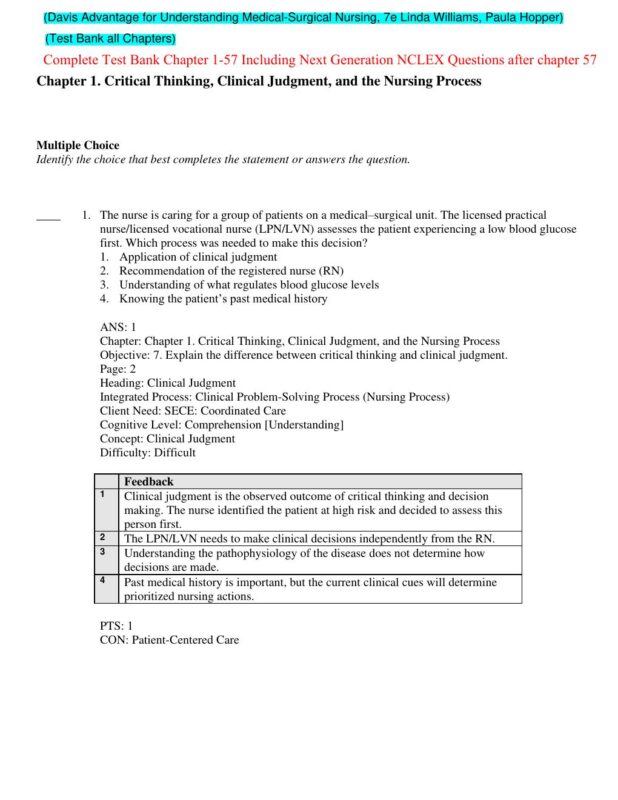
TEST BANK for Davis Advantage for Understanding Medical-Surgical Nursing 7th Edition By Linda Williams, Paula Hopper (Test Bank)
$20.00
Secure checkout
Instant digital download
PDF document
Document details
- Pages
- 1,146
- File size
- 4.6 MB
- Format
- Digital PDF
- Course
- NURSING
- Category
- TEST BANKS
Sign in or create a free account to continue. Your purchase will be saved in My Downloads.
About this ebook
The TEST BANK for Davis Advantage for Understanding Medical-Surgical Nursing, 7th Edition by Linda S. Williams and Paula D. Hopper is a comprehensive textbook tailored primarily for LPN/LVN programs. It spans 57 chapters organized into structural units that cover fundamental healthcare concepts, nursing foundations, and system-by-system medical-surgical disorders. [1, 2, 3]
The primary topics and structural units covered across the textbook include:
🩺 Unit 1: Understanding Health Care Issues
Focuses on the foundational nursing framework, legal/ethical parameters, and clinical reasoning tools needed for medical-surgical settings. [1]
- Critical thinking, clinical judgment, and the nursing process
- Evidence-based practice foundations
- Issues, trends, legalities, and ethics in nursing practice
- Cultural and spiritual influences on patient care
- Complementary and alternative modalities [1, 2, 3, 4, 5]
🧪 Unit 2: Understanding Health and Illness
Covers general clinical concepts, multi-system pathology, and perioperative nursing environments. [1]
- Fluid, electrolyte, and acid-base imbalances
- Intravenous (IV) therapy management
- Management of infections and shock
- Pain management and oncology nursing
- Perioperative care (preoperative, intraoperative, and postoperative nursing)
- Emergent conditions, disaster readiness, and first aid [1, 2, 3, 4, 5, 6]
👥 Unit 3: Understanding Life Span Influences on Health and Illness
Addresses specific developmental variations and nursing care adjustments needed throughout a patient’s life. [1]
- Developmental influences on health
- Care of the older adult population
- Care of patients at the end of life [, 2]
🛡️ Unit 4: Understanding the Immune System
- Immune system function and data collection
- Management of immune disorders and HIV/AIDS
❤️ Unit 5: Understanding the Cardiovascular System
- Cardiovascular system function and diagnostic tests
- Management of hypertension and infectious/valvular disorders
- Occlusive coronary disorders, dysrhythmias, and heart failure [1]
🩸 Unit 6: Understanding the Hematologic and Lymphatic Systems
- Hematologic/lymphatic function and data collection
- Management of anemias, bleeding disorders, leukemia, and lymphoma [1]
🫁 Unit 7: Understanding the Respiratory System
- Respiratory system function, data collection, and therapeutic measures
- Upper and lower respiratory tract disorders (e.g., pneumonia, COPD) [1]
🍏 Unit 8: Understanding the Gastrointestinal, Hepatic, and Pancreatic Systems
Covers digestive tracks, metabolic processes, and structural accessory organs. [1]
- Gastrointestinal system function and data collection
- Upper/lower gastrointestinal, liver, gallbladder, and pancreatic disorders [1]
🪨 Unit 9: Understanding the Urinary System
- Urinary system function and data collection
- Fluid elimination, urinary tract disorders, and acute/chronic kidney disease
🦋 Unit 10: Understanding the Endocrine System
- Endocrine system function, data collection, and assessment
- Disorders of the pituitary, thyroid, adrenal, and diabetes management [1, 2]
🧬 Unit 11: Understanding the Genitourinary and Reproductive Systems
Focuses on gender-specific health and sexually transmitted infections. [, 2]
- Reproductive system function and data collection
- Female reproductive, male genitourinary, and STI management [1, 2]
🦴 Unit 12: Understanding the Musculoskeletal System
Covers mobility, connective tissue health, and trauma support. []
- Musculoskeletal function, data collection, and assessment
- Connective tissue disorders, fractures, amputations, and joint replacements [1]
🧠 Unit 13: Understanding the Neurologic System
Concentrates on cognitive function, sensory pathways, and brain/spinal integrity. [1]
- Neurologic system function, assessment, and data collection
- Central nervous system, cerebrovascular, and spinal cord trauma management
👁️ Unit 14: Understanding Sensory Systems
Addresses peripheral sensory organs and functional adaptations.
- Eye and ear function and data collection
- Visual and auditory disorder management
🧴 Unit 15: Understanding the Integumentary System
Deals with structural protection, tissue healing, and skin integrity.
- Integumentary function and data collection
- Skin disorder and burn management
🧠 Unit 16: Understanding Mental Health Care
Integrates medical-surgical oversight with primary psychological illnesses.
- Mental health function, assessment, and patient coping
- Anxiety, mood, psychotic, substance abuse, and cognitive disorders
File included
ScholarFriends.com-test-bank-for-davis-advantage-for-understanding-medical-surgical-nursing-7th-edition.pdf
4.6 MB
Related ebooks