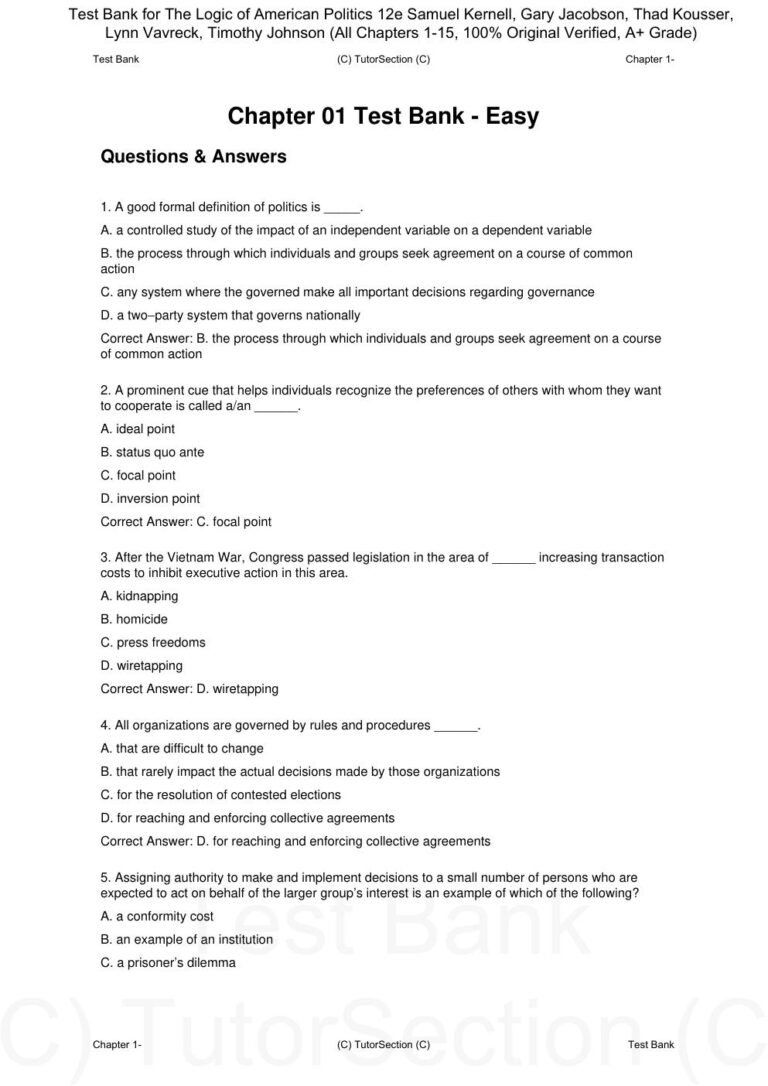
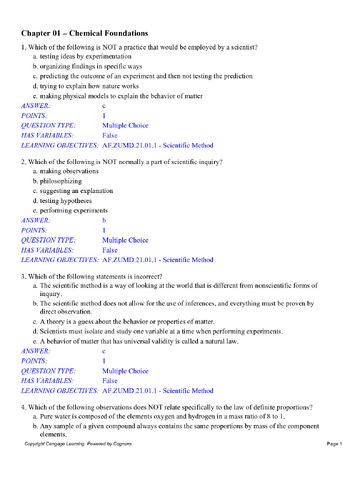
Chemistry: An Atoms First Approach, 3rd Edition by Steven Zumdahl, Susan & Donald DeCoste l TEST BANK
$23.00
Secure checkout
Instant digital download
PDF document
Document details
- Pages
- 850
- File size
- 11.25 MB
- Format
- Digital PDF
- Course
- Chemistry
- Category
- TEST BANKS
Sign in or create a free account to continue. Your purchase will be saved in My Downloads.
About this ebook
Test Bank for Chemistry An Atoms First Approach, 3rd Edition,3e by Steven S. Zumdahl, Susan A. Zumdahl TEST BANK
ISBN-13: 9780357363614
Full chapters included
Chapter 1: Chemical Foundations
1.1 Chemistry: An Atoms-First Approach
1.2 The Scientific Method
1.3 Fundamental Chemical Laws
1.4 Dalton's Atomic Theory
1.5 Early Experiments to Characterize the Atom
1.6 The Modern View of Atomic Structure: An Introduction
For Review
Chapter 2: Atomic Structure and Periodicity
2.1 Electromagnetic Radiation
2.2 The Nature of Matter
2.3 The Atomic Spectrum of Hydrogen
2.4 The Bohr Model
2.5 The Quantum Mechanical Model of the Atom
2.6 Quantum Numbers
2.7 Orbital Shapes and Energies
2.8 Electron Spin and the Pauli Principle
2.9 Polyelectronic Atoms
2.10 The History of the Periodic Table
2.11 The Aufbau Principle and the Periodic Table
2.12 Periodic Trends in Atomic Properties
Chapter 3: Bonding: General Concepts
3.1 Types of Chemical Bonds
3.2 Electronegativity
3.3 Ions: Electron Configurations and Sizes
3.4 Partial Ionic Character of Covalent Bonds
3.5 The Covalent Chemical Bond: A Model
3.6 The Localized Electron Bonding Model
3.7 Lewis Structures
3.8 Exceptions to the Octet Rule
3.9 Resonance
3.10 Naming Simple Compounds
Chapter 4: Molecular Structure and Orbitals
4.1 Molecular Structure: The VSEPR Model
4.2 Bond Polarity and Dipole Moments
4.3 Hybridization and the Localized Electron Model
4.4 The Molecular Orbital Model
4.5 Bonding in Homonuclear Diatomic Molecules
4.6 Bonding in Heteronuclear Diatomic Molecules
4.7 Combining the Localized Electron and Molecular Orbital Models
Chapter 5: Stoichiometry
5.1 Counting by Weighing
5.2 Atomic Masses
5.3 Learning to Solve Problems
5.4 The Mole
5.5 Molar Mass
5.6 Percent Composition of Compounds
5.8 Chemical Equations
5.9 Balancing Chemical Equations
5.10 Stoichiometric Calculations: Amounts of Reactants and Products
5.11 The Concept of Limiting Reactant
Chapter 6: Types of Chemical Reactions and Solution Stoichiometry
6.1 Water, the Common Solvent
6.2 The Nature of Aqueous Solutions: Strong and Weak Electrolytes
6.3 The Composition of Solutions
6.4 Types of Chemical Reactions
6.5 Precipitation Reactions
6.6 Describing Reactions in Solution
6.7 Stoichiometry of Precipitation Reactions
6.8 Acid-Base Reactions
6.9 Oxidation-Reduction Reactions
6.10 Balancing Oxidation-Reduction Equations
Chapter 7: Chemical Energy
7.1 The Nature of Chemical Energy
7.2 Enthalpy
7.3 Calorimetry
7.4 Hess's Law
7.5 Standard Enthalpies of Formation
7.6 Covalent Bond Energies and Chemical Reactions
7.7 Present Sources of Energy
7.8 New Energy Sources
Chapter 8: Gases
8.1 Pressure
8.2 The Gas Laws of Boyle, Charles, and Avogadro
8.3 The Ideal Gas Law
8.4 Gas Stoichiometry
8.5 Dalton's Law of Partial Pressures
8.6 The Kinetic Molecular Theory of Gases
8.7 Effusion and Diffusion
8.8 Real Gases
8.9 Characteristics of Several Real Gases
8.10 Chemistry in the Atmosphere
Chapter 9: Liquids and Solids
9.1 Intermolecular Forces
9.2 The Liquid State
9.3 Vapor Pressure and Changes of State
9.4 Phase Diagrams
9.5 An Introduction to Structures and Types of Solids
9.6 Structure and Bonding in Metals
9.7 Carbon and Silicon: Network Atomic Solids
9.8 Molecular Solids
Chapter 10: Properties of Solutions
10.1 Solution Composition
10.2 The Energies of Solution Formation
10.3 Factors Affecting Solubility
10.4 The Vapor Pressures of Solutions
10.5 Boiling-Point Elevation and Freezing‑Point Depression
10.6 Osmotic Pressure
10.7 Colligative Properties of Electrolyte Solutions
10.8 Colloids
Chapter 11: Chemical Kinetics
11.1 Reaction Rates
11.2 Rate Laws: An Introduction
11.3 Determining the Form of the Rate Law
11.4 The Integrated Rate Law
11.5 Reaction Mechanisms
11.6 A Model for Chemical Kinetics
11.7 Catalysis
Chapter 12: Chemical Equilibrium
12.1 The Equilibrium Condition
12.2 The Equilibrium Constant
12.3 Equilibrium Expressions Involving Pressures
12.4 Heterogeneous Equilibria
12.5 Applications of the Equilibrium Constant
12.6 Solving Equilibrium Problems
12.7 Le Chatelier's Principle
Chapter 13: Acids and Bases
13.1 The Nature of Acids and Bases
13.2 Acid Strength
13.3 The pH Scale
13.4 Calculating the pH of Strong Acid Solutions
13.5 Calculating the pH of Weak Acid Solutions
13.6 Bases
13.7 Polyprotic Acids
13.8 Acid-Base Properties of Salts
13.9 The Effect of Structure on Acid-Base Properties
13.10 Acid-Base Properties of Oxides
13.11 The Lewis Acid-Base Model
13.12 Strategy for Solving Acid-Base Problems: A Summary
Chapter 14: Acid-Base Equilibria
14.1 Solutions of Acids or Bases Containing a Common Ion
14.2 Buffered Solutions
14.3 Buffering Capacity
14.4 Titrations and pH Curves
14.5 Acid-Base Indicators
Chapter 15: Solubility and Complex Ion Equilibria
15.1 Solubility Equilibria and the Solubility Product
15.2 Precipitation and Qualitative Analysis
15.3 Equilibria Involving Complex Ions
Chapter 16: Spontaneity, Entropy, and Free Energy
16.1 Spontaneous Processes and Entropy
16.2 Entropy and the Second Law of Thermodynamics
16.3 The Effect of Temperature on Spontaneity
16.4 Free Energy
16.5 Entropy Changes in Chemical Reactions
16.6 Free Energy and Chemical Reactions
16.7 The Dependence of Free Energy on Pressure
16.8 Free Energy and Equilibrium
16.9 Free Energy and Work
Chapter 17: Electrochemistry
17.1 Balancing Oxidation-Reduction Equations
17.2 Galvanic Cells
17.3 Standard Reduction Potentials
17.4 Cell Potential, Electrical Work, and Free Energy
17.5 Dependence of Cell Potential on Concentration
17.6 Batteries
17.7 Corrosion
17.8 Electrolysis
17.9 Commercial Electrolytic Processes
Chapter 18: The Nucleus: A Chemist's View
18.1 Nuclear Stability and Radioactive Decay
18.2 The Kinetics of Radioactive Decay
18.3 Nuclear Transformations
18.4 Detection and Uses of Radioactivity
18.5 Thermodynamic Stability of the Nucleus
18.6 Nuclear Fission and Nuclear Fusion
18.7 Effects of Radiation
Chapter 19: The Representative Elements
19.1 A Survey of the Representative Elements
19.2 The Group 1A (1) Elements
19.3 The Chemistry of Hydrogen
19.4 The Group 2A (2) Elements
19.5 The Group 3A (13) Elements
19.6 The Group 4A (14) Elements
19.7 The Group 5A (15) Elements
19.8 The Chemistry of Nitrogen
19.9 The Chemistry of Phosphorus
19.10 The Group 6A (16) Elements
19.11 The Chemistry of Oxygen
19.12 The Chemistry of Sulfur
19.13 The Group 7A (17) Elements
19.14 The Group 8A (18) Elements
Chapter 20: Transition Metals and Coordination Chemistry
20.1 The Transition Metals: A Survey
20.2 The First-Row Transition Metals
20.3 Coordination Compounds
20.4 Isomerism
20.5 Bonding in Complex Ions: The Localized Electron Model
20.6 The Crystal Field Model
20.7 The Biological Importance of Coordination Complexes
20.8 Metallurgy and Iron and Steel Production
Chapter 21: Organic and Biological Molecules
21.1 Alkanes: Saturated Hydrocarbons
21.2 Alkenes and Alkynes
21.3 Aromatic Hydrocarbons
21.4 Hydrocarbon Derivatives
21.5 Polymers
21.6 Natural Polymers
File included
Zumdahl-3e-Test-Bank.pdf
11.25 MB
Related ebooks