Test Bank for Introductory Chemistry 8th Edition by Zumdahl
$29.00
Secure checkout
Instant digital download
PDF document
Document details
- Pages
- 378
- File size
- 5.62 MB
- Format
- Digital PDF
- Course
- Chemistry
- Category
- TEST BANKS
Sign in or create a free account to continue. Your purchase will be saved in My Downloads.
About this ebook
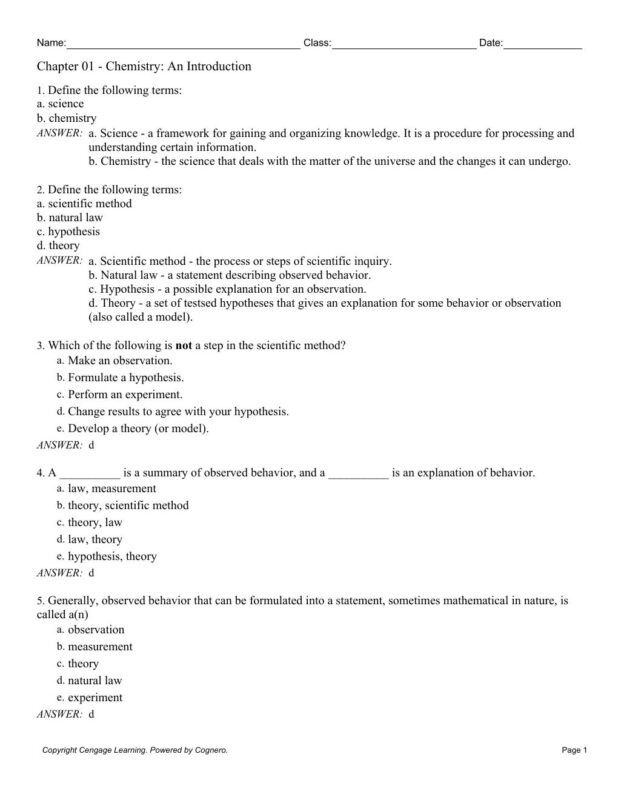
The Test Bank for 8th Edition of Introductory Chemistry (including the Introductory Chemistry: A Foundation version) by Steven S. Zumdahl and Donald J. DeCoste covers the fundamental principles of general chemistry. The textbook is structured sequentially across 21 chapters to transition students from foundational concepts to advanced chemical systems. [1, 2]
Foundational Chemistry & Measurement
- Chapter 1: Chemistry: An Introduction – Explores the definition of chemistry, scientific thinking, and the application of the scientific method. [1]
- Chapter 2: Measurements and Calculations – Focuses on scientific notation, significant figures, metric units, dimensional analysis, and density.
- Chapter 3: Matter – Details the physical and chemical properties of matter, states of matter, elements, compounds, and mixtures. [1]
Atoms, Molecules, & Nomenclature
- Chapter 4: Chemical Foundations: Elements, Atoms, and Ions – Introduces the periodic table, Dalton's atomic theory, nuclear anatomy, isotopes, and ion formation.
- Chapter 5: Nomenclature – Explains systematic naming conventions for ionic compounds, covalent compounds, and acids. [1]
Chemical Reactions & Quantitative Chemistry
- Chapter 6: Chemical Reactions: An Introduction – Identifies signs of a chemical reaction and teaches how to balance chemical equations.
- Chapter 7: Reactions in Aqueous Solutions – Examines solubility rules, precipitation reactions, and acid-base reactions.
- Chapter 8: Chemical Composition – Focuses on atomic mass, the concept of the mole, molar mass, and determining empirical and molecular formulas.
- Chapter 9: Chemical Quantities (Stoichiometry) – Teaches mole-to-mole conversions, limiting reactants, and theoretical vs. percent yield.
Atomic Theory & Molecular Structure
- Chapter 10: Energy – Covers temperature, heat capacity, enthalpy, and thermal energy changes.
- Chapter 11: Modern Atomic Theory – Explores the electromagnetic spectrum, Bohr's model, the wave mechanical model, and electron configurations.
- Chapter 12: Chemical Bonding – Discusses ionic and covalent bonding, Lewis structures, molecular geometry, and VSEPR theory.
States of Matter & Solutions
- Chapter 13: Gases – Covers gas pressure, the gas laws (Boyle's, Charles's, Avogadro's), the Ideal Gas Law, and Dalton’s Law of Partial Pressures.
- Chapter 14: Liquids and Solids – Investigates intermolecular forces, phase changes, vapor pressure, and crystalline solids.
- Chapter 15: Solutions – Details solubility factors, mass percent, molarity calculations, and solution stoichiometry.
Chemical Dynamics & Advanced Topics
- Chapter 16: Acids and Bases – Defines Arrhenius and Brønsted-Lowry concepts, pH/pOH scales, and strong vs. weak conjugates.
- Chapter 17: Equilibrium – Covers dynamic equilibrium, the equilibrium constant, and Le Chatelier’s Principle.
- Chapter 18: Oxidation-Reduction Reactions and Electrochemistry – Focuses on assigning oxidation states, balancing redox reactions, and voltaic cells.
Specialty Sub-disciplines (Included in the "A Foundation" version)
- Chapter 19: Radioactivity and Nuclear Energy – Discusses radioactive decay, nuclear half-lives, fission, and fusion.
- Chapter 20: Organic Chemistry – Introduces hydrocarbons, functional groups, and structural isomerism.
- Chapter 21: Biochemistry – Examines the molecular structures of proteins, carbohydrates, lipids, and nucleic acids. [1]
File included
tmpphp9wUrzO
5.62 MB
Related ebooks