
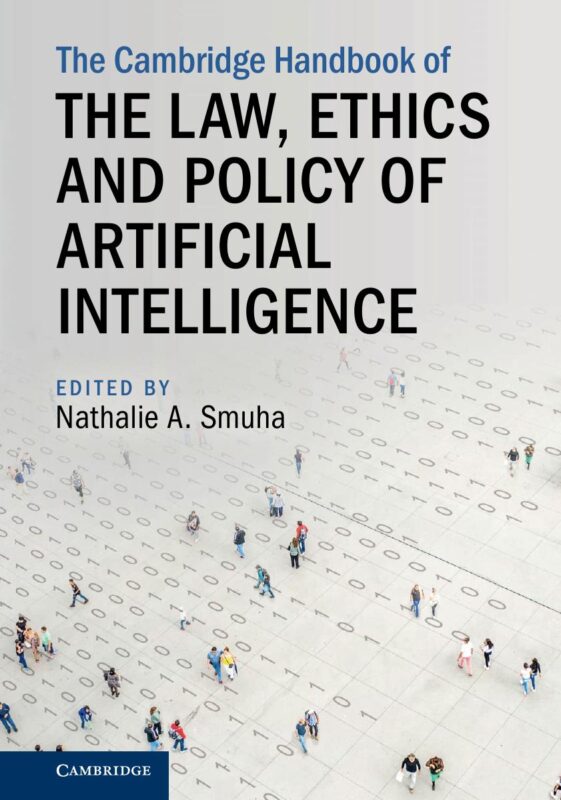
The Cambridge Handbook of the Law, Ethics and Policy of Artificial Intelligence By Nathalie Smuha
$30.00
Secure checkout
Instant digital download
PDF document
Document details
- Pages
- 460
- File size
- 4.5 MB
- Format
- Digital PDF
- Category
- eBook[PDF]
Sign in or create a free account to continue. Your purchase will be saved in My Downloads.
About this ebook
The Cambridge Handbook of the Law, Ethics and Policy of Artificial Intelligence, edited by Nathalie A. Smuha, provides an interdisciplinary, comprehensive analysis of AI governance with a strong focus on European regulatory frameworks. The text is structured into three foundational parts: [1, 2, 3, 4]
Part I: AI, Ethics and Philosophy
The opening section establishes the theoretical and technical foundations required to understand the broader societal impacts of machine learning. [1]
- Technical Foundations: Structural differences and development paths between machine learning and machine reasoning.
- Philosophy of AI: Conceptual overviews examining agency, intelligence, and the limits of autonomous decision-making.
- Design for Values: Methodologies like Value-Sensitive Design to proactively build ethical constraints into AI development.
- Fairness & Bias: Technical and philosophical approaches to addressing systemic data discrimination and algorithmic bias.
- Moral Responsibility: Assessing accountability gaps when autonomous technologies generate unpredictable real-world outcomes.
- Power and Sustainability: Examining the data economics of power, energy use, and environmental costs of training massive models. [1, 2, 3]
Part II: AI, Law and Policy
This part shifts toward legal instruments, analyzing how current laws handle algorithmic systems and outlining emergent global compliance structures. [1, 2]
- Privacy and Data Protection: Intersecting machine learning requirements with fundamental human rights under frameworks like the EU GDPR. [1]
- Competition Law: Identifying market risks like automated algorithmic collusion and anti-competitive supply chain behaviors. [1]
- Intellectual Property (IP) Law: Debating liability for copyright infringement and whether AI models can legally qualify as authors or inventors. [1]
- The EU AI Act: Comprehensive teardown of risk-based categorization, compliance obligations, and exemptions for research or defense. [1]
Part III: AI across Sectors
The final section shifts from horizontal regulation to vertical, application-specific fields to look at context-dependent effects. [1]
- Law Enforcement: Analyzing the governance, efficacy, and civil liberties impacts of predictive policing and automated target identification.
- Education: Addressing the disruption of schools by generative AI, the Beijing Consensus, and institutional policies for responsible tool deployment.
- Healthcare & Public Sector: Managing transparency, diagnostic safety, and administrative automation in public institutions. [1, 2]
File included
tmpphp62T8eU
4.5 MB
Related ebooks