
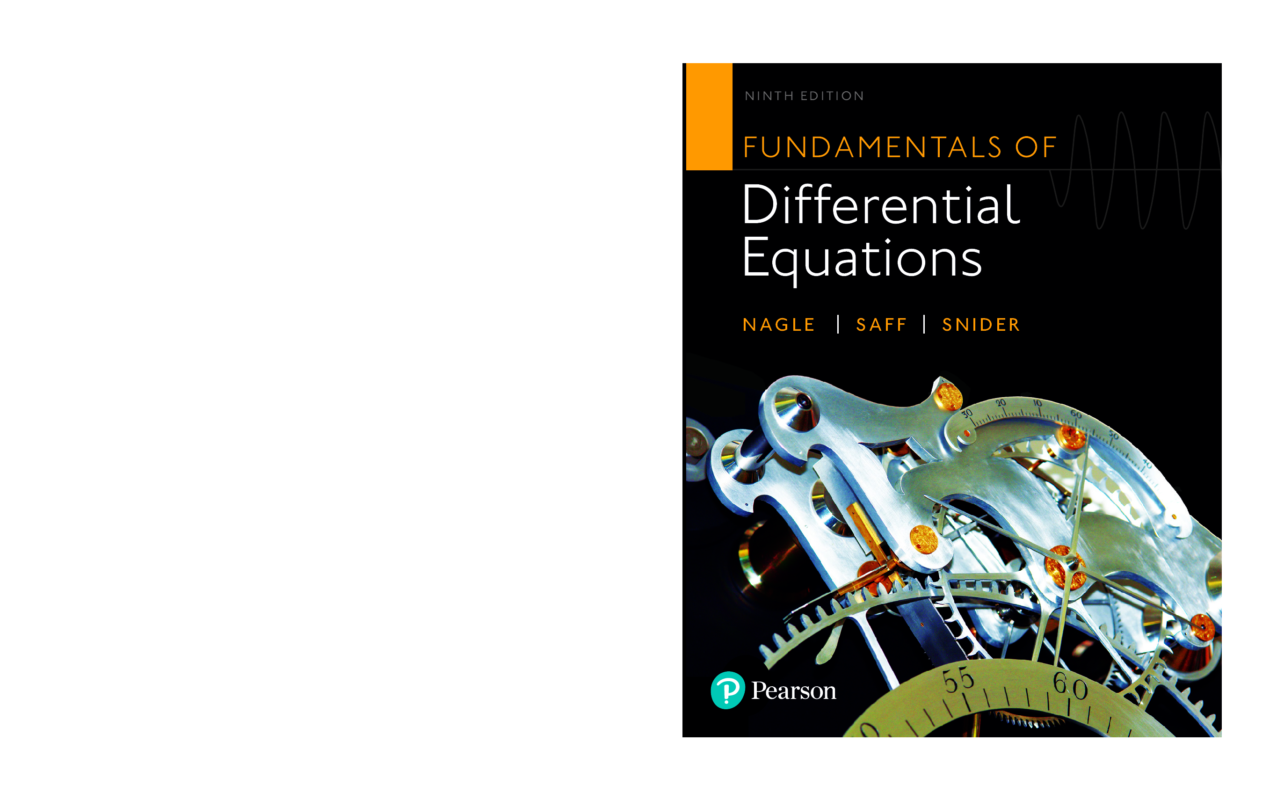
Fundamentals of Differential Equations 9th Edition By R. Kent Nagle, Edward B. Saff
$30.00
Secure checkout
Instant digital download
PDF document
Document details
- Pages
- 731
- File size
- 28.18 MB
- Format
- Digital PDF
- Course
- Education
- Category
- eBook[PDF]
Sign in or create a free account to continue. Your purchase will be saved in My Downloads.
About this ebook
Fundamentals of Differential Equations" (9th Edition) by R. Kent Nagle, Edward B. Saff, and Arthur David Snider is a leading undergraduate textbook that balances the conceptual development, mathematical theory, and analytical techniques required to solve differential equations. [1]
Here is a comprehensive overview of the textbook's structure, core topics, and target audience.
Target Audience and Prerequisites
- Audience: Sophomores and juniors majoring in mathematics, engineering, physics, or the sciences.
- Prerequisites: A solid background in Calculus (differential and integral) and some familiarity with Linear Algebra (specifically for systems of differential equations).
Core Topics Covered
The 9th edition is structured logically to take students from introductory first-order equations to complex boundary-value problems:
- Introduction and First-Order ODEs: Direction fields, separable equations, linear equations, exact equations, and substitution methods.
- Mathematical Modeling: Real-world applications including population dynamics, mixing problems, and heating/cooling laws.
- Higher-Order Linear ODEs: Homogeneous and non-homogeneous equations, undetermined coefficients, variation of parameters, and free/forced mechanical vibrations. [1]
- Laplace Transforms: Definition, properties, inverse transforms, solving initial value problems, and handling discontinuous/impulse forces. [1]
- Systems of Differential Equations: Matrix methods for linear systems, eigenvalues and eigenvectors, and phase plane analysis. [1]
- Series Solutions: Power series solutions about ordinary and regular singular points (including Bessel's equation). [1]
- Numerical Methods: Euler's method, Taylor series methods, and Runge-Kutta algorithms. [1]
Key Pedagogical Features
- Group Projects: Found at the end of chapters to encourage collaborative, deep-dive problem-solving into advanced applications.
- Technical Writing Exercises: Prompts that help students articulate mathematical concepts and reasoning clearly in writing.
- Flexible Software Integration: Focuses on conceptual understanding rather than a specific command syntax, making it compatible with MATLAB, Mathematica, Maple, or graphing calculators.
File included
eBook-PDF-Fundamentals-of-Differential-Equations-9th-Edition-By-R.-Kent-Nagle-Edward-B.-Saff.pdf
28.18 MB
Related ebooks