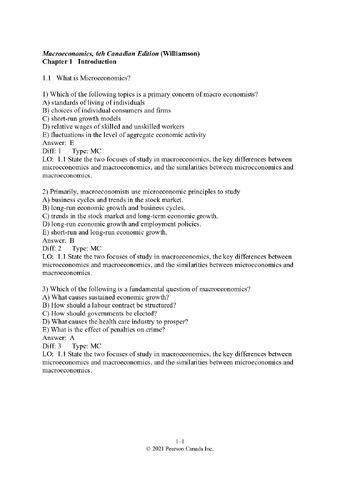
TEST BANK for Macroeconomics, 6th Canadian Edition by Stephen Williamson
$29.00
Secure checkout
Instant digital download
PDF document
Document details
- Pages
- 300
- File size
- 2.83 MB
- Format
- Digital PDF
- Course
- Economics
- Category
- TEST BANKS
Sign in or create a free account to continue. Your purchase will be saved in My Downloads.
About this ebook
Test Bank for Macroeconomics, 6th Canadian Edition, 6e by Stephen D. Williamson TEST BANK
ISBN-13: 9780135651568
Full chapters included
PART 1 Introduction and Measurement Issues
1 Introduction
What Is Macroeconomics?
Gross Domestic Product, Economic Growth, and Business Cycles
Macroeconomic Models
Microeconomic Principles
Disagreement in Macroeconomics
What Do We Learn from Macroeconomic Analysis?
Understanding Recent and Current Macroeconomic Events
Productivity Growth
Government Spending and the Government Surplus
Unemployment
Inflation
Interest Rates
Trade and the Current Account Surplus
Business Cycles
Chapter Summary
Questions for Review
Problems
2 Measurement
Measuring GDP: The National Income and Expenditure Accounts
The Product Approach to Measuring GDP
The Expenditure Approach
The Income Approach
An Example with Inventory Investment
An Example with International Trade
What does GDP Leave Out?
The Components of Aggregate Expenditure
Nominal and Real GDP and Price Indices
Real GDP
Measures of the Price Level
Problems with Measuring Real GDP and the Price Level
Macroeconomics in Action 2.1 Price Indices and Monetary Policy in Canada
Savings, Wealth, and Capital
Macroeconomics in Action 2.2 Comparing Real GDP across Countries and the Penn Effect
Labour Market Measurement
Macroeconomics in Action 2.3 Differences in Unemployment Rates in Canada and the United States
3 Business Cycle Measurement
Regularities in GDP Fluctuations
Macroeconomics in Action 3.1 Economic Forecasting and the Financial Crisis
Comovement
The Components of GDP
The Price Level and Inflation
Macroeconomics in Action 3.2 Instability in the Canadian Phillips Curve
Labour Market Variables
Macroeconomics in Action 3.3 The Great Moderation?
Comovement Summary
PART 2 Basic Macroeconomic Models: A One-Period Model, and Models of Search and Unemployment
4 Consumer and Firm Behaviour: The Work–Leisure Decision and Profit Maximization
The Representative Consumer
The Representative Consumer’s Preferences
The Representative Consumer’s Budget Constraint
Consumer Optimization
Macroeconomics in Action 4.1 How Elastic Is Labour Supply?
The Representative Firm
The Effect of a Change in Total Factor Productivity on the Production Function
Macroeconomics in Action 4.2 Management and Productivity in Canada
Theory Confronts the Data 4.1 Total Factor Productivity and the Canadian Aggregate Production Functi
The Profit Maximization Problem of the Representative Firm
5 A Closed-Economy One-Period Macroeconomic Model
Government
Competitive Equilibrium
Optimality
Sources of Social Inefficiencies
How to Use the Model
Working with the Model: The Effects of a Change in Government Purchases
Macroeconomics in Action 5.1 Sticky Wages and Prices: Empirical Evidence on the Government Spending
Working with the Model: A Change in Total Factor Productivity
Interpretation of the Model’s Predictions
Macroeconomics in Action 5.2 The Long Run: Total Factor Productivity in Canada and the United States
Theory Confronts The Data 5.1 The Short Run: Total Factor Productivity and GDP
A Distorting Tax on Wage Income, Tax Rate Changes, and the Laffer Curve
A Simplified One-Period Model with Proportional Income Taxation
Income Tax Revenue and the Laffer Curve
Keynesian Sticky Wages and Prices
6 Search and Unemployment
The Behaviour of the Unemployment Rate, the Participation Rate, and the Employment/ Population Ratio
A One-Sided Search Model of Unemployment
Macroeconomics in Action 6.1 Unemployment and Employment in the United States and Europe
The Welfare of Employed and Unemployed Workers
The Reservation Wage
The Determination of the Unemployment Rate
A Two-Sided Search Model of Unemployment and Labour Market Participation
Consumers
Firms
Matching
Optimization by Consumers
Optimization by Firms
Equilibrium
Macroeconomics in Action 6.2 On-the-Job Search, and Transitions from Not-in-the-Labour-Force to Empl
An Increase in the Employment Insurance Benefit
An Increase in Productivity
A Decrease in Matching Efficiency
Theory Confronts the Data 6.1 The Beveridge Curve
PART 3 Economic Growth
7 Economic Growth: Malthus and Solow
Economic Growth Facts
The Malthusian Model of Economic Growth
Analysis of the Steady State in the Malthusian Model
How Useful is the Malthusian Model of Economic Growth?
The Solow Model: Exogenous Growth
Analysis of the Steady State
Theory Confronts the Data 7.1 The Recent Trend in Economic Growth in Canada
Growth and the Distribution of Income
Growth Accounting
Macroeconomics in Action 7.1 Resource Misallocation and Total Factor Productivity
Solow Residuals and Productivity Slowdowns
A Growth Accounting Exercise
Macroeconomics in Action 7.2 Development Accounting
8 Income Disparity among Countries and Endogenous Growth
Convergence
Macroeconomics in Action 8.1 Slow Adoption of Technology Without Barriers
Theory Confronts the Data 8.1 Is Income per Worker Converging in the World?
Macroeconomics in Action 8.2 Measuring Economic Welfare: Per Capita Income, Income Distribution, Lei
Endogenous Growth: A Model of Human Capital Accumulation
Economic Policy and Growth
Macroeconomics in Action 8.3 Education and Growth
Convergence in the Endogenous Growth Model
Endogenous Growth and the Distribution of Income
PART 4 Savings, Investment, and Government Deficits
9 A Two-Period Model: The Consumption–Savings Decision and Credit Markets
A Two-Period Model of the Economy
Theory Confronts the Data 9.1 Consumption Smoothing and the Stock Market
Macroeconomics in Action 9.1 Registered Retirement Savings Plans, Savings, and Consumption
The Ricardian Equivalence Theorem
Ricardian Equivalence: A Numerical Example
Ricardian Equivalence: A Graph
Ricardian Equivalence and Credit Market Equilibrium
Ricardian Equivalence and the Burden of the Government Debt
Macroeconomics in Action 9.2 The Potential for Government Default and the February 1995 Federal Budg
10 Credit Market Imperfections: Credit Frictions, Financial Crises, and Social Security
Credit Market Imperfections and Consumption
Example: Credit Market Imperfections in General Equilibrium
Asymmetric Information and Financial Crises
Theory Confronts the Data 10.1 Asymmetric Information and Interest Rate Spreads
Limited Commitment and Financial Crises
Macroeconomics in Action 10.1 Housing, Collateral, and Mortgage Debt in Canada
Ricardian Equivalence, Intergenerational Redistribution, and Social Security
Macroeconomics in Action 10.2 Social Security and Incentives
11 A Real Intertemporal Model with Investment
Current Labour Supply
The Current Demand for Consumption Goods
Profits and Current Labour Demand
The Representative Firm’s Investment Decision
Investment with Asymmetric Information: The Financial Crisis
The Current Labour Market and the Output Supply Curve
The Current Goods Market and the Output Demand Curve
The Complete Real Intertemporal Model
The Equilibrium Effects of a Temporary Increase in G: Stimulus, the Multiplier, and Crowding Out
Theory Confronts the Data 11.1 The 1990s Fiscal Contraction and the Government Expenditure Multiplie
The Equilibrium Effects of a Decrease in the Current Capital Stock, K: Capital Destruction from Wars
The Equilibrium Effects of an Increase in Current Total Factor Productivity, z
The Equilibrium Effects of an Increase in Future Total Factor Productivity, z_: News about the Futur
Theory Confronts the Data 11.2 News, the Stock Market, and Investment Expenditures
Housing Market Bubbles and Aggregate Activity
PART 5 Money and Business Cycles
12 A Monetary Intertemporal Model: Money, Banking, Prices, and Monetary Policy
What Is Money?
Measuring the Money Supply
Monetary Intertemporal Model
Real and Nominal Interest Rates and the Fisher Relation
Banks and Alternative Means of Payment
Equilibrium in the Market for Credit Card Services and the Demand for Money
Competitive Equilibrium—The Complete Intertemporal Monetary Model
A Level Increase in the Money Supply and Monetary Neutrality
Shifts in Money Demand
Theory Confronts the Data 12.1 Instability in the Money Demand Function in Canada
Conventional Monetary Policy, the Liquidity Trap, and Unconventional Monetary Policy
Quantitative Easing
Negative Nominal Interest Rates
Corridor Systems and Floor Systems
Macroeconomics in Action 12.1 A Floor System in Canada
13 Business Cycles
The Real Business Cycle Model
Real Business Cycles and the Behaviour of Nominal Variables
Implications of Real Business Cycle Theory for Government Policy
Critique of Real Business Cycle Theory
The New Keynesian Model
The Non-Neutrality of Money in the New Keynesian Model
The Role of Government Policy in the New Keynesian Model
Macroeconomics in Action 13.1 Policy Lags
Does the New Keynesian Model Replicate the Data?
The Liquidity Trap and Sticky Prices
Theory Confronts the Data 13.1 New Keynesian Models and the Taylor Rule
Criticisms of Keynesian Models
Macroeconomics in Action 13.2 How Sticky Are Nominal Prices?
14 Inflation: Phillips Curves and Neo-Fisherism
Inflation in a Basic New Keynesian Model
Theory Confronts the Data 14.1 The Phillips Curve
Monetary Policy Goals
Low Real Interest Rates and the Zero Lower Bound
Macroeconomics in Action 14.1 Forward Guidance in the United States after 2008
Neo-Fisherism and a New Keynesian Rational Expectations Model
Neo-Fisherism and Taylor Rules
PART 6 International Macroeconomics
15 International Trade in Goods and Assets
A Two-Period Small Open-Economy Model
Theory Confronts the Data 15.1 Is a Current Account Deficit a Bad Thing?
Credit Market Imperfections and Default
Theory Confronts the Data 15.2 Greece and Sovereign Default
Production, Investment, and the Current Account
The Effects of An Increase in the World Real Interest Rate
A Temporary Increase in Government Expenditure and the Effects On the Current Account and Domestic O
The Effects of Increases in Current and Future Total Factor Productivity
Current Account Deficits, Consumption, and Investment
Tariff Barriers
Macroeconomics in Action 15.1 Measuring the Effects of NAFTA
16 Money in the Open Economy
The Nominal Exchange Rate, the Real Exchange Rate, and Purchasing Power Parity
Theory Confronts the Data 16.1 The PPP Relationship for the United States and Canada
Flexible and Fixed Exchange Rates
A Monetary Small Open-Economy Model with a Flexible Exchange Rate
The Neutrality of Money with a Flexible Exchange Rate
A Nominal Shock to the Domestic Economy from Abroad: P* Increases
A Real Shock to the Domestic Economy from Abroad
A Monetary Small Open-Economy Model with a Fixed Exchange Rate
A Nominal Foreign Shock Under a Fixed Exchange Rate
A Real Foreign Shock Under a Fixed Exchange Rate
Exchange Rate Devaluation
Flexible versus Fixed Exchange Rates
Macroeconomics in Action 16.1 Sovereign Debt and the EMU
Macroeconomics in Action 16.2 Foreign Exchange Intervention in Canada and Switzerland
Capital Controls
The Capital Account and the Balance of Payments
The Effects of Capital Controls
A New Keynesian Sticky Price Open-Economy Model
Flexible Exchange Rate
Fixed Exchange Rate
Tariff Wars and Short Run Macroeconomic Activity
PART 7 Money, Inflation, and Banking
17 Money and Inflation: A Deeper Look
Alternative Forms of Money
Macroeconomics in Action 17.1 Commodity Money and Commodity-Backed Paper Money: Yap Stones and Playi
Money and the Absence of Double Coincidence of Wants: The Roles of Commodity Money and Fiat Money
Anticipated Inflation and the Friedman Rule: A Lagos-Wright Monetary Model
Pareto-Optimal Allocation
Equilibrium in the Lagos-Wright Model
Optimal Monetary Policy: The Friedman Rule
Macroeconomics in Action 17.2 The Bank of Canada’s Goals
18 Financial Intermediation and Banking
Properties of Assets
Financial Intermediation
The Diamond-Dybvig Bankin
File included
Williumson.pdf
2.83 MB
Related ebooks