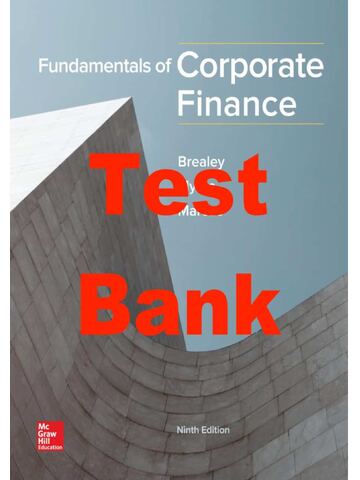
Test Bank for Fundamentals of Corporate Finance 9th Edition By Richard Brealey, Stewart Myers, Alan Marcus
$26.00
Secure checkout
Instant digital download
PDF document
Document details
- Pages
- 1,041
- File size
- 6.56 MB
- Format
- Digital PDF
- Course
- Finance
- Category
- TEST BANKS
Sign in or create a free account to continue. Your purchase will be saved in My Downloads.
About this ebook
The Test Bank for Fundamentals of Corporate Finance (9th Edition) by Richard Brealey, Stewart Myers, and Alan Marcus mirrors the structure of the textbook. It systematically checks core concepts across 24 key chapters, divided into major foundational areas of corporate finance. [1, 2, 3, 4]
The critical corporate finance domains and specific chapter topics tested within this test bank are outlined below: [1]
🏢 1. Introduction & Financial Context
- Goals and Governance of the Corporation: Covers the definition of a corporation, capital budgeting vs. financing decisions, the ultimate goal of the financial manager (shareholder wealth maximization), and corporate governance/agency problems. [1, 2, 3]
- Financial Markets and Institutions: Evaluates the flow of savings to corporations, the roles of financial intermediaries, stock/bond markets, and insights from the 2007–2009 financial crisis. [1]
- Accounting and Finance: Tests the interpretation of Balance Sheets, Income Statements, and Statements of Cash Flows, as well as corporate vs. personal taxes and book vs. market values. [1]
- Measuring Corporate Performance: Examines financial statement analysis, market value added (MVA), economic value added (EVA), and key financial efficiency, liquidity, and leverage ratios. [1, 2]
📈 2. Value & Capital Budgeting
- The Time Value of Money: Covers basic and advanced compounding, discounting, future value, net present value (NPV), and annuities/perpetuities.
- Valuing Bonds: Focuses on bond characteristics, pricing formulas, yield to maturity (YTM), and the relationship between interest rates and bond prices.
- Valuing Stocks: Explores common stock characteristics, the dividend discount model (DDM), and the growth-opportunity model.
- Net Present Value and Other Investment Criteria: Compares NPV to alternate metrics like the Internal Rate of Return (IRR), payback period, and profitability index.
- Using Discounted Cash Flow Analysis to Make Investment Decisions: Tests the identification of incremental cash flows, treating depreciation tax shields, inflation corrections, and capital rationing. [1, 2, 3, 4]
⚖️ 3. Risk, Return, & Capital Structure
- Project Analysis: Focuses on sensitivity analysis, scenario analysis, break-even metrics, and evaluating real options.
- Introduction to Risk, Return, and the Opportunity Cost of Capital: Assesses historical market returns, variance, standard deviation, and portfolio diversification.
- Risk, Return, and Capital Budgeting: Covers the Capital Asset Pricing Model (CAPM), beta calculations, and determining project-specific hurdle rates.
- The Weighted Average Cost of Capital (WACC): Examines how to structure a firm's hybrid discount rate based on after-tax costs of debt and equity.
- Corporate Financing: Introduces venture capital, initial public offerings (IPOs), underwriting, and long-term financing instruments.
- Debt Policy and Capital Structure: Analyzes Modigliani-Miller theorems, financial leverage, the tax trade-off theory, and the costs of financial distress. [1, 2, 3, 4]
💵 4. Payout Policy & Working Capital
- Payout Policy: Evaluates cash dividends vs. share repurchases, dividend payment mechanics, and behavioral finance implications.
- Long-Term Financial Planning: Examines sales forecasting, pro forma financial statements, and identifying external financing needed (EFN).
- Short-Term Financial Planning & Working Capital Management: Explores net working capital, cash cycles, receivables policy, and managing short-term cash surpluses or deficits.
- Cash, Credit, and Inventory Management: Deep dives into float, collections, credit analysis, aging schedules, and optimal inventory metrics.
- Mergers, Acquisitions, and Corporate Control: Tests the economic motives for M&A, proxy contests, leverage buyouts (LBOs), and restructuring defenses.
- International Financial Management: Touches on foreign exchange risk management, purchasing power parity, and evaluating overseas capital expenditure. [1, 2]
File included
Test-Bank-for-Fundamentals-of-Corporate-Finance-9th-Edition-By-Richard-Brealey-Stewart-Myers-Alan-Marcus.pdf
6.56 MB
Related ebooks