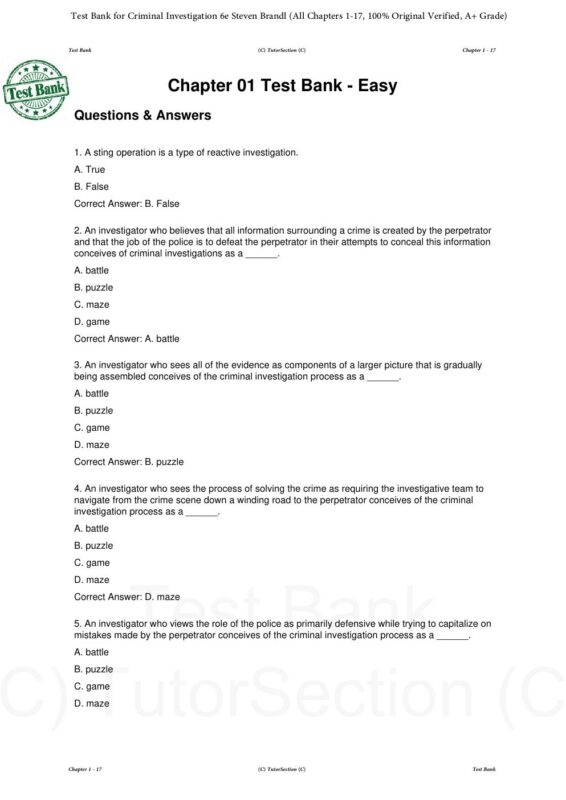
Test Bank for Criminal Investigation 6th Edition By Steven Brandl (All Chapters 1-17, 100% Original Verified)
$35.00
Secure checkout
Instant digital download
PDF document
Document details
- Pages
- 231
- File size
- 3.43 MB
- Format
- Digital PDF
- Course
- Social Sciences
- Category
- TEST BANKS
Sign in or create a free account to continue. Your purchase will be saved in My Downloads.
About this ebook
The Test Bank for 6th Edition of Criminal Investigation by Steven G. Brandl (published by SAGE Publications) spans 17 chapters structured across five critical areas. The textbook shifts away from simple procedural "how-to" guides to emphasize the real-world application of criminal evidence using modern research and actual casework. [1, 2, 3]
The 5 Core Pillars
The textbook's curriculum is structurally anchored around five foundational areas of criminal justice study: [1]
- Background and Contextual Issues: Understanding the foundational definitions of investigations, criminal evidence, and the historical evolution of the police detective role. [1, 2]
- Criminal Evidence: Examining different classifications of evidence and the psychological frameworks of information gathered during investigations. [1]
- Legal Procedures: Navigating constitutional boundaries, including search and seizure laws, interrogation rules, and legal constraints placed on investigators. [1]
- Evidence Collection Procedures: Operational workflows regarding physical, digital, and testimonial evidence extraction. [1]
- Forensic Science: The systematic, scientific evaluation of crime scenes and biological material. [1]
Chapter-by-Chapter Core Topics
The 17 chapters track a logical progression from historical theory to specific crime profiles: [1]
- Chapter 1: The Investigation of Crime: Defining the parameters of criminal investigation, forensic science, and criminal evidence. It covers reactive, cold case, and undercover operations (stings, decoys, stakeouts), mental traps in investigations, and how investigations interface with the broader criminal justice system. [1, 2, 3]
- Chapter 2: The History of Criminal Investigation: Tracing the evolution of investigative units from early English developments through the emergence of the first American police departments and detectives. [1]
- Constitutional & Legal Frameworks: Dedicated sections addressing the Fourth, Fifth, and Sixth Amendments, outlining legal requirements for arrest warrants, exceptions to search warrants, and custody/interrogation standards (e.g., Miranda warnings). [1]
- Evidence Gathering & Sourcing: Deep dives into crime scene management, documentation, the strategic deployment of undercover operations, and the management and cultivation of informants. [1, 2]
- Interviews & Interrogations: The psychological and tactical differences between interviewing cooperative witnesses versus interrogating hostile suspects, including behavioral analysis and avoiding cognitive errors. [1, 2]
- Forensic & Scientific Analysis: Heavy emphasis on modern developments in DNA profiling, fingerprinting, digital/cyber forensics, and biometric analysis. [1]
- Specific Crime Investigations: Tactical breakdowns for investigating individual major offenses, including:
File included
tmpphpbtKtto
3.43 MB
Related ebooks