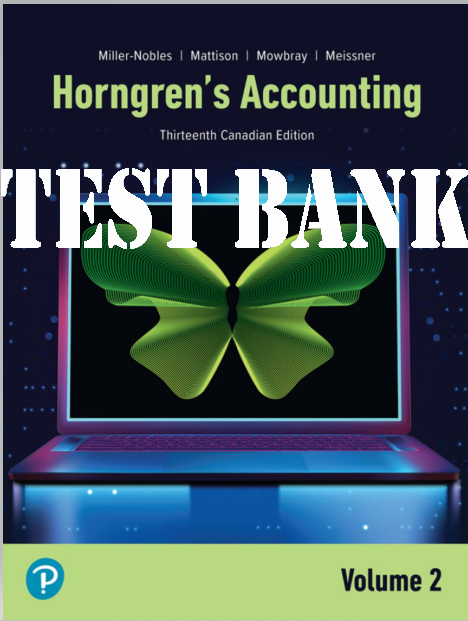
Test Bank for Horngren’s Accounting (Volume 2, Canadian Edition) 13th Edition By Tracie Miller, Brenda Mattison, Grant Mowbray, Carol Meissner
$25.00
Secure checkout
Instant digital download
PDF document
Document details
- Pages
- 830
- File size
- 6.1 MB
- Format
- Digital PDF
- Course
- Accounting
- Category
- TEST BANKS
Sign in or create a free account to continue. Your purchase will be saved in My Downloads.
About this ebook
Test Bank for Horngren's Accounting, Volume 2, 13th Canadian Edition (by Tracie L. Miller, Brenda Mattison, Grant Mowbray, and Carol A. Meissner) covers Chapters 11 through 18, focusing on liabilities, business structures, investments, and financial statement analysis under Canadian accounting standards (ASPE and IFRS). [1, 2]
Chapters Covered
-
- Chapter 11: Current Liabilities and Payroll. Short-term obligations (accounts payable, notes payable, unearned revenue, sales taxes, warranties), contingent liabilities, and Canadian payroll accounting (gross pay, statutory deductions like CPP/EI and income tax, and employer payroll costs). [1, 2]
- Chapter 12: Partnerships. Characteristics of partnerships, partner capital accounts, allocating profits and losses, admission and withdrawal of partners, and partnership liquidation. [1, 2]
- Chapter 13: Corporations: Share Capital and the Balance Sheet. Corporate organization, issuing common and preferred shares, dividends, share splits, and reporting shareholders' equity on the balance sheet. [1, 2]
- Chapter 14: Corporations: Retained Earnings and the Income Statement. Retained earnings transactions, prior-period adjustments, corporate income taxes, discontinued operations, and calculating earnings per share (EPS). [1, 2]
- Chapter 15: Long-Term Liabilities. Bonds payable (issuing at par, discount, or premium), effective-interest and straight-line amortization, notes payable, mortgages, leases, and off-balance-sheet financing. [1, 2]
- Chapter 16: Investments and International Operations. Accounting for short-term and long-term debt and equity investments (cost/amortized cost, fair value through profit or loss, equity method, consolidation) and foreign currency transactions. [1, 2]
- Chapter 17: The Cash Flow Statement. Preparing and interpreting the cash flow statement using the indirect and direct methods across operating, investing, and financing activities. [1, 2]
- Chapter 18: Financial Statement Analysis. Horizontal and vertical analysis, benchmarking, and key financial ratios (liquidity, solvency, profitability, and market value ratios). [1, 2]
Key Pedagogical Themes
- Canadian Standards Alignment. Integrates both Accounting Standards for Private Enterprises (ASPE) and International Financial Reporting Standards (IFRS) throughout the chapters.
- Data Analytics & Excel. Features real-world data analytics examples and Excel-based applications to show how accounting data supports business decisions. [1, 2]
File included
ScholarFriends.com-tb-v2-ready.pdf
6.1 MB
Related ebooks