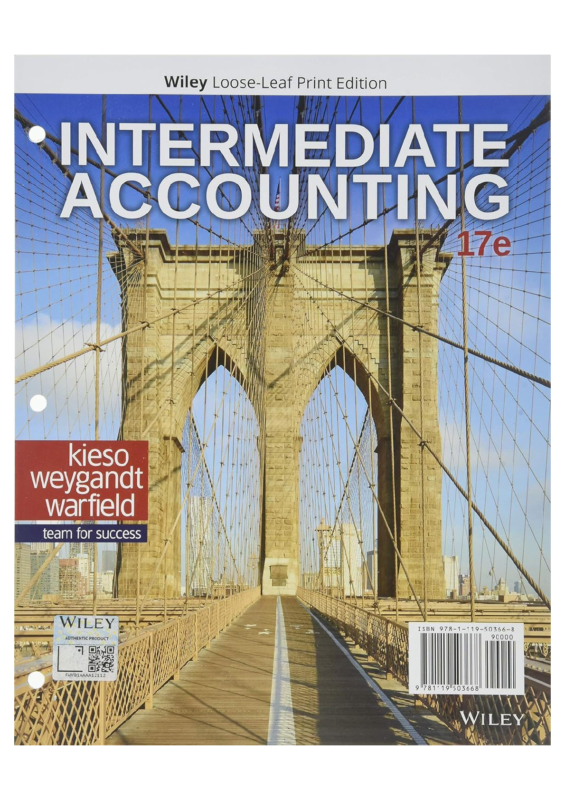
Solution manual for Intermediate Accounting, 17th Edition by Donald E. Kieso, Jerry J. Weygandt, and Terry D. Warfield
$23.00
Secure checkout
Instant digital download
PDF document
Document details
- Pages
- 2,117
- File size
- 10.98 MB
- Format
- Digital PDF
- Course
- Accounting
- Category
- SOLUTIONS MANUAL
Sign in or create a free account to continue. Your purchase will be saved in My Downloads.
About this ebook
Solution manual for Intermediate Accounting, 17th Edition by Donald E. Kieso, Jerry J. Weygandt, and Terry D. Warfield covers comprehensive US GAAP and IFRS financial reporting standards across 24 structured chapters. The textbook focuses heavily on fundamental accounting conceptual frameworks, detailed asset and liability management, revenue recognition, and financial statement analysis. [1, 2, 3, 4, 5]
The core topics and detailed chapter breakdown are structured as follows:
Part 1: Financial Accounting Framework & Foundations
- Chapter 1: Financial Accounting and Accounting Standards — Explores the global financial reporting environment, capital allocation, and organizations like the FASB and IASB. [1, 2]
- Chapter 2: Conceptual Framework for Financial Reporting — Details the fundamental characteristics, qualitative traits, elements, and core constraints of financial accounting. [1]
- Chapter 3: The Accounting Information System — Reviews the accounting cycle, from recording journal entries and ledger postings to adjusting and closing books. [1]
- Chapter 4: Income Statement and Related Information — Formulating the income statement, reporting discontinued operations, and calculating comprehensive income.
- Chapter 5: Balance Sheet and Statement of Cash Flows — Analyzing the structure, uses, limitations, and classifications of financial position statements. [1, 2]
- Chapter 6: Accounting and the Time Value of Money — Covers compound interest, present value, and future value concepts applied to long-term valuation. [1]
Part 2: Asset Management & Valuation
- Chapter 7: Cash and Receivables — Internal cash controls, accounts receivable valuation, uncollectible accounts, and financing through notes.
- Chapter 8: Valuation of Inventories: A Cost-Basis Approach — Covers cost flows under FIFO, LIFO, average-cost methods, and specific identification.
- Chapter 9: Inventories: Additional Valuation Issues — Evaluates inventory using lower-of-cost-or-net-realizable-value (LCNRV), lower-of-cost-or-market (LCM), and retail inventory methods.
- Chapter 10: Acquisition and Disposition of Property, Plant, and Equipment — Capitalization of asset costs, self-constructed assets, interest during construction, and exchanges.
- Chapter 11: Depreciation, Impairments, and Depletion — Methods of depreciation, testing operational assets for impairment, and natural resource depletion.
- Chapter 12: Intangible Assets — Valuation and amortization of identifiable intangibles, R&D costs, and evaluating goodwill. [1, 2]
Part 3: Liabilities, Equities, & Financial Instruments
- Chapter 13: Current Liabilities and Contingencies — Accounts payable, short-term debt obligations, and recognizing estimated liabilities or loss contingencies.
- Chapter 14: Long-Term Liabilities — Accounting for bond issuances, premiums, discounts, extinguish-of-debt, and long-term notes payable.
- Chapter 15: Stockholders’ Equity — Corporate capital structures, stock issuances, treasury stock transactions, dividends, and retained earnings.
- Chapter 16: Dilutive Securities and Earnings per Share — Convertible securities, stock warrants, stock compensation plans, and computing basic vs. diluted EPS.
- Chapter 17: Investments — Classification and reporting of debt and equity securities, equity method investments, and derivative instruments. [1, 2, 3, 4, 5]
Part 4: Advanced Advanced Revenue & Reporting Topics
- Chapter 18: Revenue Recognition — Application of the comprehensive 5-step framework under updated FASB standards.
- Chapter 19: Accounting for Income Taxes — Deferred tax assets and liabilities, temporary vs. permanent differences, and net operating loss carryforwards.
- Chapter 20: Accounting for Pensions and Postretirement Benefits — Computing pension obligations, service costs, corridor amortization, and plan assets.
- Chapter 21: Accounting for Leases — Treatment of lessee operating and finance leases, as well as lessor sales-type and operating leases.
- Chapter 22: Accounting Changes and Error Analysis — Handling retrospective vs. prospective changes in accounting principles, estimates, and fixing prior errors.
- Chapter 23: Statement of Cash Flows — Preparation using direct and indirect methods, evaluating operating, investing, and financing activities.
- Chapter 24: Full Disclosure in Financial Reporting — Notes to financial statements, segment reporting, subsequent events, and auditor reports. [1, 2, 3, 4, 5]
Key Technical Updates in the 17th Edition
- Data Analytics Integration: Contains specialized Analytics in Action modules detailing how modern accountants manipulate and analyze real business data.
- US GAAP & IFRS Convergence: Explicitly compares major rules, highlighting key differences or global alignments between standard-setting bodies. [1, 2]
File included
Solution-manual-for-Intermediate-Accounting-17th-Edition-by-Donald-E.-Kieso.pdf
10.98 MB
Related ebooks