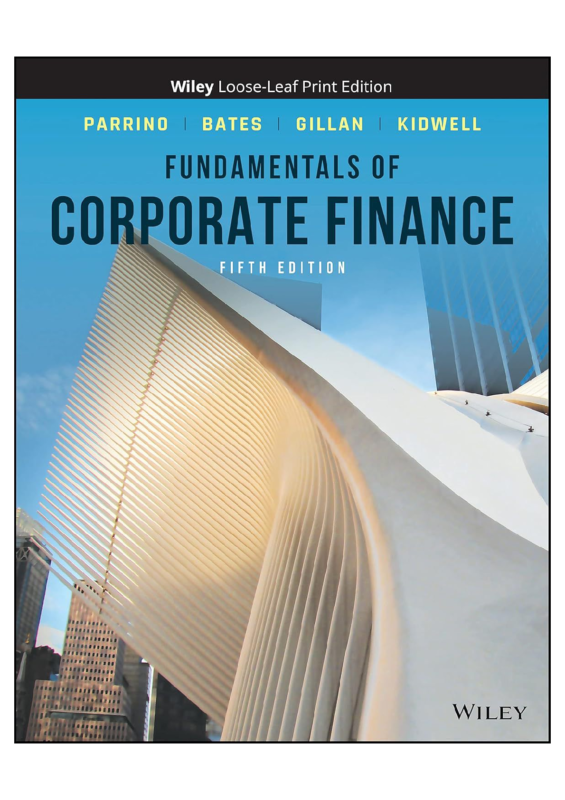
Solution Manual for Fundamentals of Corporate Finance 5th Edition by Robert Parrino, David Kidwell, Thomas Bates, and Stuart Gillan
$23.00
Secure checkout
Instant digital download
PDF document
Document details
- Pages
- 1,316
- File size
- 15 MB
- Format
- Digital PDF
- Course
- Finance
- Category
- SOLUTIONS MANUAL
Sign in or create a free account to continue. Your purchase will be saved in My Downloads.
About this ebook
The Solution Manual for Fundamentals of Corporate Finance (5th Edition) by Robert Parrino, David Kidwell, Thomas Bates, and Stuart Gillan comprehensively covers step-by-step solutions, conceptual answers, and calculation walk-throughs across 21 core chapters. [1, 2]
The textbook and its accompanying solutions manual are structurally organized into the following major financial topics and chapters: [1, 2, 3]
Part 1: Introduction to Corporate Finance
- Chapter 1: The Financial Manager and the Firm – Explores the role of financial executives, forms of business organization, agency conflicts, and the goal of maximizing shareholder wealth. [1, 2]
- Chapter 2: The Financial System and the Level of Interest Rates – Discusses financial markets, financial institutions, and the economic forces determining interest rates. [1, 2, 3]
- Chapter 3: Financial Statements, Cash Flows, and Taxes – Provides a deep dive into balance sheets, income statements, cash flow tracking, and relevant corporate tax structures. [1, 2]
- Chapter 4: Analyzing Financial Statements – Reviews financial ratio analysis, DuPont analysis, and sizing up corporate health trends. [1, 2]
Part 2: Valuation of Future Cash Flows and Risk
- Chapter 5: The Time Value of Money – Focuses on compounding and discounting single sums of money.
- Chapter 6: Discounted Cash Flows and Valuation – Examines more complex cash flows, including multiple uneven flows, annuities, and perpetuities.
- Chapter 7: Risk and Return – Explores historical returns, calculating risk (variance and standard deviation), diversification, and the Capital Asset Pricing Model (CAPM).
- Chapter 8: Bond Valuation and the Structure of Interest Rates – Outlines debt characteristics, bond pricing calculations, and the yield curve.
- Chapter 9: Stock Valuation – Covers dividend discount models, the constant-growth model, and free cash flow valuation methods for equity. [1, 2, 3, 4]
Part 3: Capital Budgeting and Value Creation
- Chapter 10: The Fundamentals of Capital Budgeting – Introduces evaluation metrics including Net Present Value (NPV), Internal Rate of Return (IRR), and Payback Period.
- Chapter 11: Cash Flows and Capital Budgeting – Teaches how to forecast incremental project cash flows, handle depreciation, and account for working capital changes.
- Chapter 12: Evaluating Project Economics – Focuses on risk management tools within budgeting, such as scenario analysis, sensitivity analysis, and break-even calculations.
- Chapter 13: The Cost of Capital – Calculates the Weighted Average Cost of Capital (WACC), combining the individual costs of debt, preferred stock, and common equity. [1, 2, 3, 4]
Part 4: Working Capital Management
- Chapter 14: Working Capital Management – Focuses on day-to-day liquidity, the cash conversion cycle, and general strategies for short-term assets and liabilities. [1, 2]
Part 5: Financing Decisions and Long-Term Capital Structure
- Chapter 15: How Firms Raise Capital – Discusses venture capital, investment banking, Initial Public Offerings (IPOs), and issuing seasoned securities.
- Chapter 16: Capital Structure Policy – Evaluates the mix of debt and equity, bankruptcy costs, and the Modigliani-Miller theorems (including an appendix on leasing).
- Chapter 17: Dividends, Stock Repurchases, and Payout Policy – Covers corporate decisions regarding returning cash to shareholders via dividends or buybacks. [, 2, 3, 4, 5]
Part 6: Advanced Topics and Integration
- Chapter 18: Business Formation, Growth, and Valuation – A capstone chapter integrating forecasting for new enterprises, entrepreneurship, and comprehensive corporate valuation techniques.
- Chapter 19: Financial Planning and Managing Growth – Reviews percentage-of-sales forecasting, pro forma financial statements, and external funding needs.
- Chapter 20: Options and Corporate Finance – Looks at option mechanics, options embedded in corporate securities, and real options in capital budgeting.
- Chapter 21: International Financial Management – Explores foreign exchange markets, currency risk management, and the unique layers of international capital budgeting. [1, 2, 3, 4, 5, 6]
File included
Solution-for-each-chapter-and-Solution-manual-for-Fundamentals-of-Corporate-Finance-5th-Edition-Robert-Parrino.pdf
15 MB
Related ebooks