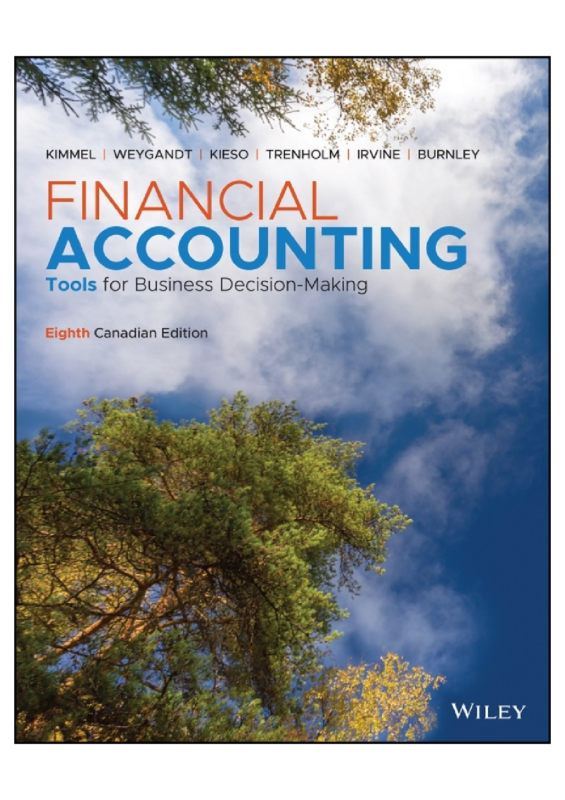
Solution manual For Financial Accounting Tools for Business Decision Making 8th Canadian Edition Paul D. Kimmel
$23.00
Secure checkout
Instant digital download
PDF document
Document details
- Pages
- 1,641
- File size
- 9.04 MB
- Format
- Digital PDF
- Course
- Accounting
- Category
- SOLUTIONS MANUAL
Sign in or create a free account to continue. Your purchase will be saved in My Downloads.
About this ebook
The Solutions Manual for Financial Accounting: Tools for Business Decision Making, 8th Canadian Edition by Paul D. Kimmel, Jerry J. Weygandt, Donald E. Kieso, Barbara Trenholm, Valerie A. Irvine, and Christopher D. Burnley systematically covers 13 core chapters. [1, 2]
The comprehensive list of chapters and specific topics covered inside this instructor solutions manual includes:
Chapter 1: The Purpose and Use of Financial Statements
- Users and uses of accounting information
- Primary forms of business organization (Sole proprietorships, partnerships, and corporations)
- Three main types of business activities (Operating, investing, and financing)
- Purpose and framework of the four core financial statements [1, 2, 3, 4]
Chapter 2: A Further Look at Financial Statements
- The classified balance sheet structure (Current vs. non-current items)
- Using financial statements for ratio analysis (Liquidity, solvency, and profitability)
- Concepts and frameworks of financial reporting in Canada [1, 2, 3]
Chapter 3: The Accounting Information System
- Analyzing business transactions
- The mechanics of accounts: Debits and credits
- Journalizing transactions and posting to the general ledger
- Preparing an unadjusted trial balance [1, 2, 3]
Chapter 4: Accrual Accounting Concepts
- Accrual versus cash basis of accounting
- Revenue and expense recognition principles
- The logic and types of adjusting entries (Prepayments and accruals)
- Preparing an adjusted trial balance and closing entries [1, 2]
Chapter 5: Merchandising Operations
- Merchandising operating cycles and inventory systems (Perpetual vs. periodic)
- Recording purchases and sales under a perpetual inventory system
- Single-step versus multi-step income statements
- Evaluating profitability using the gross profit margin [1, 2]
Chapter 6: Reporting and Analyzing Inventory
- Classifying inventory and identifying ownership ownership rules (FOB shipping point vs. destination)
- Cost flow assumptions (Specific identification, FIFO, and weighted average)
- Financial effects of inventory valuation and the Lower of Cost and Net Realizable Value (LCNRV)
- Inventory metrics: Inventory turnover and days in inventory [1]
Chapter 7: Internal Control and Cash
- Principles of internal control systems
- Control applications specifically over cash receipts and disbursements
- Preparing a formal bank reconciliation
- Reporting cash and cash equivalents [1, 2]
Chapter 8: Reporting and Analyzing Receivables
- Recognizing and accounting for Accounts Receivable
- Valuing receivables and accounting for Bad Debts Expense (Allowance method)
- Accounting for Notes Receivable
- Receivable metrics: Accounts receivable turnover and average collection period [1, 2]
Chapter 9: Reporting and Analyzing Long-Lived Assets
- Determining the cost of Property, Plant, and Equipment (PPE)
- Depreciation methods (Straight-line, diminishing-balance, and units-of-production)
- Accounting for asset disposals, intangible assets, and goodwill
- Asset metrics: Asset turnover ratio [1, 2, 3]
Chapter 10: Reporting and Analyzing Liabilities
- Accounting for current liabilities (Notes payable, sales taxes, payroll, and unearned revenues)
- Long-term liabilities (Bond issuances, interest adjustments, and amortizations)
- Liability metrics: Debt to total assets and times interest earned ratios [1, 2, 3, 4]
Chapter 11: Reporting and Analyzing Shareholders' Equity
- Corporate structure and the issuance of common and preferred shares
- Accounting for cash dividends, stock dividends, and stock splits
- Components of Retained Earnings and comprehensive income
- Equity metrics: Return on equity (ROE) and book value per share [1, 2, 3]
Chapter 12: Reporting and Analyzing Investments
- Accounting for debt and equity investments
- Valuation frameworks (Cost, amortized cost, fair value through net income/OCI, and the equity method)
- Financial statement presentation of investments [1, 2]
Chapter 13: Statement of Cash Flows
File included
Solution-manual-For-Financial-Accounting-Tools-for-Business-Decision-Making-8th-Canadian-Edition-Paul-D.-Kimmel.pdf
9.04 MB
Related ebooks