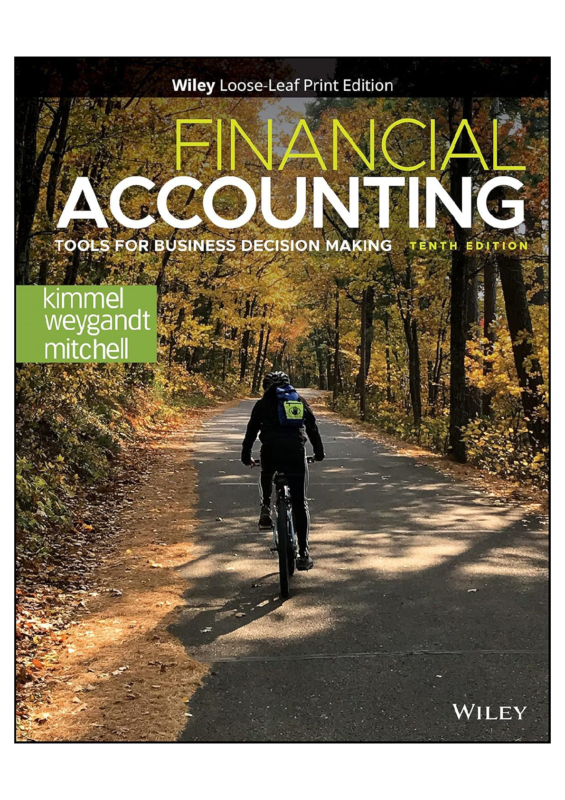
Solution manual for Financial Accounting: Tools for Business Decision Making, 10th Edition by Paul D. Kimmel, Jerry J. Weygandt, and Jill E. Mitchell
$23.00
Secure checkout
Instant digital download
PDF document
Document details
- Pages
- 1,937
- File size
- 32.45 MB
- Format
- Digital PDF
- Course
- Accounting
- Category
- Solutions Guide
Sign in or create a free account to continue. Your purchase will be saved in My Downloads.
About this ebook
The solution manual for Financial Accounting: Tools for Business Decision Making, 10th Edition by Paul D. Kimmel, Jerry J. Weygandt, and Jill E. Mitchell provides step-by-step problem walkthroughs across 13 core chapters. It covers fundamental concepts, the accounting cycle, asset management, and financial statement analysis. [1, 2, 3, 4, 5]
Core Topics Covered by Chapter
1. Introduction to Financial Statements
- Forms of business organization (sole proprietorship, partnership, corporation).
- Users and uses of accounting information.
- The four financial statements (Income Statement, Balance Sheet, Retained Earnings Statement, Statement of Cash Flows). [1, 2]
2. A Further Look at Financial Statements
- The classified balance sheet format and categories.
- Ratio analysis for liquidity, profitability, and solvency.
- Financial reporting concepts (GAAP, qualitative characteristics of accounting information). [1, 2, 3, 4]
3. The Accounting Information System
- Analyzing business transactions using the accounting equation.
- The journal and ledger mechanics (debits and credits).
- Trial balance preparation and error detection. [1, 2]
4. Accrual Accounting Concepts
- Revenue and expense recognition principles.
- Adjusting entries for deferrals and accruals.
- The adjusted trial balance and the closing process. [1, 2]
5. Merchandising Operations and the Multiple-Step Income Statement
- Merchandising inventory systems (perpetual vs. periodic).
- Recording purchases and sales of merchandise.
- The multi-step income statement layout, gross profit, and operating income. [1, 2]
6. Reporting and Analyzing Inventory
- Inventory cost flow assumptions (FIFO, LIFO, Average Cost).
- Financial statement effects of inventory errors.
- Lower-of-cost-or-net-realizable-value valuation rules. [1]
7. Internal Control and Cash
- Internal control principles to safeguard corporate cash assets.
- Bank reconciliations and required adjusting journal entries.
- Reporting cash equivalents and restricted cash assets. [1]
8. Reporting and Analyzing Receivables
- Valuing accounts receivable using the allowance method.
- Estimating uncollectible accounts based on sales or aging metrics.
- Notes receivable computations, including interest and maturity dates. [1]
9. Reporting and Analyzing Long-Lived Assets
- Determining cost for plant assets (land, buildings, equipment).
- Depreciation methods (Straight-Line, Declining-Balance, Units-of-Activity).
- Intangible assets accounting, amortization, and asset disposals. [1, 2]
10. Reporting and Analyzing Liabilities
- Current liabilities (notes payable, sales taxes, payroll).
- Long-term liabilities including bond issuance pricing at par, premium, or discount.
- Amortization of bonds using the effective-interest or straight-line method. [1, 2]
11. Reporting and Analyzing Stockholders' Equity
- Corporate formation and the issuance of common and preferred stock.
- Treasury stock transactions and accounting treatments.
- Dividends cash vs. stock tracking, and retained earnings restrictions. [1]
12. Statement of Cash Flows
- Purpose and classification of cash flows (operating, investing, financing).
- Indirect method for calculating net cash from operating activities.
- Free cash flow metrics used to assess financial flexibility. [1]
13. Financial Analysis: The Big Picture
- Horizontal and vertical analysis of comparative statements.
- Comprehensive ratio framework to judge liquidity, solvency, and profitability.
- Quality of earnings assessments and data analytics insights. [1, 2, 3, 4, 5]
Solution Manual Contents for Practice Problems
The companion solution manual provides fully-worked instructional steps for every item in the Wiley textbook's review sections: [1, 2]
- Do It! Review Exercises designed for quick concept checks.
- Brief Exercises targeting isolated calculation mechanics.
- Exercises assessing comprehensive chapter dynamics.
- Problem Sets (A & B) incorporating large, multi-part business scenarios.
- Analytics in Action solutions utilizing data analysis tools in Excel. [1, 2, 3, 4, 5]
File included
Solution-for-each-chapter-and-Solution-manual-For-Financial-Accounting-Tools-for-Business-Decision-Making-10th-Edition-Paul-D.-Kimmel.pdf
32.45 MB
Related ebooks