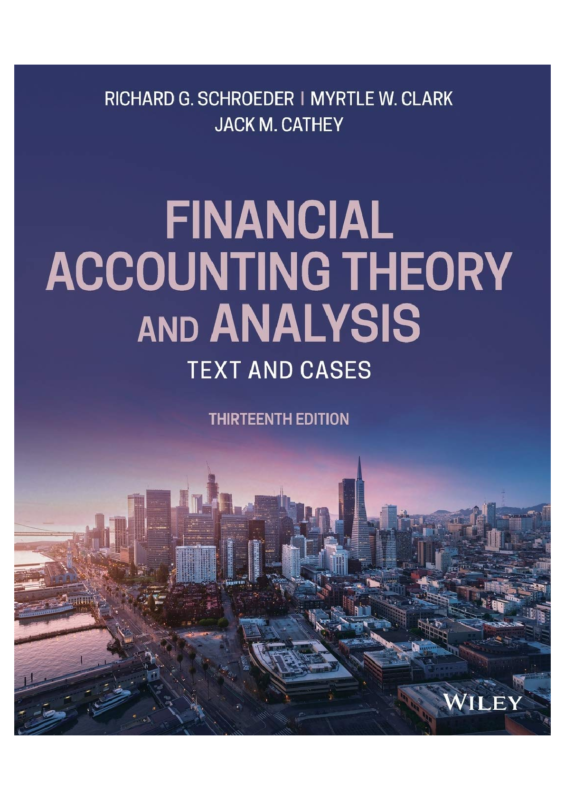
Solutions manual for Financial Accounting Theory and Analysis: Text and Cases 13th Edition by Richard G. Schroeder, Myrtle W. Clark, and Jack M. Cathey
$23.00
Secure checkout
Instant digital download
PDF document
Document details
- Pages
- 359
- File size
- 2.05 MB
- Format
- Digital PDF
- Course
- Accounting
- Category
- SOLUTIONS MANUAL
Sign in or create a free account to continue. Your purchase will be saved in My Downloads.
About this ebook
The solution manual for Financial Accounting Theory and Analysis: Text and Cases (13th Edition) by Richard G. Schroeder, Myrtle W. Clark, and Jack M. Cathey provides step-by-step guidance, discussion notes, and case resolutions across 17 structured chapters. [1, 2, 3]
The manual serves as a comprehensive academic resource by providing detailed solutions to end-of-chapter questions, specialized FASB ASC Research Cases, and "Room for Debate" exercises. [1, 2]
Overview of Topics Covered by Chapter
Part I: Foundations & Professional Environment
- Chapter 1: The Development of Accounting Theory – Early history, evolution of U.S. GAAP, accounting post-1930, the establishment of the SEC, CAP, APB, and FASB, along with the foundational role of ethics in accounting. [1, 2]
- Chapter 2: The Pursuit of the Conceptual Framework – The early theorists, organizational attempts to establish standard accounting rules, the FASB Conceptual Framework Project, and principles-based versus rules-based standards. [1, 2]
- Chapter 3: International Accounting – Global standard convergence, the role of the International Accounting Standards Board (IASB), adoption issues, and transnational financial reporting. [1, 2]
Part II: Methodology & Economic Theories
- Chapter 4: Research Methodology and Theories on the Uses of Accounting Information – Deductive, inductive, and pragmatic approaches to standard-setting; the Efficient Market Hypothesis (EMH); Behavioral Finance; Capital Asset Pricing Model (CAPM); and Positive Accounting Theory.
- Chapter 5: Income Concepts – Economic versus accounting definitions of income, revenue recognition rules, and historical cost concepts.
- Chapter 6: Financial Statements I: The Income Statement and Statement of Cash Flows – Format requirements, quality of earnings, presentation of discontinued operations, and tracking cash flows.
- Chapter 7: Financial Statements II: The Balance Sheet and the Statement of Shareholders' Equity – Asset/liability definitions, liquidity reporting, and components of equity. [1, 2]
Part III: Specific Asset & Liability Disclosures
- Chapter 8: Working Capital – Cash, short-term investments, receivables management, and related measurement issues.
- Chapter 9: Long-Term Assets I: Property, Plant, and Equipment – Cost allocation, depreciation methods, asset impairment, and subsequent expenditures.
- Chapter 10: Long-Term Assets II: Investments and Intangibles – Goodwill valuation, accounting for financial derivatives, and specialized investment classifications.
- Chapter 11: Long-Term Liabilities – Bonds payable, debt restructuring, and accounting treatments for contingencies. [1]
Part IV: Advanced Corporate Transactions & Specialized Reporting [1]
- Chapter 12: Accounting for Leases – Detailed applications of standard updates regarding lessor and lessee classifications, and balance sheet recognition.
- Chapter 13: Accounting for Income Taxes – Deferred tax assets, deferred tax liabilities, temporary differences, and intraperiod tax allocation.
- Chapter 14: Corporate Accounting: Stockholders’ Equity – Issuance of stock, treasury stock transactions, stock dividends, and stock compensation plans.
- Chapter 15: Corporate Accounting: Dilutive Securities and Earnings per Share – Basic vs. diluted EPS formulas, stock options, and convertible bonds.
- Chapter 16: Intercorporate Investments and Business Combinations – Consolidated financial statements, equity method reporting, and accounting for mergers.
- Chapter 17: Financial Reporting Disclosure Requirements and Ethical Responsibilities – Segment reporting, subsequent events, interim financial reports, full-disclosure principles, and the ethical responsibilities of managers and auditors. [1, 2, 3]
Key Pedagogical Features Solved in the Manual
For every single chapter listed above, the solution manual covers:
- FASB Accounting Standards Codification (ASC) Tutorials – Direct guidance on navigating the official codification database to resolve complex institutional assignments. [1, 2]
- Comprehensive Case Studies – Real-world corporate financial profiles detailing why specific entities favor distinct accounting strategies. [1, 2]
- Debate Frameworks – Sample talking points and structural arguments mapped directly to the textbook's custom Room for Debate prompts. [1]
File included
Solution-manual-For-Financial-Accounting-Theory-and-Analysis-Text-and-Cases-13th-Edition-by-Richard-G.-Schroeder.pdf
2.05 MB
Related ebooks