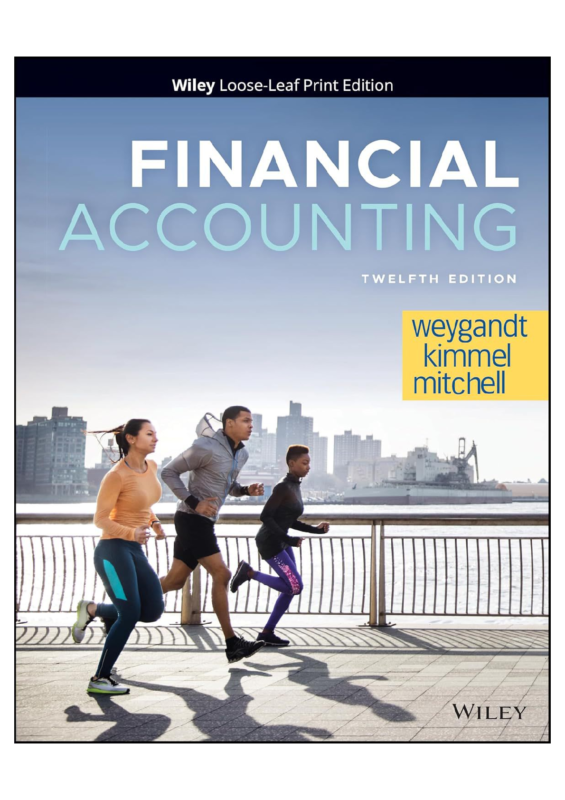
Solutions Manual for Financial Accounting (12th Edition) by Jerry J. Weygandt, Paul D. Kimmel, and Jill E. Mitchell
$23.00
Secure checkout
Instant digital download
PDF document
Document details
- Pages
- 2,335
- File size
- 32.57 MB
- Format
- Digital PDF
- Course
- Accounting
- Category
- SOLUTIONS MANUAL
Sign in or create a free account to continue. Your purchase will be saved in My Downloads.
About this ebook
The Solutions Manual for Financial Accounting (12th Edition) by Jerry J. Weygandt, Paul D. Kimmel, and Jill E. Mitchell contains comprehensive, step-by-step solutions for all end-of-chapter problems, exercises, and case studies across 13 core chapters. [1, 2, 3]
The text is published by Wiley and heavily emphasizes real-world corporate decision-making, the complete accounting cycle, data analytics, and ESG considerations. [1, 2, 3]
Core Topics Covered by Chapter
Chapter 1: Accounting in Action
- Purpose and activities of financial accounting.
- Internal and external users of accounting data.
- Building blocks: Ethics, GAAP, and measurement principles (cost vs. fair value).
- The basic accounting equation (Assets = Liabilities + Equity).
- Analyzing business transactions and preparing initial financial statements. [1, 2, 3, 4]
Chapter 2: The Recording Process
- The framework of accounts using debits and credits.
- Journalizing business transactions in the general journal.
- Posting journal entries to the general ledger.
- Preparing and understanding the purpose of a trial balance. [1, 2, 3]
Chapter 3: Adjusting the Accounts
- Accrual-basis versus cash-basis accounting.
- The necessity of adjusting entries at the end of a period.
- Types of adjustments: Deferrals (prepaid expenses, unearned revenues).
- Types of adjustments: Accruals (accrued revenues, accrued expenses).
- Preparing an adjusted trial balance. [1, 2]
Chapter 4: Completing the Accounting Cycle
- Utilizing a worksheet to streamline year-end processes.
- Preparing closing entries to reset temporary accounts.
- Posting closing entries and creating a post-closing trial balance.
- Steps of the standard accounting cycle.
- Preparing a classified balance sheet. [1, 2, 3]
Chapter 5: Accounting for Merchandising Operations
- Merchandising operations and the operating cycle.
- Inventory systems: Perpetual versus periodic tracking.
- Recording purchases and sales of merchandise under a perpetual system.
- The multiple-step and single-step income statement formats.
Chapter 6: Inventories
- Classifying inventory and determining inventory quantities.
- Cost flow assumptions: Specific Identification, FIFO, LIFO, and Average-Cost.
- Financial statement effects of different cost flow choices.
- Lower-of-cost-or-net-realizable-value (LCNRV) rule.
- Analysis of inventory turnover and errors. [1]
Chapter 7: Fraud, Internal Control, and Cash
- Fraud principles and the Sarbanes-Oxley Act (SOX).
- Principles and limitations of internal control.
- Application of controls to cash receipts and cash disbursements.
- Preparing a comprehensive bank reconciliation.
- Reporting cash and cash equivalents.
Chapter 8: Accounting for Receivables
- Types of receivables and recognizing accounts receivable.
- Valuing accounts receivable using the allowance method vs. direct write-off.
- Accounting for notes receivable, interest calculations, and disposals.
- Evaluating receivables using the accounts receivable turnover ratio. [1]
Chapter 9: Plant Assets, Natural Resources, and Intangible Assets
- Determining the cost of plant assets.
- Depreciation methods: Straight-line, declining-balance, and units-of-activity.
- Accounting for expenditures during use and asset disposals.
- Depletion of natural resources and amortization of intangible assets.
Chapter 10: Liabilities
- Accounting for current liabilities: Notes payable, sales taxes, and unearned revenue.
- Payroll accounting and fundamental taxes.
- Bond basics: Issuing bonds at face value, a discount, or a premium.
- Amortization of bond discounts and premiums.
- Reporting and analyzing long-term liabilities. [1]
Chapter 11: Corporations: Organization, Stock Transactions, Dividends, and Retained Earnings
- Corporate form of organization and stock issuance (common vs. preferred).
- Accounting for treasury stock transactions.
- Cash dividends, stock dividends, and stock splits.
- Reporting equity, retained earnings restrictions, and financial statement analysis. [1, 2]
Chapter 12: Statement of Cash Flows
- Purpose and primary categories of cash flows: Operating, Investing, and Financing.
- Preparing the statement of cash flows using the indirect method.
- Preparing the statement of cash flows using the direct method.
- Using cash flows to evaluate a company’s net liquidity and free cash flow. [1]
Chapter 13: Financial Analysis: The Big Picture
- Sustainable income and quality of earnings.
- Horizontal (trend) analysis and vertical (common-size) analysis.
- Ratio analysis frameworks: Liquidity, solvency, and profitability. [1, 2]
Special Solution Walkthrough Features
The 12th edition updates WileyPLUS integration, which mirrors the manual with digital-first solutions: [1]
- Data Analytics & Insights: Solutions step through data visualization interpretation using modern platforms like Tableau and Power BI.
- Excel Problems: Detailed solutions showing active formulas and layouts used for solving critical financial problems.
- ESG (Environmental, Social, Governance) Cases: Critical thinking solutions focused on modern corporate sustainability reports. [1, 2]
File included
Solution-manual-For-Financial-Accounting-12e-Weygandt.pdf
32.57 MB
Related ebooks