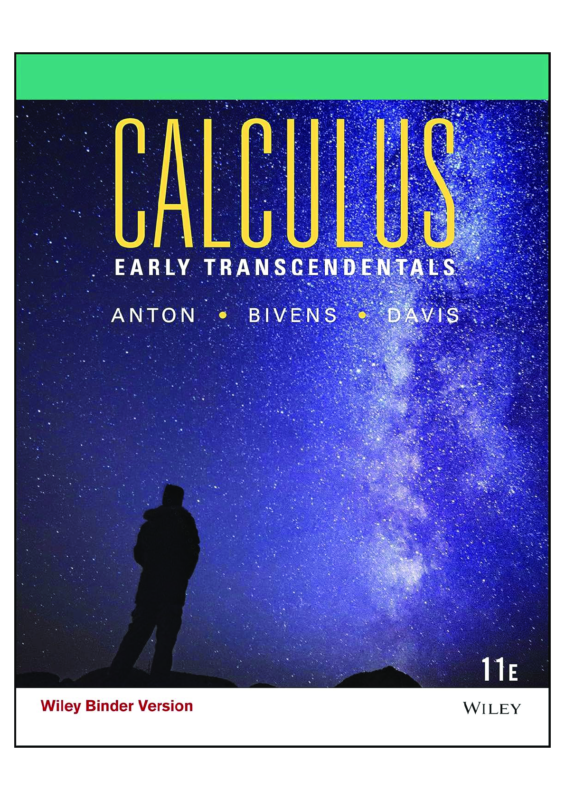
Solutions manual For Calculus: Early Transcendentals, 11th Edition by Howard Anton, Irl C. Bivens, and Stephen Davis
$23.00
Secure checkout
Instant digital download
PDF document
Document details
- Pages
- 722
- File size
- 13.66 MB
- Format
- Digital PDF
- Course
- Calculus
- Category
- SOLUTIONS MANUAL
Sign in or create a free account to continue. Your purchase will be saved in My Downloads.
About this ebook
Solutions manual For Calculus: Early Transcendentals, 11th Edition by Howard Anton, Irl C. Bivens, and Stephen Davis covers a comprehensive range of topics designed for three-semester calculus courses (Calculus I, II, and III) for math, science, and engineering majors. [1]
The textbook covers the following core topics, broken down by chapter:
Chapter 0: Before Calculus
- Functions and Modeling: Domain, range, and operational effects.
- New Functions from Old: Graph translations, reflections, and compositions.
- Family of Functions: Linear, polynomial, rational, algebraic, and inverse functions.
- Transcendental Functions: Exponential, logarithmic, and trigonometric functions introduced early in the curriculum. [1, 2]
Chapter 1: Limits and Continuity
- The Limit Concept: Intuitive approaches to limits and tangent lines.
- Computing Limits: Algebraic methods and limit laws.
- Limits at Infinity: Infinite limits, asymptotes, and end behavior of functions.
- Continuity: Continuity at a point, over intervals, and the Intermediate Value Theorem. [1, 2, 3, 4]
Chapter 2: The Derivative
- Rates of Change: Tangent lines, average velocity, and instantaneous rates.
- The Derivative Function: Definition of a derivative and local linearity.
- Differentiation Techniques: Power rule, product rule, quotient rule, and higher-order derivatives.
- The Chain Rule: Differentiating composite functions. [1, 2, 3]
Chapter 3: Topics in Differentiation
- Implicit Differentiation: Differentiating functions defined implicitly.
- Transcendental Derivatives: Differentiation of logarithmic, exponential, and inverse trigonometric functions.
- Related Rates: Formulating and solving multi-variable rate problems over time.
- Local Linear Approximation: Differentials and linearization of functions. [1, 2, 3, 4]
Chapter 4: The Derivative in Graphing and Applications
- Analysis of Functions: Increasing/decreasing intervals, concavity, and the First and Second Derivative Tests.
- Extreme Values: Finding absolute and relative extrema on closed or open intervals.
- Optimization Problems: Real-world maximum and minimum problems across physics and geometry.
- Mean Value Theorem: Rolle's Theorem and its implications for rates of change. [1, 2, 3, 4, 5]
Chapter 5: Integration
- The Area Problem: Approximating area using sigma notation and Riemann sums.
- The Indefinite Integral: Antiderivatives and basic integration rules.
- The Definite Integral: Area under curves, net change, and properties of the definite integral.
- Fundamental Theorem of Calculus: Connecting differentiation and integration.
- Integration by Substitution: The u-substitution method for reversing the Chain Rule. [1, 2, 3]
Chapter 6: Applications of the Definite Integral
- Geometry Applications: Area between two curves, volumes by slicing, disks, washers, and cylindrical shells.
- Arc Length and Surface Area: Finding the length of a curve and area of a surface of revolution.
- Science and Engineering: Work, fluid pressure, forces, centers of mass, and centroids. [1, 2, 3]
Chapter 7: Principles of Integral Evaluation
- Advanced Integration: Integration by parts, trigonometric integrals, and trigonometric substitution.
- Partial Fractions: Integrating rational functions using partial fraction decomposition.
- Improper Integrals: Evaluating integrals with infinite limits or discontinuous integrands. [1, 2]
Chapter 8: Mathematical Modeling with Differential Equations
- First-Order Differential Equations: Separation of variables and slope fields.
- Growth and Decay Models: Exponential models, population dynamics, and logistic equations.
Chapter 9: Infinite Series
- Sequences: Convergence, divergence, and limits of monotonic sequences.
- Infinite Series: Geometric series, harmonic series, and telescoping series.
- Convergence Tests: Divergence test, Integral test, Comparison tests, Ratio test, and Root test.
- Taylor and Maclaurin Series: Power series representations, interval of convergence, and approximating functions. [1, 2, 3]
Chapter 10: Parametric and Polar Curves
- Parametric Equations: Graphing, tangents, arc length, and surface area of parametric curves.
- Polar Coordinates: Converting coordinates, graphing polar curves, and calculating polar areas. [1, 2]
Chapters 11–15 (Multivariable Calculus / Calc III)
- Three-Dimensional Space: Vectors, dot products, cross products, lines, and planes in 3D.
- Vector-Valued Functions: Calculus of vector functions, space curves, motion in space, and curvature.
- Partial Derivatives: Functions of multiple variables, limits, continuity, partial differentiation, gradients, and optimization.
- Multiple Integrals: Double and triple integrals in rectangular, polar, cylindrical, and spherical coordinates.
- Vector Calculus: Vector fields, line integrals, surface integrals, Green's Theorem, Stokes' Theorem, and the Divergence Theorem. [1, 2, 3, 4, 5]
File included
Solution-manual-For-Calculus-Early-Transcendentals-11th-Edition-Howard-Anton.pdf
13.66 MB
Related ebooks