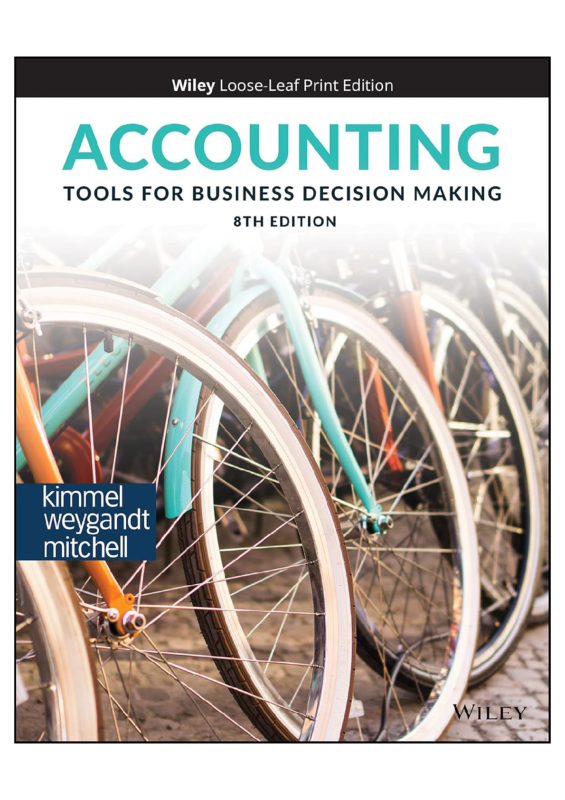
Solution manual for Accounting Tools for Business Decision Making 8th Edition Paul D. Kimmel
$23.00
Secure checkout
Instant digital download
PDF document
Document details
- Pages
- 3,828
- File size
- 45.36 MB
- Format
- Digital PDF
- Course
- Accounting
- Category
- SOLUTIONS MANUAL
Sign in or create a free account to continue. Your purchase will be saved in My Downloads.
About this ebook
Solution manual for Accounting: Tools for Business Decision Making (8th Edition) by Paul D. Kimmel, Jerry J. Weygandt, and Jill E. Mitchell provides a comprehensive, two-semester baseline covering both financial and managerial accounting. [1, 2, 3, 4]
The curriculum focuses on interpreting data to guide corporate operations, utilizing updated frameworks like real-world Excel data analytics via Wiley WileyPLUS. [1, 2]
Part 1: Financial Accounting Topics
The first half of the textbook analyzes financial data tracking, statement assembly, and external reporting compliance: [1, 2]
- Chapter 1: Introduction to Financial Statements – Forms of business organization, users of financial data, and the primary financial statements.
- Chapter 2: A Further Look at Financial Statements – Using a classified balance sheet and baseline ratios to analyze liquidity and profitability.
- Chapter 3: The Accounting Information System – Analyzing transactions, double-entry mechanics, journaling, and ledger posting.
- Chapter 4: Accrual Accounting Concepts – Timing issues, adjusting entries, the closing process, and preparing a post-closing trial balance.
- Chapter 5: Merchandising Operations and the Multiple-Step Income Statement – Freight terms (FOB), inventory tracking systems, and multi-step profit margins.
- Chapter 6: Reporting and Analyzing Inventory – Cost flow assumptions (FIFO, LIFO, Average Cost) and lower-of-cost-or-market rules.
- Chapter 7: Fraud, Internal Control, and Cash – Sarbanes-Oxley guidelines, control activities, and bank reconciliations.
- Chapter 8: Reporting and Analyzing Receivables – Valuation of accounts receivable and accounting for uncollectible accounts.
- Chapter 9: Reporting and Analyzing Long-Lived Assets – Plant asset acquisitions, depreciation methodologies, and intangible asset amortization.
- Chapter 10: Reporting and Analyzing Liabilities – Bond issuances, pricing methods, amortizations, and contingent obligations.
- Chapter 11: Reporting and Analyzing Stockholders' Equity – Corporate structures, issuing common stock, treasury stock, and cash dividends.
- Chapter 12: Statement of Cash Flows – Differentiating operating, investing, and financing flows using direct or indirect models.
- Chapter 13: Financial Analysis: The Big Picture – Comparative horizontal analysis, vertical analysis, and foundational liquidity/solvency financial ratios. [1, 2, 3, 4, 5, 6, 7, 8]
Part 2: Managerial Accounting Topics
The second half shifts internally, introducing operational frameworks used by administrators to budget, set prices, and control production overhead: [1, 2, 3]
- Chapter 14: Managerial Accounting – Distinguishing managerial from financial branches, detailing manufacturing inventories, and tracking overhead.
- Chapter 15: Job Order Costing – Allocating custom production costs via predetermined overhead rates to specific jobs.
- Chapter 16: Process Costing – Calculating equivalent units of production in continuous processing assembly lines.
- Chapter 17: Activity-Based Costing – Tracing corporate overhead costs dynamically to individual activity pools and cost drivers.
- Chapter 18: Cost-Volume-Profit (CVP) – Margin calculations, breakeven thresholds, and volume change mapping.
- Chapter 19: Cost-Volume-Profit Analysis: Additional Issues – Evaluating sales mix patterns and operational leverage risks.
- Chapter 20: Incremental Analysis – Evaluating special item orders, make-or-buy processes, or line-discontinuation parameters.
- Chapter 21: Pricing – Executing target costing, cost-plus formatting, and variable transfer pricing models.
- Chapter 22: Budgetary Planning – Assembling master budgets, sales projections, cash positions, and coordinated schedules.
- Chapter 23: Budgetary Control and Responsibility Accounting – Analyzing static and flexible variances alongside profit center evaluations.
- Chapter 24: Standard Costs and Balanced Scorecard – Assessing raw material and manufacturing labor variances against corporate performance indices.
- Chapter 25: Planning for Capital Investments – Running investment paybacks, Net Present Value (NPV), and internal rate of return metrics. [1, 2, 3, 4, 5]
File included
Solution-manual-for-Accounting-Tools-for-Business-Decision-Making-8th-Edition-Paul-D.-Kimmel.pdf
45.36 MB
Related ebooks