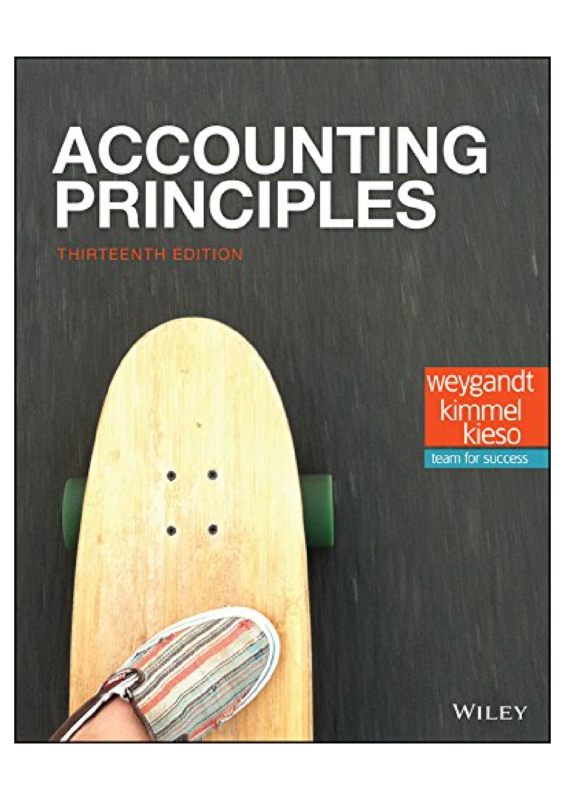
Solution manual for Accounting Principles, 13th Edition by Jerry J. Weygandt, Paul D. Kimmel, and Donald E. Kieso
$23.00
Secure checkout
Instant digital download
PDF document
Document details
- Pages
- 1,582
- File size
- 12.77 MB
- Format
- Digital PDF
- Course
- Accounting
- Category
- SOLUTIONS MANUAL
Sign in or create a free account to continue. Your purchase will be saved in My Downloads.
About this ebook
Solution manual for Accounting Principles, 13th Edition by Jerry J. Weygandt, Paul D. Kimmel, and Donald E. Kieso covers 27 foundational chapters spanning both financial and managerial accounting. The textbook focuses heavily on mastering the accounting cycle using a sole proprietor framework before expanding into corporate finance and cost accounting systems. [1, 2, 3, 4, 5]
1. The Accounting Cycle (Chapters 1–4)
- Chapter 1: Accounting in Action – Covers the basic accounting equation, the identification/recording/communication framework, and financial statements.
- Chapter 2: The Recording Process – Introduces the system of debits and credits, journals, ledgers, and posting.
- Chapter 3: Adjusting the Accounts – Focuses on accrual-basis accounting, deferrals, and accruals.
- Chapter 4: Completing the Accounting Cycle – Teaches the construction of worksheets, closing entries, and a classified balance sheet. [1, 2, 3, 5]
2. Merchandising, Inventory, & Internal Controls (Chapters 5–8)
- Chapter 5: Accounting for Merchandising Operations – Compares perpetual and periodic approaches for buying and selling goods.
- Chapter 6: Inventories – Covers costing methods like FIFO, LIFO, and Average Cost.
- Chapter 7: Accounting Information Systems – Reviews subsidiary ledgers and special journals.
- Chapter 8: Fraud, Internal Control, and Cash – Discusses the Sarbanes-Oxley Act (SOX), bank reconciliations, and cash controls. [, 2, 3, 4, 5]
3. Asset and Liability Management (Chapters 9–11)
- Chapter 9: Accounting for Receivables – Covers bad debt estimation, notes receivable, and account disposals.
- Chapter 10: Plant Assets, Natural Resources, and Intangible Assets – Breaks down straight-line depreciation, depletion, amortization, and asset sales.
- Chapter 11: Current Liabilities and Payroll Accounting – Examines short-term debt obligations, notes payable, and payroll taxes. [, 2, 3]
4. Partnerships and Corporations (Chapters 12–15)
- Chapter 12: Accounting for Partnerships – Focuses on partnership formation, profit/loss division, and liquidation.
- Chapter 13: Corporations: Organization and Capital Stock Transactions – Covers stock issuance, treasury stock, and preferred stock.
- Chapter 14: Corporations: Dividends, Retained Earnings, and Income Reporting – Details cash/stock dividends, stock splits, and retained earnings.
- Chapter 15: Long-Term Liabilities – Covers bond issuance, premium/discount amortization, and long-term notes. [, 2, 3, 4]
5. Advanced Financial Analysis (Chapters 16–18)
- Chapter 16: Investments – Looks at debt and stock investments under equity and cost methods.
- Chapter 17: Statement of Cash Flows – Teaches the operating, investing, and financing sections via direct/indirect methods.
- Chapter 18: Financial Analysis: The Big Picture – Introduces horizontal, vertical, and ratio analysis (liquidity, profitability, solvency). [1, 2]
6. Managerial Accounting & Cost Systems (Chapters 19–21)
- Chapter 19: Managerial Accounting – Differentiates between financial and managerial structures while introducing manufacturing costs.
- Chapter 20: Job Order Costing – Tracks manufacturing overhead and specific job cost sheets.
- Chapter 21: Process Costing – Computes equivalent units of production for mass-produced goods. [, 2, 3, 4]
7. Planning, Control, and Decision Making (Chapters 22–27)
- Chapter 22: Cost-Volume-Profit (CVP) – Determines break-even points and target net income.
- Chapter 23: Incremental Analysis – Guides decisions like make-or-buy, retain-or-replace, and special orders.
- Chapter 24: Budgetary Planning – Builds the master budget, including sales, production, and cash budgets.
- Chapter 25: Budgetary Control and Responsibility Accounting – Covers static vs. flexible budgets and responsibility centers.
- Chapter 26: Standard Costs and Balanced Scorecard – Evaluates variance analysis for materials, labor, and overhead.
- Chapter 27: Planning for Capital Investments – Utilizes cash payback, net present value (NPV), and internal rate of return (IRR). [, 2, 3, 4]
File included
Solution-manual-for-Accounting-Principles-13th-Edition-by.-Weygandt.pdf
12.77 MB
Related ebooks