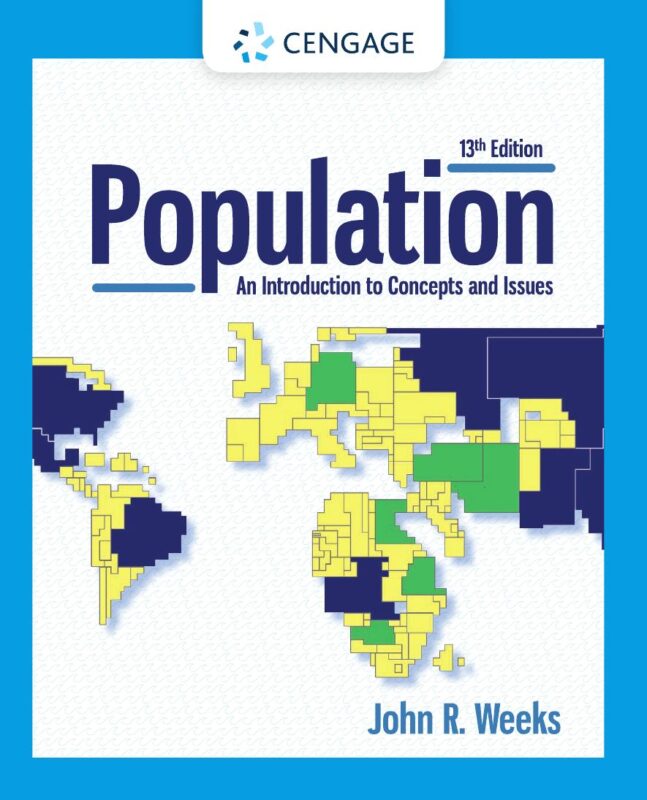
Population: An Introduction to Concepts and Issues 13th Edition By John R. Weeks
$30.00
Secure checkout
Instant digital download
PDF document
Document details
- Pages
- 545
- File size
- 11.5 MB
- Format
- Digital PDF
- Course
- Education
- Category
- eBook[PDF]
Sign in or create a free account to continue. Your purchase will be saved in My Downloads.
About this ebook
The 13th edition of Population: An Introduction to Concepts and Issues by John R. Weeks covers core demographic theories, population processes, and global socio-economic issues. [1, 2]
Streamlined into 10 comprehensive chapters across three core parts, the textbook examines the mechanics of how populations change and how those changes impact global sustainability, families, and resource allocation. [1, 2, 3]
Part I: A Demographic Perspective
- Introduction to Demography (Chapter 1): Examines the basics of demography and links population growth to critical resources like food and water. [1]
- Demographic Data and Applied Demography (Chapter 2): Explains how census data, vital statistics, and spatial data are gathered and applied to real-world business and government planning. [1]
- Demographic Perspectives and Theories (Chapter 3): Reviews historical and modern population theories, including Malthusian perspectives and the Demographic Transition Theory. [, 2, 3]
Part II: Population Processes
- The Health and Mortality Transition (Chapter 4): Focuses on patterns of disease and death, detailing the shift from high infectious disease mortality to degenerative conditions.
- The Fertility Transition (Chapter 5): Analyzes how and why societies transition from high birth rates to below-replacement levels, considering cultural, economic, and biological factors.
- The Migration Transition (Chapter 6): Covers the drivers of internal and international migration, examining the societal impacts on both sending and receiving regions.
- The Urban Transition (Chapter 7): Details the global shift from rural living to concentrated urban areas and the social dynamics that accompany rapid urbanization. [1, 3]
Part III: Using the Demographic Perspective
- The Age Transition and the Life Course (Chapter 8): Analyzes the shifting age structures within populations, highlighting the socioeconomic challenges of aging societies and generational resource distribution. [1, 2]
- Family Demography, Race/Ethnicity, and Life Chances (Chapter 9): Explores how demographic factors shape family structures, marriage patterns, diversity, and individual socioeconomic opportunities. [1, 2]
- Population, the Environment, and Global Sustainability (Chapter 10): Evaluates how population growth and resource consumption directly threaten global sustainability, climate stability, and ecological health. [1, 2]
File included
tmpphpaWFfn2
11.5 MB
Related ebooks